
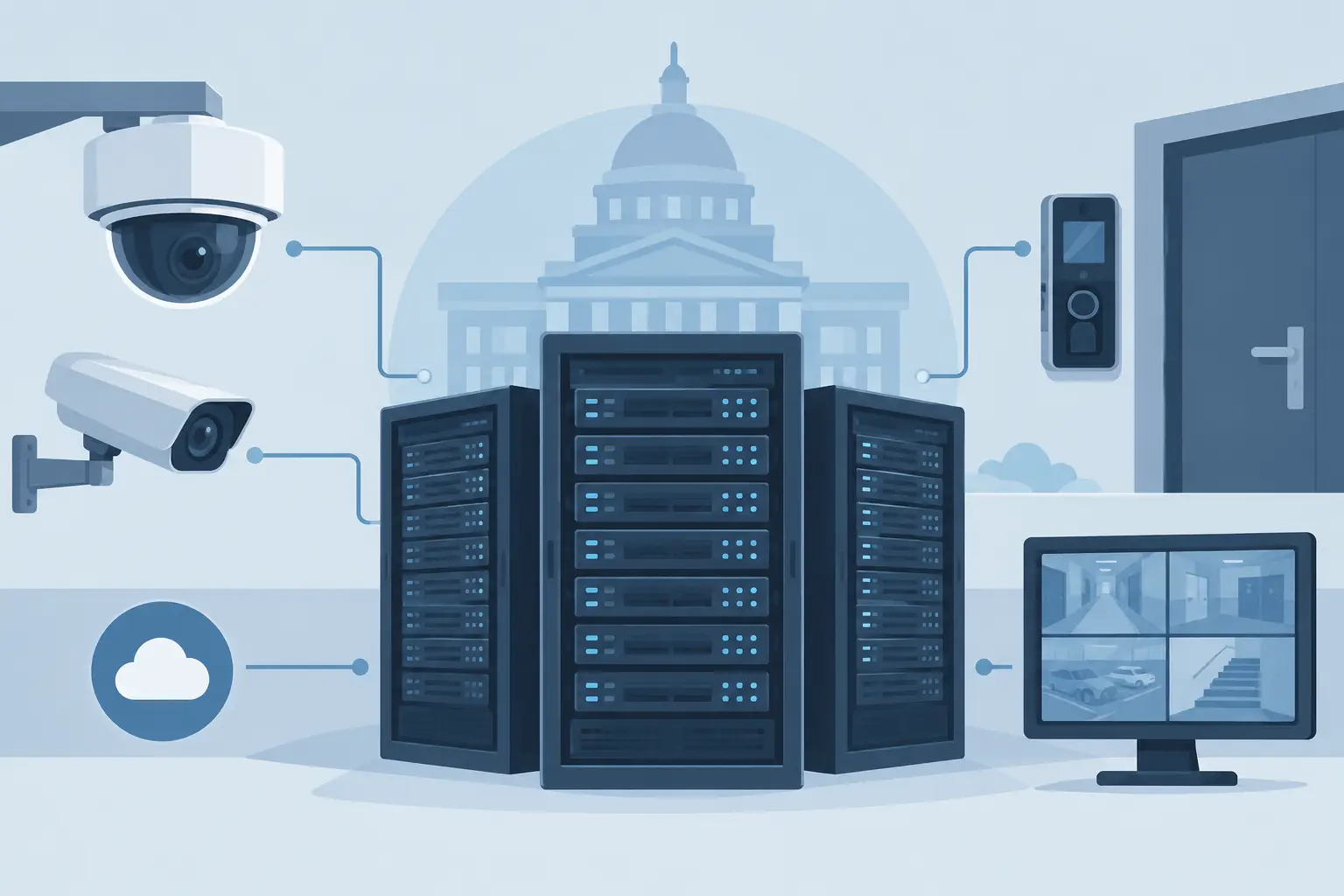
A surveillance server is not simply a high-capacity computer placed in a rack. Government surveillance server specifications must protect recording continuity, evidence availability, operator performance, and future expansion under real site conditions. Rasilient, Dell, and FIBRENETIX server and storage platforms are relevant options when a project requires purpose-built surveillance infrastructure rather than an improvised IT build.
For system integrators and government procurement teams, the most costly mistake is specifying server hardware from camera quantity alone. A server can appear adequate at handover, then struggle when retention periods increase, additional streams are enabled, analytics are introduced, or operators begin reviewing recorded video during peak recording periods. The specification should define the workload first, then select the server and storage architecture that can sustain it.
Government Surveillance Server Specifications Start With the Workload
The starting point is a recording workload schedule, not a processor preference or a storage capacity target. The consultant or integrator should establish how many cameras will record to each recording node, whether recording is continuous or event-based, the expected resolution and frame rate, the selected VMS, retention requirement, and the number of concurrent users who may view live or recorded video.
These inputs affect different parts of the system. Recording streams create a sustained write workload. Live viewing and playback create read activity. Video export, forensic search, health monitoring, and database operations add further demand. If the VMS performs analytics centrally, the compute profile can change significantly. If analytics run at the edge, the server may require less processing capacity but still needs enough resources to manage streams, metadata, users, and storage activity.
A well-written schedule also identifies the operational priority for each camera group. Perimeter, custody, critical infrastructure, and incident review cameras may need a different level of retention, storage protection, or recording continuity than general-area cameras. Treating every stream identically can either inflate the budget or leave critical evidence exposed to unnecessary risk.
Match Compute Resources to the VMS Design
Processor selection should be based on the responsibilities assigned to the server. Recording-only nodes, management servers, failover servers, client workstations, and analytics servers may all have different requirements. Combining every function into one server can simplify a small deployment, but it concentrates risk and makes expansion harder. Larger estates generally benefit from separating functions where the VMS architecture supports it.
Specify sufficient processing headroom for normal use and for abnormal conditions. A recording server may see increased demand during camera reconnection events, user playback, exports after an incident, or maintenance activity. Running continuously near maximum utilization leaves little margin for these events.
Memory should also be treated as an operational requirement, not an afterthought. The VMS application, operating system, database services, and background monitoring tools all consume memory. For enterprise and government projects, error-correcting memory is commonly preferred because the platform is intended for continuous operation. The final requirement should align with the approved server platform and VMS guidance rather than rely on a generic desktop-server configuration.
Graphics processing needs depend on where video is decoded and where analytics are processed. An operator workstation handling multiple live views may need graphics capability that a recording node does not. Conversely, a centralized analytics workload may call for dedicated acceleration. The correct decision depends on the VMS platform, camera behavior, client layout, and analytics scope. Procurement documents should state the function clearly instead of assuming that every surveillance server requires the same graphics configuration.
Size Storage for Retention, Performance, and Recovery
Storage capacity is only one part of the requirement. The server must also sustain continuous video writes while allowing playback and export without disrupting recording. A design with enough raw capacity but insufficient disk performance can create recording gaps or slow incident review when the system is under load.
Government surveillance server specifications should therefore distinguish between raw capacity, usable capacity, retention capacity, and protected capacity. Raw capacity is the total installed disk space. Usable capacity reflects the storage available after the selected protection method and system overhead. Retention capacity is what remains after calculating the actual video workload for the mandated retention period. Protected capacity reflects what can remain available when a disk or other component fails.
Redundancy choices involve trade-offs. Disk protection can reduce the usable capacity available for video, but it helps protect recorded evidence against a drive failure. Hot-spare arrangements can improve recovery readiness, while separate recording nodes can limit the impact of a server outage. Neither approach replaces a defined evidence management policy. Projects that require long-term preservation of selected incidents should identify how exported or archived footage will be retained, accessed, and protected outside the normal recording cycle.
Storage layout must also consider growth. A project may open with fewer cameras than the final approved quantity, or future phases may add entrances, parking areas, remote facilities, or specialized monitoring points. Expanding within a validated platform is generally safer than adding unplanned external storage later. The bill of quantities should identify expansion options, licensing dependencies, rack space, power, and network port requirements from the outset.
Build for Continuity, Not Just Capacity
A surveillance server that records well under normal conditions can still fail the project requirement if it has no plan for outages. The required resilience level should reflect the security consequence of losing video from a node, not simply the size of the site.
Power protection is fundamental. Dual power supplies may be appropriate where the chosen server platform and site power design support them, but they provide value only when connected to independent protected power paths. A UPS strategy should allow orderly operation through short disturbances and support controlled shutdown where a longer outage occurs. Rack cooling, physical access control, and clean cable management also matter because surveillance infrastructure often operates continuously in communications rooms that serve multiple systems.
Network resilience deserves equal attention. A recording server needs predictable connectivity to cameras, VMS clients, and management services. The surveillance network design may use dedicated switching, segmentation, or controlled uplinks according to the project architecture. AETEK network infrastructure can support PoE and surveillance network requirements, while server specifications should still define interface needs, uplink capacity, and any redundancy expected at the server connection.
Failover is not automatically necessary for every government site. It is justified when the loss of recordings from a server would create an unacceptable security or compliance exposure. Where failover is specified, define what it must protect: recording service, management service, storage access, or a combination of these. Also define the expected behavior when the primary node returns. A vague requirement for “redundant servers” often produces inconsistent bids and unclear acceptance testing.
Specify Cybersecurity and Supportability Early
A surveillance server is part of the security environment it protects. The specification should require supported operating systems, controlled administrator access, account separation, logging, update procedures, and a documented method for applying VMS and operating system patches. Network segmentation and firewall rules should be coordinated with the wider ICT and cybersecurity teams before deployment, particularly where surveillance platforms connect to command centers or other government systems.
Avoid writing specifications that force a particular hardware configuration without a clear operational reason. Instead, describe required performance, compatibility, resilience, and supportability, then request a compliant platform from authorized partners. This approach gives the procurement team a clearer basis for technical evaluation while reducing the risk of incompatible substitutions.
Documentation should be a deliverable, not a handover afterthought. Require an asset schedule, server role matrix, storage calculation, warranty details, serial-number records, firmware baseline, and compatibility confirmation for the nominated VMS. These records make maintenance, expansion, and incident investigation more manageable after the project moves into operation.
Questions to Resolve Before Releasing the BOQ
Before issuing a bill of quantities, confirm whether the camera count is final or phased, whether recording is continuous or event-driven, and whether analytics will run at the edge or centrally. Confirm the retention policy for each camera class, the expected number of concurrent operators, and whether recorded evidence needs a separate archive.
The project team should also establish whether server failure can be tolerated, what recovery time is acceptable, and who owns patching and lifecycle support after handover. These decisions determine whether the project needs a single recording server, multiple recording nodes, failover capability, or separate archive storage.
For government facilities and major infrastructure projects, the right server specification is the one that remains understandable and supportable years after commissioning. Seven Sectors Trading Co. can help procurement teams and integrators source surveillance server and storage platforms from Rasilient, FIBRENETIX, and Dell through an authorized supply channel. For a quotation aligned with your VMS workload and documentation requirements, contact info@7sectors.com or use the Get Quotation form.
Ready to discuss your project? Contact Seven Sectors or contact us directly on +966-012 229 3474.