
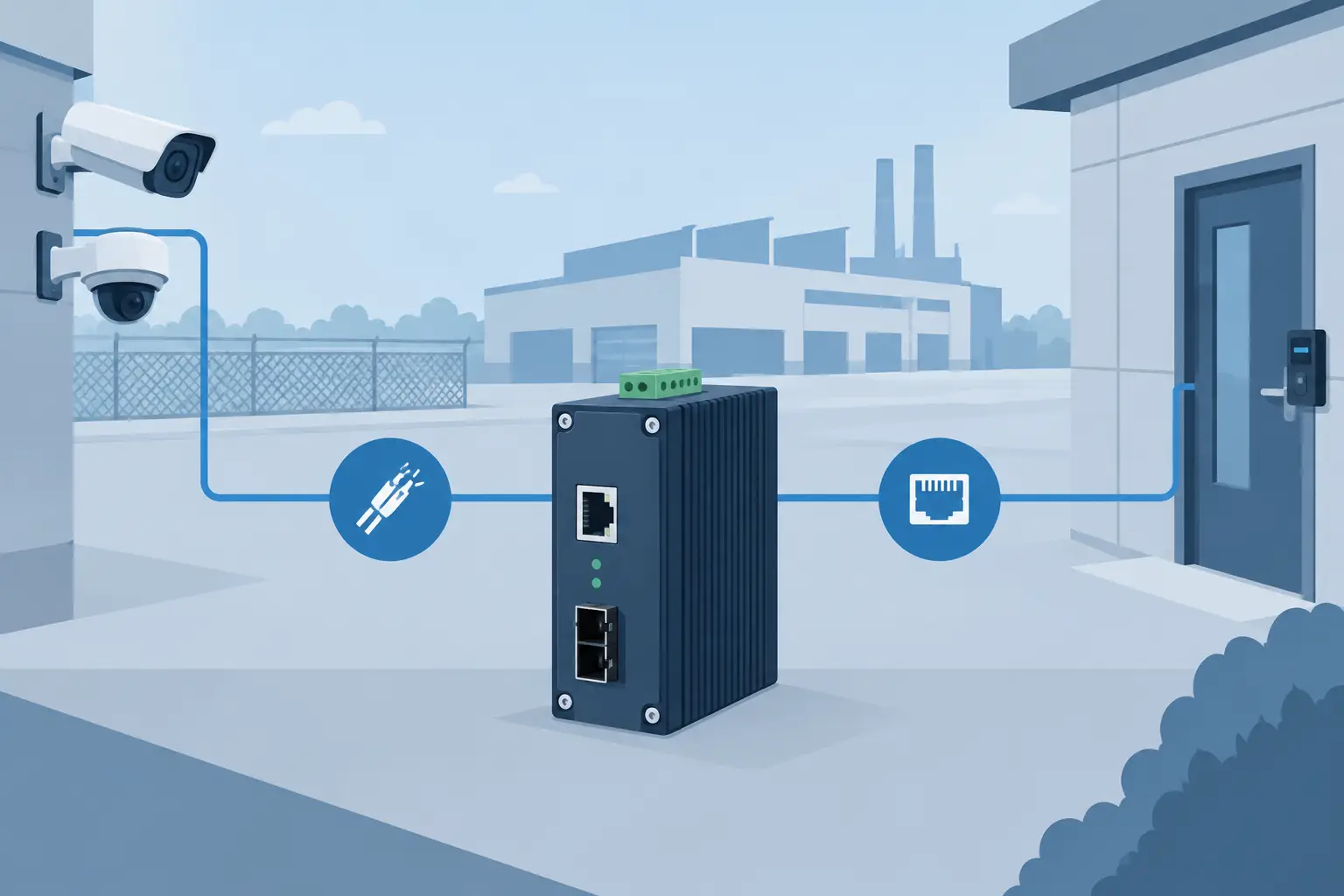
A network link that works perfectly in a conditioned telecom room can fail quickly when it is placed beside motors, switchgear, conveyors, or outdoor cabinets. Selecting an industrial media converter is therefore not simply a matter of changing copper Ethernet to fiber. It is a decision about power resilience, environmental conditions, monitoring, and how the network will be maintained after handover. Seven Sectors Trading Co. supports system integrators and project procurement teams with AETEK network infrastructure and related security connectivity requirements across Saudi Arabia.
Start with the network problem, not the connector
A media converter is used when two parts of a network need different physical media. The common example is extending an Ethernet connection from a copper-based device or switch to a fiber backbone. In security and industrial environments, this may connect a remote field cabinet, gatehouse, substation building, parking area, or perimeter location to the core network.
The conversion itself is straightforward. The site conditions are not. A converter installed in a cabinet that is exposed to heat, vibration, dust, unstable power, or electrical interference has a different role from an office-grade unit sitting under a desk. Industrial-grade equipment is selected because the installation environment can be as critical as the data path.
Before selecting a unit, define what must connect at each end. Is the copper endpoint a network switch, access controller, wireless bridge, server interface, or another field device? Is the fiber already specified by the consultant? Will the link carry ordinary data traffic, or does it support security video, access events, and operational systems with defined availability expectations? These answers narrow the selection quickly.
Match the fiber interface to the installed cabling
Fiber type is the first technical checkpoint. A converter must match the installed fiber architecture rather than force an unsuitable change later in the project. The relevant questions include whether the backbone uses single-mode or multimode fiber, the connector format provided at the cabinet, and whether the network design requires one fiber strand or two.
Single-mode fiber is commonly chosen where distances are significant or where a site backbone needs room for expansion. Multimode fiber may already exist inside a building or campus environment. Neither is universally better. The correct option depends on the approved cabling design, the intended link distance, and what is available at both ends.
Procurement teams should also confirm whether the converter uses a fixed optical interface or a pluggable transceiver approach. A fixed interface can simplify a tightly defined bill of materials. A modular approach can be useful where link types vary across a large site or the final fiber interface is still subject to consultant approval. The trade-off is simple: flexibility can reduce standardization, while a fixed design can limit later changes.
Do not assume that a connector match confirms compatibility. Fiber mode, transmission approach, and the required pairing arrangement must all be checked as one link. A converter can be powered and appear operational while still failing to establish a usable fiber connection if these details are wrong.
Choose an industrial media converter for the cabinet environment
The phrase industrial media converter should mean more than a metal enclosure. Review the actual environment where it will operate and the way it will be mounted, powered, and accessed by maintenance teams.
For a field cabinet, consider the expected temperature range, ventilation, exposure to dust or moisture, vibration, and potential electromagnetic interference. Electrical rooms, production areas, roadside cabinets, transport facilities, and perimeter installations each create different risks. A device appropriate for one may not be appropriate for another.
Power input deserves the same attention. Industrial networks often use DC power arrangements, while some locations may require redundancy or connection to a monitored power source. A procurement specification should identify the available supply at the cabinet, any polarity or grounding requirements, and whether power continuity is expected during a wider site event. It should also be clear whether surge protection is handled externally, built into the panel design, or required as a separate component.
Mounting and access matter in real installations. DIN-rail mounting may suit a control panel, while wall mounting can fit a compact enclosure. Allowing space for fiber bend radius, cable entry, labeling, and replacement access prevents a small converter from becoming a difficult maintenance point. These details are often missed when equipment is selected only from a network diagram.
Decide how much network visibility the project needs
An unmanaged converter may be suitable for a simple, fixed link where the network is small and on-site teams can inspect the cabinet easily. It performs the basic conversion function without adding configuration overhead.
A managed converter is more appropriate when the project team needs visibility into link status, alarms, port behavior, or remote troubleshooting. This can be valuable on distributed surveillance and access-control networks, where a fiber issue may otherwise be reported as a device fault. Monitoring can help the integrator isolate whether the problem is on the copper side, the optical path, power source, or connected endpoint.
Management is not automatically the right answer for every project. It adds configuration responsibility and must fit the wider network administration approach. If the site does not have a clear method for assigning addresses, securing access, recording configurations, and responding to alarms, the value of advanced management features may be limited. Specify it where it supports an agreed operational process, not because it appears on a checklist.
Plan for security traffic and future expansion
Security systems place particular demands on network continuity. Video streams, access-control events, intercom traffic, and management data may share the same physical infrastructure, but they do not always have the same priorities. The media converter must fit the bandwidth and network segmentation decisions made by the consultant and integrator.
Avoid treating the converter as an isolated accessory. Confirm its role within the switch architecture, fiber termination strategy, VLAN plan, and cabinet power arrangement. If a remote location will later add cameras, access doors, or additional network devices, the existing converter arrangement may become a constraint. Sometimes a converter is the most efficient answer. In other cases, an industrial switch is the better choice because it provides multiple ports and simplifies future growth.
This is where early coordination between the security integrator, MEP contractor, and network team pays off. The choice should reflect the approved system scope, not an assumption that every remote endpoint needs the same hardware.
Specify the converter clearly in tender documents
A vague request for a “fiber converter” creates room for incompatible substitutions. A practical specification should state the required Ethernet interface, fiber type, connector arrangement, installation environment, power input, mounting method, and whether management functions are required. It should also identify any project requirements for labeling, cabinet integration, documentation, warranty handling, and approved source channels.
For government facilities and large infrastructure packages, it is useful to ask for a complete compatibility review against the network drawings and bill of materials before placing the order. This reduces the risk of a converter arriving with the correct category label but the wrong optical or power configuration.
If the security design is still evolving, separate what is fixed from what is provisional. The fixed items may be the cabinet environment and available power. The provisional items may be the endpoint count, fiber terminations, or switch topology. This gives the sourcing team a clearer basis for proposing suitable options without turning an early procurement request into a redesign exercise.
FAQ
When should a project use a media converter instead of a switch?
Use a converter when the requirement is a straightforward copper-to-fiber link for one endpoint or one uplink. Consider an industrial switch when the cabinet needs several Ethernet ports, network segmentation, additional uplinks, or planned expansion.
Can a standard office converter be used in an industrial cabinet?
It may operate initially, but it may not be suitable for the temperature, power, interference, mounting, or maintenance conditions of the cabinet. The installation environment should determine the equipment category.
What information should be provided when requesting a quotation?
Provide the network drawing if available, fiber type, connector details, copper interface requirement, cabinet environment, power source, mounting preference, quantity, and any management or documentation requirements.
The right converter is the one that fits the link, the cabinet, and the operating plan at the same time. For project sourcing support and a quotation aligned with your approved network requirement, contact Seven Sectors Trading Co. at info@7sectors.com or use the Get Quotation form.
Ready to discuss your project? Contact Seven Sectors or contact us directly on +966-012 229 3474.