
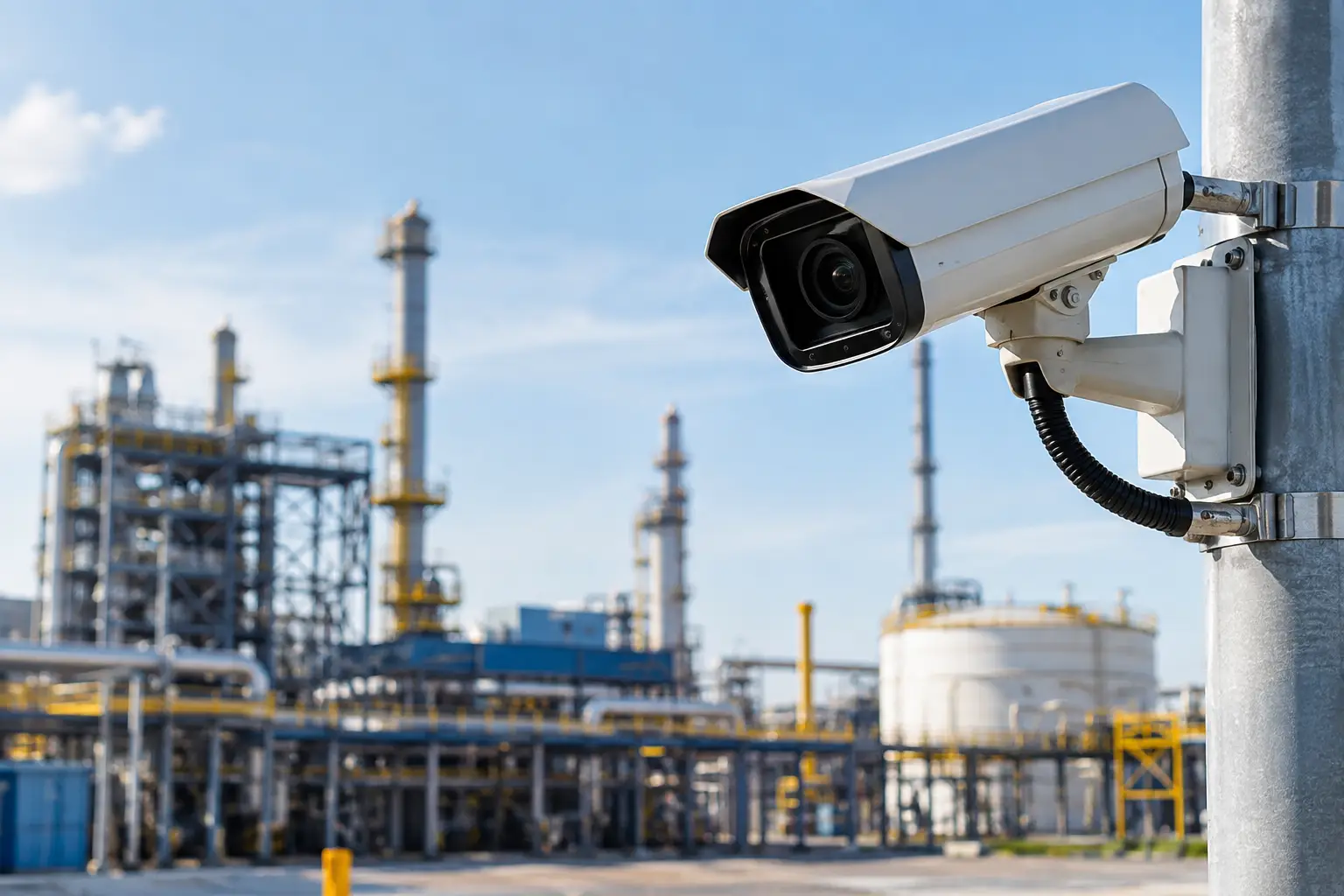
Hub: Video Surveillance and Storage Keyword target: CCTV solutions for industrial sites
A loading yard can be fully visible at noon and nearly unusable for identification after sunset. A conveyor line may need continuous operational oversight, while a perimeter breach demands immediate verification from a control room. CCTV solutions for industrial sites must account for both situations without creating a network, storage, or maintenance burden that the project team cannot support.
For system integrators, consultants, and procurement teams, the decision is not simply which cameras to buy. It is how camera placement, switching capacity, recording architecture, video management, and future expansion will operate as one system. Seven Sectors Trading Co. supports this procurement process with video infrastructure from partners including Rasilient, ISS/SecurOS, AETEK, Dell, and FIBRENETIX.
Start With the Industrial Risk, Not the Camera Count
Industrial facilities are not uniform environments. A warehouse entrance, tank farm perimeter, fabrication bay, utility corridor, truck gate, and control room each create different surveillance requirements. Treating all locations as standard camera points often leads to weak evidence quality in critical areas and unnecessary spend in lower-risk zones.
The first question is what the operator must be able to establish from the footage. In some zones, detection is sufficient: the control room needs to know that someone or something has entered a restricted area. In others, the requirement is verification or identification. A gate incident may require clear review of vehicle movement, driver activity, and access events. An indoor production area may prioritize process visibility and incident reconstruction rather than facial identification.
This distinction changes the design brief before any equipment is specified. It affects camera position, lighting assumptions, scene coverage, recording duration, bandwidth estimates, and storage capacity. Consultants should also separate security objectives from operational objectives. Both can share a platform, but they should not be confused when setting retention and access permissions.
Map the site by consequence
A practical industrial surveillance plan ranks areas by consequence if visibility is lost or an event occurs. Perimeters and vehicle gates are typically high consequence. Hazardous process areas, remote substations, loading docks, inventory zones, and staff entrances may have different priorities depending on the facility.
This approach prevents the common mistake of assigning equal recording and retention requirements to every channel. Higher-consequence zones may justify more detailed coverage, more careful scene testing, and longer retention. Lower-consequence areas can be specified appropriately without compromising the overall security objective.
Build CCTV Solutions for Industrial Sites Around the Network
Video systems fail operationally when the network is treated as an afterthought. A camera can capture useful footage only if power, connectivity, switching, transmission, recording, and operator access remain available when needed.
Industrial projects often have long cable routes, dispersed buildings, outdoor cabinets, and network closets that are difficult to access once the site is live. Network selection must therefore begin with the real topology: camera quantities per zone, uplink paths, expected traffic, power demand, cabinet conditions, and the resilience required if one route fails.
AETEK supplies PoE switching and network infrastructure for surveillance deployments. It is relevant where integrators need to source the power and connectivity layer alongside the wider video system, rather than treating it as a separate procurement package. The exact switch selection should follow the approved network design, camera load calculation, uplink requirement, and environmental conditions of the installation.
Bandwidth must be calculated from the recording policy, not guessed from camera quantity alone. Scene activity, compression settings, frame rate, image quality requirements, and the number of simultaneous live viewers all influence demand. A site that records continuously at every camera will have a different traffic profile from one using event-driven recording in selected zones.
There is a trade-off here. Reducing bitrate can lower storage and network demand, but it can also reduce the evidential value of footage during the incident that matters most. The correct balance is project-specific and should be documented in the system specification before procurement.
Treat Storage Retention as an Operational Requirement
Storage is often sized as a simple number of days, but industrial investigations rarely follow a simple timeline. An incident may be reported hours later, after a shift change, or after equipment has moved through several controlled areas. The recording system must preserve footage long enough for the client’s operational and security procedures.
Retention planning should consider continuous versus event-based recording, camera criticality, investigation workflows, user access, and the possibility of export requests. It should also account for future camera additions. A system sized precisely for day-one capacity can become difficult to expand when a facility adds gates, warehouses, production lines, or contractor access points.
Rasilient, Dell, and FIBRENETIX support the surveillance server and storage portion of a project stack. The appropriate platform depends on the required architecture, capacity planning, redundancy expectations, video workload, and the customer’s preferred support model. Procurement teams should request a clear bill of materials that distinguishes recording servers, storage, drives, network components, and any platform licensing requirements.
Do not assume that more retention is always the best answer. Longer retention raises capacity requirements and can affect budget, rack space, power, and operating procedures. The better decision is to align retention with site policy, risk level, and the realistic time needed to report and investigate incidents.
Choose the VMS for Operators, Not Just Specifications
A video management system is where an industrial CCTV deployment becomes usable or frustrating. Security teams need fast access to the correct cameras, logical site maps, incident playback, user permissions, alarm handling, and reliable export workflows. If operators cannot find the relevant scene quickly, the value of the surveillance investment falls sharply.
ISS/SecurOS can be considered as the VMS layer where the project requires centralized video operations and structured management across a facility or wider estate. The platform should be evaluated against the project’s camera quantities, operator roles, integration scope, retention strategy, and required workflows.
A VMS decision also needs governance. Who can view live video? Who can export evidence? Who can alter camera settings or retention policies? Industrial facilities may have security, operations, HSE, IT, and contractor teams with different access requirements. Defining roles early avoids uncontrolled access and makes incident handling more defensible.
Plan for integration boundaries
Industrial sites commonly combine CCTV with access control, intrusion detection, visitor management, and operational systems. Integration can improve incident response, but only when the required behavior is defined. “Integration ready” is not a usable requirement by itself.
For example, a consultant can specify whether an access event should call up a related camera view, whether alarms require operator acknowledgment, and whether video evidence must be tied to incident records. HID access control may form part of the wider security stack where those workflows call for coordinated access and video operations. The integration scope should be written into the project requirements, with responsibility boundaries made clear between the consultant, integrator, software provider, and equipment suppliers.
Specify for Site Conditions and Maintainability
Industrial locations create practical constraints that are easy to miss in drawings. Dust, vibration, glare, night lighting, heat, reflective surfaces, moving machinery, and vehicle headlights can all affect usable video. A suitable layout considers where cameras can be safely mounted, how technicians will access them, and whether the view will remain clear as the site changes.
Commissioning teams should be able to test each camera against a stated purpose. “Camera installed and online” is not the same as “camera delivers the required operational view.” Site acceptance should verify field of view, day and night performance, recorded playback, time synchronization, camera naming, user permissions, and fault notifications.
Maintainability also matters after handover. Clear labeling, logical cabinet documentation, spare capacity, approved device records, and a consistent naming standard reduce the time needed to isolate a fault or add a future device. These details are rarely the headline item in a tender, but they strongly affect lifecycle performance.
Procurement Questions That Prevent Rework
Before releasing a CCTV package for an industrial site, procurement and technical teams should be able to answer four questions clearly: What risk does each camera address? What happens if its network path or recording destination is unavailable? How long must footage remain available? Who will use the video and under what permissions?
If those answers are incomplete, the bill of materials may still look complete while the system remains exposed to scope changes. This is especially relevant for phased developments, where temporary gates, added work areas, and expanding perimeters can change surveillance needs during construction and operation.
Seven Sectors Trading Co. can support integrators and project teams with sourcing for the required video, storage, VMS, and network infrastructure categories. For a quotation aligned to an approved specification or a developing bill of materials, email info@7sectors.com or submit a Get Quotation form request.
FAQ
Should every industrial camera record continuously?
Not necessarily. Continuous recording can be appropriate for high-risk gates, production areas, and locations where activity must be reconstructed in detail. Event-driven recording may suit other zones, provided the trigger logic and investigation requirements have been reviewed. The choice affects bandwidth, storage, and retention calculations.
Can existing industrial networks support a new CCTV system?
Sometimes, but that should be confirmed through a network assessment. Available switch capacity, PoE power, uplink utilization, segregation requirements, and resilience must be reviewed before new cameras are added. Using existing infrastructure without this check can create video loss or affect other services.
What should be included in an industrial CCTV bill of materials?
A complete package normally identifies cameras, mounts and accessories where specified, switching and network components, recording servers, storage, VMS licensing, operator workstations if required, and any defined integration elements. It should also make assumptions and exclusions visible rather than leaving them to be discovered during installation.
The strongest industrial CCTV outcome is not the one with the most devices. It is the one where every critical view, network path, recording policy, and operator workflow has a clear reason to exist.
Ready to discuss your project? Contact Seven Sectors or contact us directly on +966-012 229 3474.