
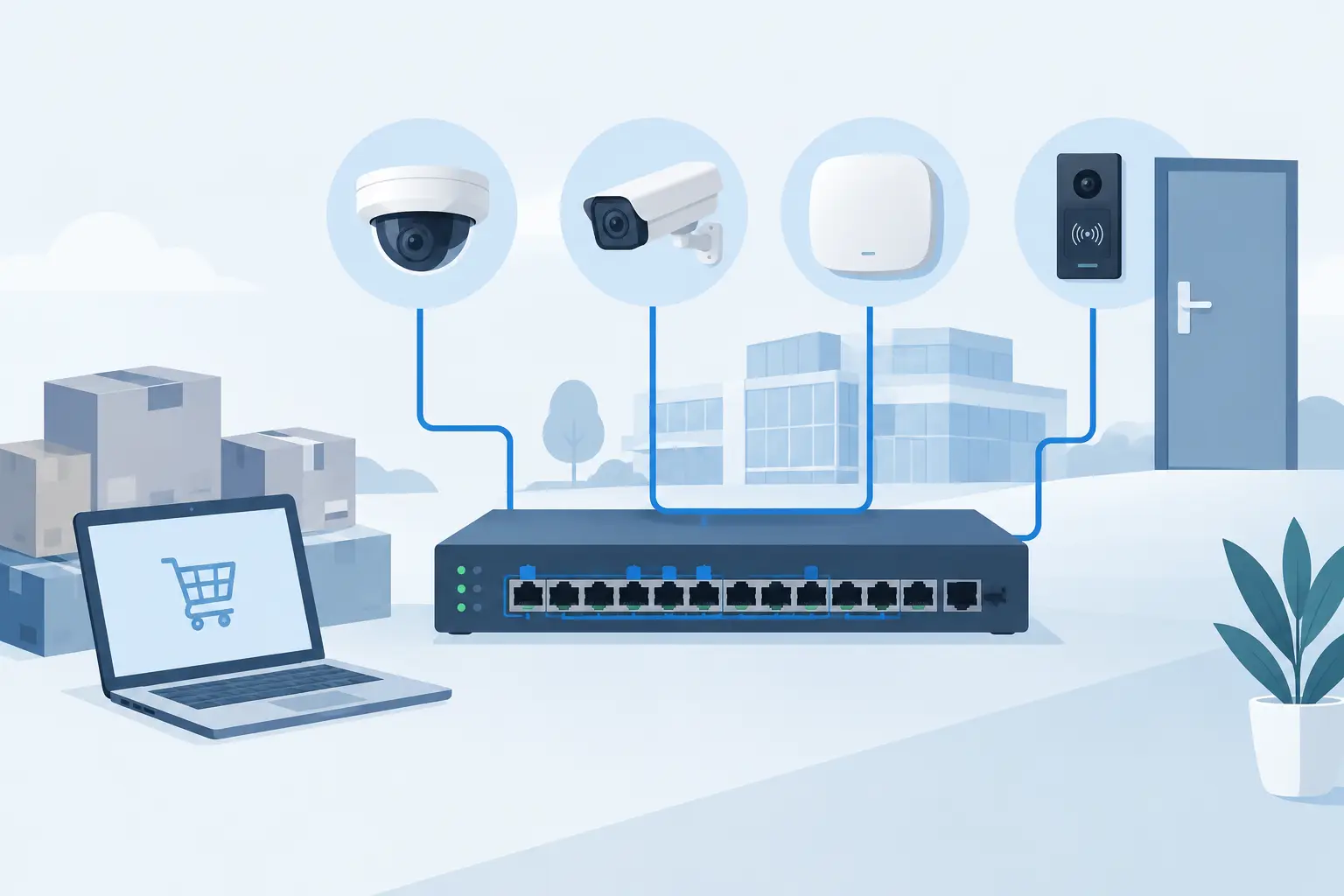
A PoE switch can look correct on a bill of quantities and still become the point of failure when cameras, access controllers, wireless devices, and uplinks are connected. Knowing how to source PoE switches is less about finding a port count and more about verifying that the equipment supports the actual operating load, installation environment, and handover requirements. Seven Sectors Trading Co. supplies AETEK PoE switching and network infrastructure to Saudi project buyers who need a dependable, documented supply route.
Start with the devices, not the switch
The switch should be selected after the powered devices are known. A surveillance network, for example, may include fixed cameras, PTZ cameras, edge devices, intercoms, and access control hardware with very different power profiles. Treating every endpoint as a standard PoE load can leave insufficient capacity once the system reaches full operation.
Ask for a clear endpoint schedule from the consultant, system integrator, or security team. It should identify the device type, quantity, power requirement, location, and whether the device will operate continuously or only at intervals. This information allows the sourcing team to assess both per-port power availability and the total switch power budget.
The required port count is not simply the number of devices in the current drawing. Allow for the architecture around the switch: uplink connections, spare capacity for approved expansion, segregation between services where required, and any devices that may be added during fit-out. The right allowance depends on the project. A tightly defined government tender may require strict adherence to an approved quantity, while a commercial campus may benefit from planned capacity for future phases.
How to source PoE switches by power budget
A switch can provide PoE on multiple ports but still have a limited total power budget. That distinction is central to successful sourcing. If the combined demand of connected equipment exceeds the available budget, some devices may not receive the power expected during peak operation.
Request the power consumption stated for each endpoint and calculate the expected simultaneous load. Then include a sensible engineering margin agreed with the design authority. The final selection must account for real conditions, including devices that draw more power when infrared illumination, heaters, motors, or other onboard functions are active.
Do not rely on a single headline such as “PoE switch” or “high-power PoE.” Procurement documents should confirm the required power standard, available power per port where relevant, and the total budget for the intended configuration. These details should align with the approved device schedule rather than with a generic product description.
Power sourcing also affects resilience. If the network design calls for backup power, identify how the switch itself will be supported during utility loss. A connected camera cannot remain operational merely because it is PoE-capable if the switch supplying it has no approved backup arrangement. This is a design and infrastructure decision, but it must be visible during procurement so the supplied equipment matches the intended power strategy.
Confirm the network role and uplink path
PoE is only one part of the switch decision. The equipment must also fit the network architecture. Before requesting a quotation, establish whether the switch is intended for an access layer, an aggregation point, an outdoor field cabinet, or an industrial zone. Each role creates different expectations for uplinks, management, physical construction, and environmental suitability.
For an access switch serving field devices, confirm how traffic will reach the core network and storage environment. The uplink type, media, interface availability, and redundancy requirement should be clear in the procurement specification. A switch with adequate powered ports but an unsuitable uplink path may constrain video traffic or require unplanned additional hardware.
Managed and unmanaged switching is another practical decision. An unmanaged switch can be appropriate where the approved network design is simple and centralized management is not required. Managed switching is generally more suitable when the project needs segmentation, monitoring, traffic controls, remote administration, or a defined cybersecurity policy. The choice should follow the consultant’s network requirements, not a default preference.
For surveillance and security projects, separate device networks, VLAN requirements, multicast handling, and monitoring expectations should be clarified before supply. These are not optional technical details. They affect the switch family and the configuration capabilities that the installation team will need at handover.
Match the enclosure and environment to the site
Many sourcing errors begin when an indoor network-room product is specified for a field cabinet, gatehouse, parking area, or industrial perimeter. Installation location matters as much as port count. Ask where the switch will be housed, whether the cabinet is conditioned, and whether the project has requirements for temperature, dust, humidity, vibration, surge exposure, or physical access control.
Where the equipment will serve outdoor cameras or remote security points, establish the full path between the switch and endpoint. This may include distance limitations, copper or fiber transmission requirements, power delivery needs, and protection measures identified by the project design. The procurement package should not assume that all cable runs and environments are identical.
The same principle applies to mounting and cabinet space. Confirm the intended installation method and available rack or enclosure arrangement early. A compatible switch that cannot be accommodated in the designated location creates avoidable changes during installation.
Request documentation that supports approval and handover
For government, critical infrastructure, and large commercial projects, product selection is rarely approved on a basic quotation alone. Procurement teams commonly need manufacturer documentation, model references, technical data, country-of-origin information where requested, warranty terms, and authorization confirmation from the supply channel.
Provide the exact approved make and model requirements to the supplier whenever available. If an equivalent is being considered, it should be reviewed through the formal consultant or client approval process. Avoid substituting equipment based only on apparent similarity in port count or PoE labeling. The differences may be material in power capacity, management functions, uplinks, environmental performance, or approved project standards.
A traceable supply route is equally valuable. Working with an authorized partner helps integrators and procurement teams obtain product documentation and commercial support aligned with the specified equipment. It also reduces the risk of mixing incompatible product versions or relying on incomplete technical information during submittals.
Build the request for quotation around decisions
A well-written RFQ speeds up sourcing because it gives the supplier enough information to match the requirement accurately. Include the approved brand or acceptable category, model if specified, quantity, port requirement, PoE requirement, uplink requirement, managed or unmanaged preference, installation environment, and any required documentation.
For larger projects, separate the switch schedule by location or system role. Core-side equipment, IDF switches, security field switches, and remote cabinet equipment should not be grouped into one vague line item. Clear separation makes it easier to identify whether each product is being sourced for the correct task.
Also identify dependencies that affect supply decisions. A PoE switch may need compatible power accessories, mounting hardware, fiber interfaces, enclosures, or related network components. Listing these requirements at the RFQ stage prevents a partial supply package that delays installation later.
Questions buyers should resolve before issuing an order
Is more PoE power always better?
Not necessarily. Higher capacity can provide useful headroom, but it may add cost or introduce features the project does not require. Source to the approved load calculation, resilience strategy, and expected expansion, rather than selecting the highest-rated option by default.
Should spare ports be included?
It depends on the contract scope and growth plan. Spare ports can support future devices and reduce later disruption, but they should be intentional and documented. In tightly controlled tenders, confirm whether expansion capacity is permitted within the approved schedule.
Can any PoE switch support a security network?
No. The switch must match the endpoint power demand, network architecture, uplink design, environment, and required management functions. It must also meet the documentation and approval requirements of the project.
When the switch schedule is complete, sourcing becomes a controlled technical purchase instead of a last-minute commodity decision. Send the device schedule, network requirements, and project documentation needs to info@7sectors.com or submit a Get Quotation form so the supply package can be reviewed against the actual application.
Ready to discuss your project? Contact Seven Sectors or contact us directly on +966-012 229 3474.