
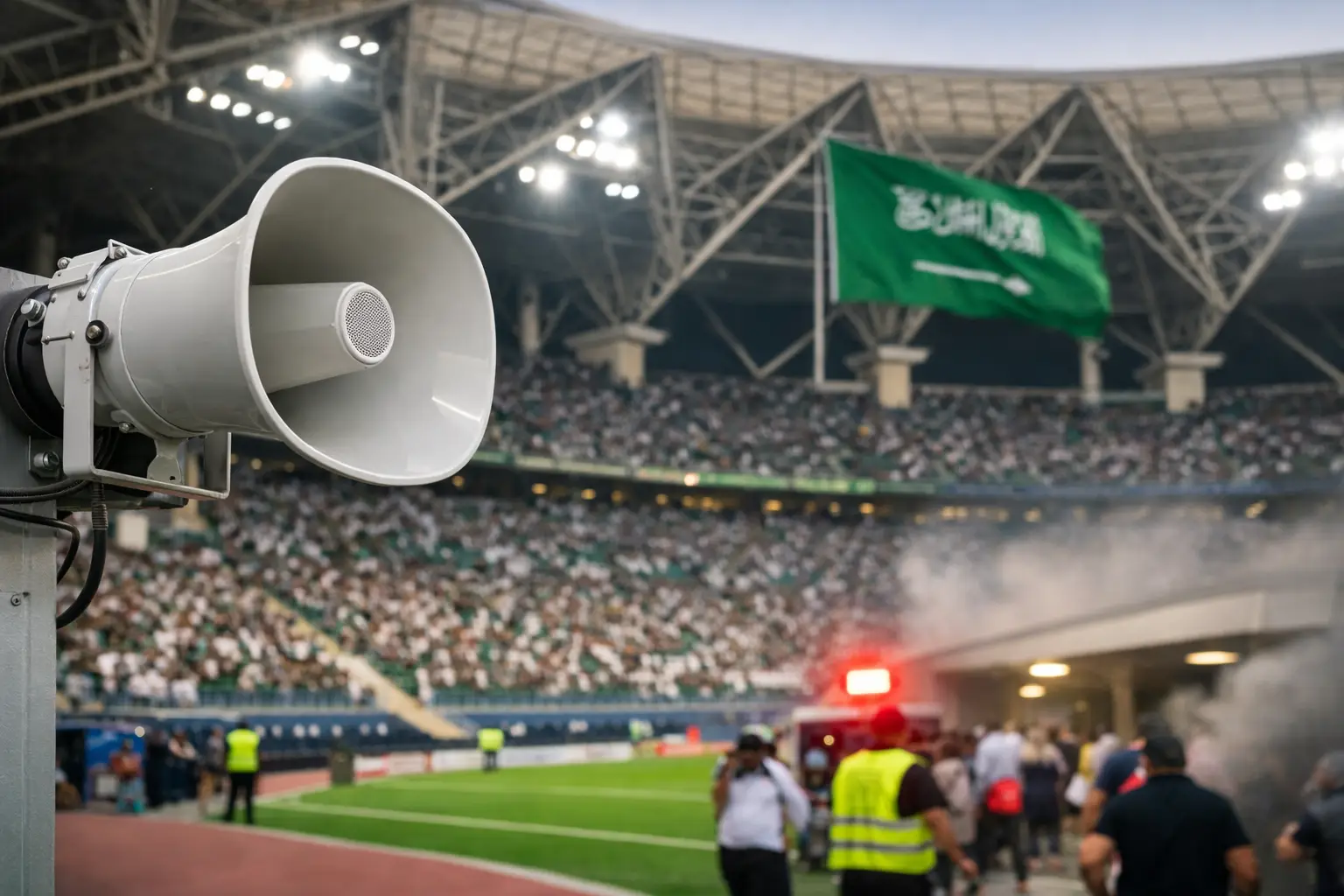
A stadium announcement is only useful if every seat can hear it. That means every concourse, gate, hospitality area, and external assembly point too. Saudi stadium PA systems must do more than produce high sound pressure levels. They must keep speech clear through crowd noise, wind, and reverberation.
The acoustic environment changes across the venue. For example, an open bowl behaves differently to an enclosed stand. Back-of-house corridors and public plazas are different again. For major venues, ITC professional audio and voice evacuation platforms give consultants and system integrators a practical route to a properly zoned, scalable specification.
This matters for the sports, entertainment, and multipurpose venues under delivery across Saudi Arabia. On match day, the system must support routine announcements, music, sponsor content, and event control. During an emergency, that same infrastructure must switch to clear evacuation messaging. It must also protect critical audio paths and direct people by zone, not broadcast one generic instruction to the whole venue.
What Saudi Stadium PA Systems Must Deliver
A stadium is not one acoustic space. It is many. For example, the spectator bowl may need high-output line arrays aimed precisely at seating tiers. Concourses need distributed loudspeakers that control reflections and preserve vocal clarity. VIP lounges, prayer areas, control rooms, service corridors, parking structures, and perimeter gates each need their own coverage pattern and operating priority.
This is why a single amplifier rack and a group of high-power speakers is not a stadium PA design. The system needs defined audio zones, supervised signal paths, priority logic, and enough amplifier headroom to stay intelligible during peak crowd conditions. In fact, sound that is merely loud can become harder to understand. This is because reflections and delayed arrivals mask consonants in spoken messages.
Outdoor resilience matters for Saudi projects too. Heat, dust, open-air exposure, and long cable routes should shape the equipment schedule, rack location, loudspeaker selection, and maintenance access. The right answer depends on venue geometry and the consultant’s acoustic model. A compact covered arena and a 40,000-seat outdoor stadium both count as sports venues. However, that alone does not mean they should get the same loudspeaker approach.
ITC Audio Platforms for Stadium Communication
ITC provides professional PA, network audio, conference, and voice evacuation product families suited to complex public-address requirements. For stadium applications, the relevant selection normally combines three elements. ITC line array loudspeakers cover high-output spectator areas. In addition, centralized amplification and processing handle signal routing. Finally, an ITC 6000, 6100, or 6200 series voice evacuation platform delivers dedicated emergency communication where the project requires it.
Line arrays for controlled high-output coverage
ITC designed the LA-2650, LA-2100, LA-2800K, and LA-2120 line array series for venues that need controlled vertical dispersion. They also deliver substantial throw distance across large seating areas. When properly deployed, line arrays direct acoustic energy toward seating areas. As a result, they limit unnecessary spill onto hard roof surfaces or adjacent zones.
Low-frequency reinforcement is a separate decision. ITC KS-212 and KS-218 professional subwoofers may support event music and entertainment programming. However, do not confuse them with the intelligibility requirements of life-safety announcements. Emergency voice messages depend first on clear midrange and high-frequency reproduction. They also need suitable coverage density, correct aiming, and the ability to override entertainment sources immediately.
The trade-off is straightforward. A high-output system can cover large distances with fewer loudspeaker locations. But it may create uneven coverage or excessive reflections in difficult architecture. On the other hand, more distributed loudspeakers can improve consistency in concourses and enclosed areas. However, they need careful delay alignment and more circuit planning. Acoustic modeling and measured commissioning by the responsible project team determine the final balance.
Amplification, zoning, and control
ITC digital mixer amplifiers such as the T-120DM and T-500DM suit smaller ancillary areas and local applications. Bluetooth, MP3, USB, and microphone inputs are useful there. Larger venue subsystems, however, may use rack-format ITC T-120DTB, T-500DTB, or T-650DTB digital mixer amplifiers. These suit equipment rooms and operator-controlled spaces.
For facilities that need multiple independently controlled public areas, ITC TI-1206S, TI-2406S, TI-3506S, and TI-5006S six-zone amplifiers provide zone-oriented operation with MP3 functionality. For more refined audio management, the ITC TI-120Z, TI-240Z, TI-350Z, and TI-500Z multi-zone DSP models add digital processing capability.
However, zoning should follow crowd movement and emergency response plans. It should not follow architectural room names alone. For example, a stadium may need separate zones for upper and lower seating bowls, and for each concourse level. Entry gates, food courts, hospitality suites, parking, and external assembly areas each need their own zone. In an incident, operators may need to send different messages to affected and unaffected areas. Project teams should settle that operational scenario before they finalize the bill of materials.
Voice evacuation is a distinct system requirement
Voice evacuation requires more than a paging microphone and a background music controller. ITC built the 6000, 6100, and 6200 series for voice evacuation applications. They bring supervised equipment, emergency priority, zone control, and fault reporting into one system where the project requires it.
Procurement teams should ask the appointed designer to clarify the applicable Saudi Civil Defense requirements and project specifications. The same applies to any international standards that the tender references. The selected equipment, speaker circuits, backup power strategy, monitoring architecture, and test procedures must match those requirements. Product names alone cannot validate a voice evacuation system.
This distinction is commercially important. A conventional PA system may be suitable for operational announcements in a training facility or a small venue. A major stadium with phased evacuation requirements generally needs a more disciplined emergency communications architecture. Combining the two without confirming priorities, redundancy, and emergency zoning creates avoidable risk. These gaps tend to surface late in the project, when changes are most costly.
Network Audio and Operational Integration
For distributed facilities, ITC IP PA 77, 67, and 88 series network speakers and intercom devices can extend communication to remote gates, security posts, plant rooms, staff entrances, and perimeter locations. IP audio works well where the venue already has managed network infrastructure. It also suits venues where operators need centrally addressed devices across several buildings or precinct zones.
Network design remains a project-critical responsibility. For example, audio endpoints need appropriate bandwidth planning, VLAN strategy, PoE capacity where applicable, and resilient uplinks. When IP speakers or intercom endpoints require PoE infrastructure, AETEK PoE switches and extenders can support the network layer. AETEK is a PoE infrastructure brand, not a camera brand. Its outdoor IP67 H-series, indoor C-series, and industrial D-series equipment may be relevant depending on the endpoint environment and cable-distance requirement.
Security and venue operations also need clear boundaries between systems. A stadium PA platform can receive operational triggers or communications requests from a command center. But it is not a replacement for video management, access control, or emergency management procedures. A project may include Milesight AI cameras, HID access control, ISS SecurOS VMS, or Rasilient and Dell server infrastructure. In this case, the consultant should define what information the systems share, who has command authority, and how the design protects emergency priorities.
For government and Vision 2030 procurement, the wider security stack may require NDAA/TAA-compliant components from verified partners. Project teams should manage that compliance review by product category. In particular, teams should not assume that a compliance status assigned to surveillance, servers, or PoE infrastructure applies automatically to every audio component in the project.
Specification Questions That Prevent Late Changes
Before issuing a stadium PA tender, project teams should set the performance criteria. Do not just request a generic “stadium sound system.” At minimum, the specification should address these five points:
- Required speech intelligibility targets for the bowl, concourses, hospitality, back-of-house, and external areas.
- Emergency zoning, message priorities, fire alarm interfaces, fault monitoring, and backup power requirements.
- Loudspeaker environmental ratings, mounting constraints, heat exposure, dust conditions, and access for maintenance.
- Event-mode needs such as music playback, commentator positions, wireless microphone inputs, and control-room paging.
- Network, rack-space, cable-route, and integration requirements for IP audio and associated venue systems.
These details reduce substitutions that look equivalent on a schedule but perform differently under real venue conditions. They also help integrators compare amplifier capacity, loudspeaker coverage, evacuation functionality, and control interfaces on a like-for-like basis.
A Practical Supply Approach for Saudi Venue Projects
Seven Sectors supports system integrators, MEP consultants, government procurement teams, and giga-project contractors on Saudi stadium and major-venue projects. That support covers ITC PA and voice evacuation product sourcing. The value is not in treating a stadium as a standard commercial audio job. Instead, it lies in supplying the appointed project team with identifiable ITC product families. These families let the team align loudspeaker coverage, amplification, zoning, and emergency communications with the actual venue brief.
For availability, technical product selection support, and competitive project pricing for ITC stadium audio, contact Seven Sectors at info@7sectors.com or submit the website Get Quotation form.
Frequently Asked Questions — Saudi Stadium PA Systems
ITC (itc®, Guangdong) is the professional audio brand Seven Sectors supplies for stadium PA in Saudi Arabia. ITC provides high-output line array systems, distributed speaker networks, zone amplifiers, digital signal processors with Dante networking, and integrated voice evacuation platforms — all on a single architecture suited to large-venue specifications.
Yes. ITC voice evacuation systems — including the 6000 Series — integrate with event PA so that the same speaker network handles match-day announcements and emergency evacuation messaging. Priority routing overrides entertainment audio and directs zone-specific evacuation instructions, which is essential for Saudi Civil Defense compliance in large public venues.
A PA system manages event announcements and music. A voice evacuation system is a life-safety platform with supervised signal paths, priority logic, and zone-by-zone control to guide occupants during emergencies. In a Saudi stadium, both functions are typically delivered through one integrated infrastructure. ITC systems are designed for this combined requirement.
ITC outdoor stadium speakers and line arrays are rated for outdoor installation and are selected based on environmental conditions. For Saudi projects, Seven Sectors specifies ITC products appropriate to the exposure level — open bowl, covered concourse, or external plaza — and can advise on IP ratings and thermal performance for Gulf climate conditions.
Contact Seven Sectors with the venue type, seating capacity, zone layout, and whether voice evacuation integration is required. We supply ITC PA systems to system integrators, MEP contractors, and consultants on Saudi stadium and large-venue projects from our Jeddah base. Pricing is project-specific and provided on request.
Ready to discuss your project? Contact Seven Sectors or contact us directly on +966-012 229 3474.