
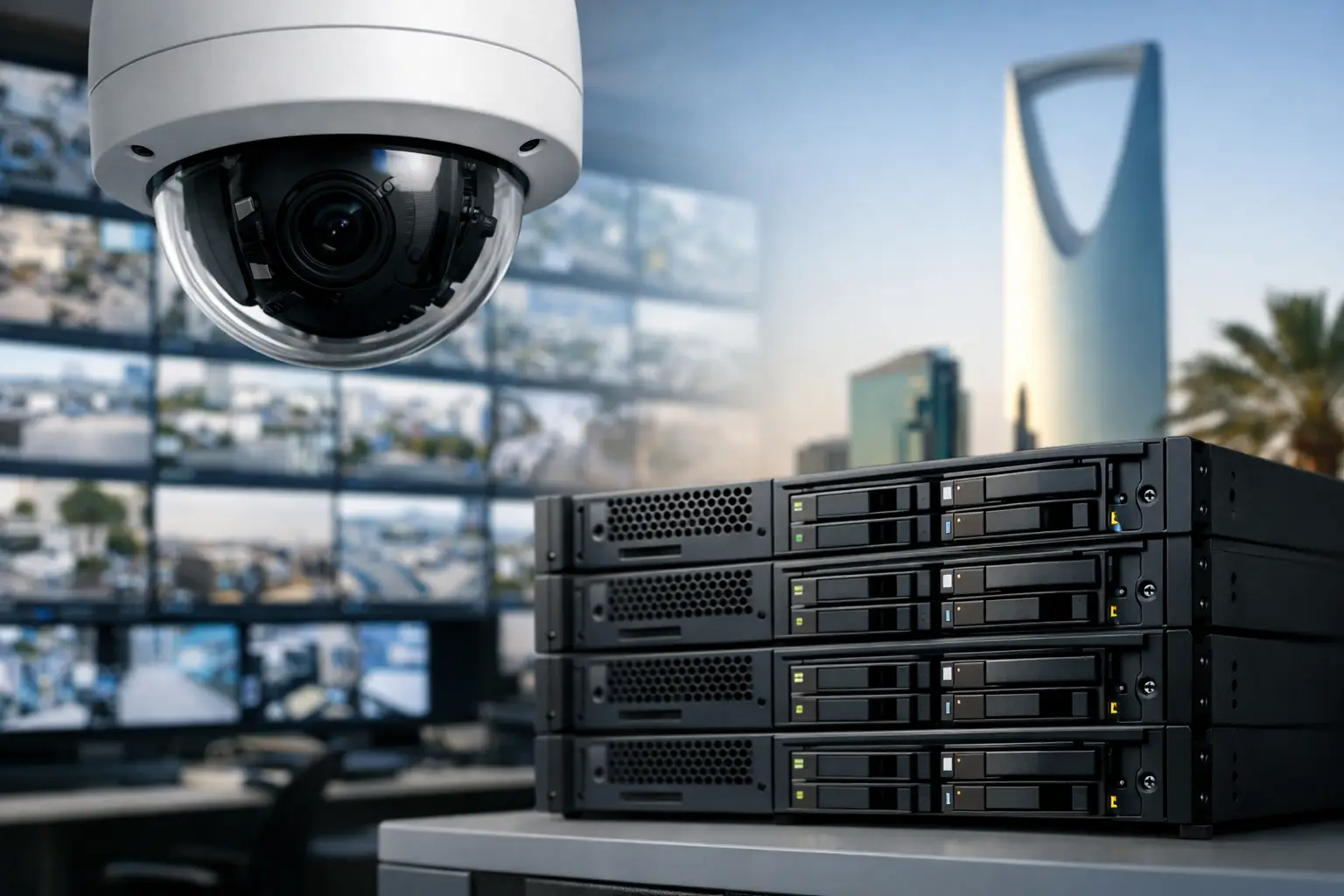
A surveillance server can pass a camera stream in a demonstration and still fail a major project months later. Recording gaps, undersized storage, unsupported components, and unclear compliance documentation are frequent reasons why procurement teams now scrutinize NDAA compliant CCTV servers as closely as cameras and VMS licenses. For Saudi government, critical infrastructure, industrial, and Vision 2030 projects, the server is not a back-office item. It is the evidence platform.
The correct choice depends on the recording workload, retention policy, VMS architecture, resilience target, and tender compliance requirements. A compact NVR may suit a single commercial site. A multi-server deployment with forensic storage is a different requirement entirely for an airport, logistics hub, utility facility, or smart-city command center.
What NDAA Compliance Means for CCTV Servers
NDAA compliance is often discussed as a camera requirement, but the server layer needs the same discipline. Section 889 of the U.S. National Defense Authorization Act restricts specified telecommunications and video surveillance equipment and services. In practice, a compliant CCTV server specification should examine the complete proposed platform, including the server manufacturer, storage components, network interfaces, management hardware, and the video management ecosystem connected to it.
A server chassis alone does not make a surveillance solution compliant. Integrators and consultants should request model-specific declarations and confirm that the proposed bill of materials meets the project requirement. This is particularly relevant when servers are supplied with preconfigured storage, RAID controllers, operating systems, video acceleration hardware, or embedded management components.
NDAA and TAA are also not interchangeable terms. A project may require NDAA compliance, TAA compliance, or both. TAA requirements generally relate to country-of-origin rules for U.S. government procurement, while NDAA restrictions focus on prohibited equipment and suppliers. Tender documentation should state which standard applies and what evidence is required at submittal stage.
For consultants, the practical rule is simple: do not accept a general statement that a server family is compliant. Verify the exact server, storage configuration, and associated surveillance solution proposed for the project.
Choosing NDAA Compliant CCTV Servers by Workload
The starting point is not the number of cameras alone. Camera count is useful, but server sizing is driven by total bitrate, resolution, frame rate, retention period, recording mode, analytics load, failover requirements, and expected client connections.
A 100-camera deployment recording 4 MP streams at continuous high frame rates can impose a substantially different workload than 100 cameras recording motion events at lower bitrates. Analytics change the calculation again. Milesight AI cameras can reduce false alarms through functions such as human and vehicle classification, but the VMS and server must still be sized for live viewing, event search, metadata handling, and archive retrieval.
Recording throughput and retention
Recording throughput is the first hard limit. The server must continuously receive and write all planned streams without dropped frames during normal load, peak activity, or a simultaneous playback request. Storage capacity must then support the retention period required by the authority, client, or project security plan.
A correct design considers usable RAID capacity rather than raw disk capacity. RAID protection consumes capacity, and a realistic calculation must account for system overhead, VMS database requirements, spare capacity, and future camera additions. Specifying storage at the theoretical minimum may reduce the purchase order value, but it leaves no practical margin for a project change order or a higher-than-expected scene bitrate.
Rasilient addresses this concern with its NFD architecture – No Frames Dropped – built for surveillance recording workloads where evidentiary continuity matters. Its ApplianceStor 1U and 3U platforms, PixelStor storage, and NFDCloud options are relevant where projects require scalable forensic storage rather than a basic office-server approach.
VMS compatibility and processing roles
A CCTV server is usually part of a VMS environment, not a standalone recording appliance. The proposed platform must be validated for the selected VMS version and role. A recording server, management server, mobile gateway, analytics server, failover server, and client workstation can have very different hardware profiles.
ISS SecurOS deployments, for example, can include advanced capabilities such as LPR, facial recognition, and behavior analytics. These workloads should be treated separately from the recording layer when the project scale or analytics demand justifies it. SecurOS Professional, Premium, Enterprise, and MCC configurations should be matched to the operational model, whether the site is managed locally or through a central command environment.
Rasilient is VMS-agnostic and can be considered alongside platforms such as ISS SecurOS and Milestone where the project requires a dedicated surveillance storage architecture. FIBRENETIX enterprise CCTV servers and NVRs are another option for projects needing purpose-built recording and storage systems. Dell PowerEdge servers, Precision workstations, and PowerVault storage can also support VMS infrastructure where an enterprise IT architecture is preferred. These are different paths, not interchangeable product labels.
The Server Is Only as Reliable as Its Architecture
For high-consequence sites, a single server is a single point of failure. The appropriate resilience level depends on the threat model and operational requirement. A retail warehouse may accept planned maintenance windows. A border facility, transportation site, oil and gas location, or government command center may require failover recording, redundant storage, dual power supplies, monitored disk health, and geographically separated archive strategies.
Network design also affects recording integrity. Camera traffic must reach the server consistently, with adequate uplink bandwidth and correctly planned VLANs. AETEK supplies NDAA/TAA-compliant PoE network infrastructure, including industrial D-series switches, IP67 H-series outdoor switches, indoor C-series products, ceiling PoE switches, and PoE extenders supporting up to 250 meters. These products are not camera equipment, but they directly affect whether cameras remain powered and connected to the recording platform.
The server should be specified with its network path in mind. A camera system using high-resolution Milesight panoramic cameras, PTZ cameras, or LPR Pro Bullet Plus cameras may create burst traffic during live investigation and playback. The uplink, aggregation switch, recording NICs, and storage write performance must be considered as one system.
Documentation That Procurement Teams Should Request
For NDAA-sensitive tenders, compliance cannot be left until final delivery. It should be captured early in the submittal package and tied to the exact quotation. The most useful documents are manufacturer compliance declarations, model numbers, country-of-origin information where TAA applies, VMS compatibility statements, warranty details, and a clear bill of materials.
Procurement teams should also ask who will support replacement hardware, warranty processing, and configuration changes during the project lifecycle. This matters in Saudi Arabia, where government and giga-project schedules may require coordinated supply against phased construction packages. A server platform with unclear local availability can become a project risk even if its initial specification looks correct.
There is a trade-off between a fully integrated recording appliance and a modular server-and-storage architecture. Appliances can simplify deployment and support for defined camera counts. Modular platforms can offer more flexibility for expansion, VMS separation, storage scaling, and enterprise IT policies. Neither is automatically better. The right answer comes from the required retention, availability, analytics, and future expansion plan.
Build the Compliance Path Before the Purchase Order
NDAA compliant CCTV servers should be selected as part of a documented video architecture, not added to a camera quotation at the last minute. Confirm the compliance standard, size the recording and retrieval workload, identify the VMS roles, validate storage protection, and request documentation for the specific proposed configuration.
Seven Sectors supports Saudi system integrators, consultants, and procurement teams with NDAA/TAA-focused surveillance infrastructure from established technology partners, including Rasilient, FIBRENETIX, Dell, ISS, Milesight, and AETEK. For project pricing, availability, and compliance documentation support, contact Seven Sectors at info@7sectors.com or submit the website Get Quotation form. The best time to resolve server compliance is before the specification becomes a procurement exception.
nnFrequently Asked Questions — NDAA Compliant CCTV Servers
nnNDAA compliance for a CCTV server means the server hardware, storage components, and related equipment do not include components from manufacturers restricted under Section 889 of the U.S. National Defense Authorization Act. For Saudi projects with government or infrastructure requirements, the full bill of materials — not just the server chassis — must meet this standard.
Rasilient purpose-built surveillance servers are designed with NDAA-compliant supply chain principles and are used in government and critical infrastructure environments. FIBRENETIX enterprise surveillance servers are evaluated on a model-by-model basis. Contact Seven Sectors with your project specification to receive current compliance documentation for the required platform.
NDAA compliance focuses on excluding restricted manufacturers's equipment under Section 889. TAA (Trade Agreements Act) compliance requires that products be manufactured or substantially transformed in a TAA-designated country. A project may require one, the other, or both. Seven Sectors can confirm which standard applies to each platform we supply.
Rasilient servers are VMS-agnostic and validated with ISS SecurOS, Milestone, Genetec, and other major platforms. FIBRENETIX and Dell PowerEdge servers also support multi-VMS environments. Seven Sectors advises on server and VMS pairing based on camera count, retention, and compliance requirements for each project.
Contact Seven Sectors with your project details — camera count, retention period, VMS platform, and compliance requirements. We supply Rasilient, FIBRENETIX, and Dell surveillance servers to system integrators, consultants, and procurement teams across the Kingdom from our Jeddah base. Pricing depends on project scope; we do not publish list prices.
See the full Surveillance Storage & Servers overview for the complete Rasilient, Dell and Fibrenetix range.
Ready to discuss your project? Contact Seven Sectors or contact us directly on +966-012 229 3474.