
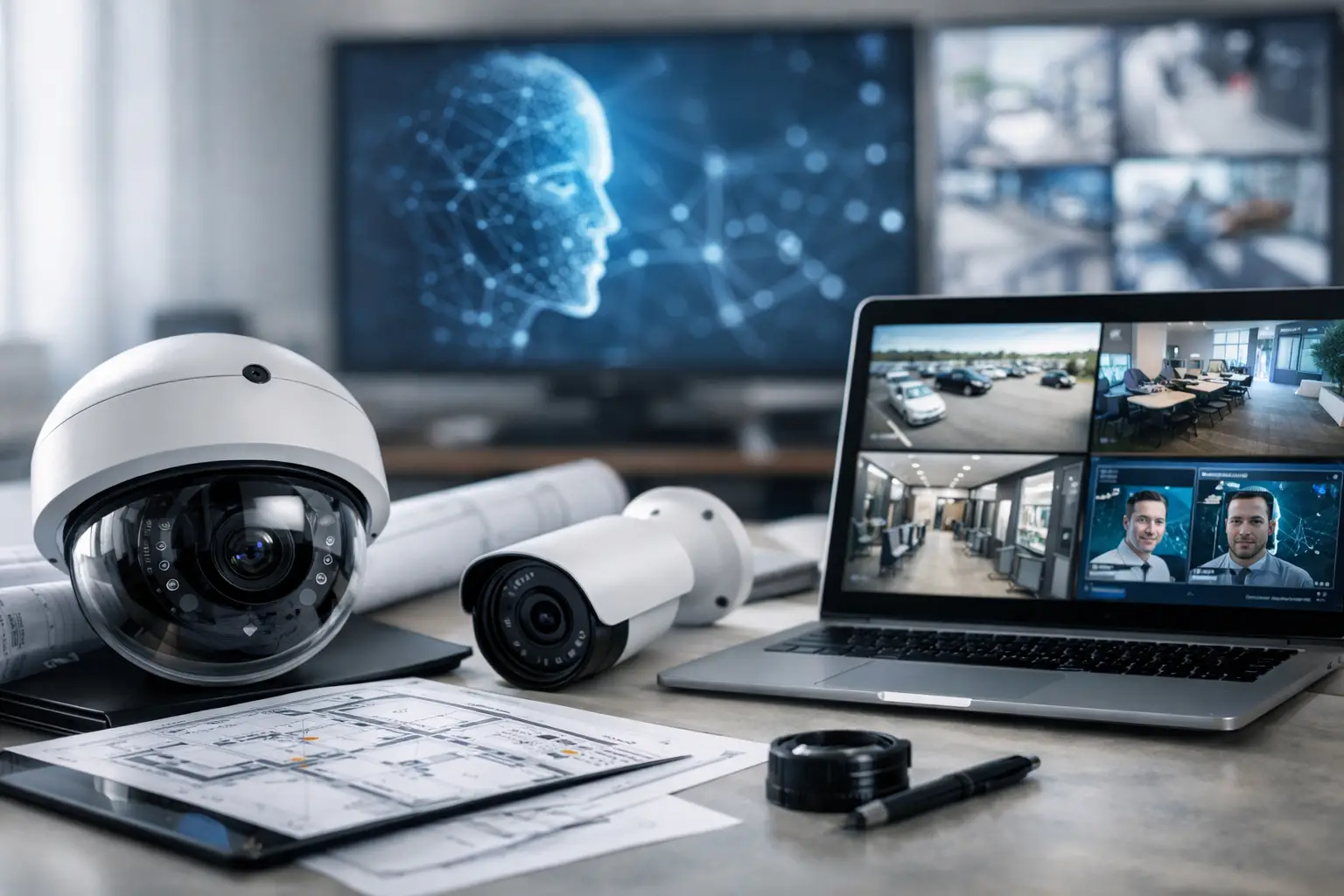
A video surveillance system design guide should begin with operational evidence requirements, not a camera count. For government facilities, industrial sites, transport corridors, and Vision 2030 developments, the specification must establish what an operator needs to see, identify, search, retain, and export under real lighting and network conditions. Milesight AI CCTV provides the camera layer for that work, with AETEK PoE infrastructure, an appropriate VMS, and verified recording capacity supporting the wider design.
The common procurement failure is treating every camera point as identical. A loading bay needs vehicle detail, an entrance needs facial capture at a defined distance, and a perimeter needs reliable intrusion classification after dark. Each objective produces a different lens, mounting height, illumination, bandwidth, storage, and analytics requirement. The following framework helps consultants and system integrators develop specifications that are technically defensible and commercially practical.
Start With the Security Objective, Not the Camera Model
Before selecting a Milesight model, divide the site into operational scenes. Define whether each scene requires observation, detection, recognition, or identification. These are different standards. A wide overview camera may be correct for observation of a lobby, while identification at a gate requires enough pixel density on the subject’s face or vehicle plate at the expected capture point.
For every scene, document the target, maximum distance, direction of travel, lighting condition, camera mounting constraints, and required retention period. This avoids the familiar problem of a high-resolution camera being specified without a lens or position that can produce usable evidence.
A vehicle entrance may require a Milesight LPR Pro Bullet Plus Camera dedicated to plate capture, rather than relying on a general overview camera. Its paired overview camera can provide vehicle color, type, and context. For large open yards, a Milesight PTZ camera with 12X to 23X optical zoom can support active response, but it should not replace fixed cameras covering critical pathways. A PTZ only records where it is looking.
Video Surveillance System Design Guide: Camera Selection
Milesight AI cameras should be selected by scene behavior and environmental exposure. The Pro and Mini Series suit many fixed-camera applications, while the Q/Panoramic range addresses scenes where broad coverage matters more than a conventional narrow field of view. A 360-degree fisheye can reduce blind spots in a lobby, concourse, or central open area, provided the VMS can dewarp views effectively. A 180-degree dual-sensor model can be a better choice for long facades, perimeter lines, and parking lanes where a circular fisheye image is not desirable.
Low-light performance must be evaluated against the actual site, not a generic day/night assumption. Milesight TrueColor AI cameras, with sensitivity down to 0.002 Lux on applicable models, can preserve color detail in low ambient light. This may reduce dependence on additional white light in certain scenes, but it does not remove the need for a lighting survey. Glare from gatehouse lights, headlights at a ramp, reflective paving, and direct sun at sunrise can all undermine evidence quality. Milesight cameras with 140 dB WDR are relevant where strong backlight is expected, such as building entrances and vehicle exits.
Analytics also need deliberate specification. Milesight AI classification can distinguish people and vehicles, reducing irrelevant alarms compared with conventional motion detection. The stated reduction of up to 95% in false alarms is useful only when the analytic rule, detection area, target size, and environmental exclusions are correctly configured by the project team. Exclude trees, flagpoles, water, moving shadows, and traffic beyond a fence line at the design stage.
Camera placement is equally important. Avoid mounting cameras so high that faces become top-down images. Protect critical cameras against tampering while preserving their viewing angle. At industrial sites and exposed external locations, account for vibration, wind, dust, heat, and cable routing. The selected housing and mounting accessories must suit the location, and the surveillance schedule should include cleaning where dust accumulation is likely.
Design the PoE Network as Critical Infrastructure
A camera specification is incomplete without power and network design. AETEK is the PoE infrastructure layer in this stack, not a camera manufacturer. Its Taiwan-made, NDAA/TAA-compliant PoE switches and extenders help system integrators address the physical realities of surveillance networks in Saudi projects.
Calculate the PoE power budget from actual camera consumption, including infrared or white-light operation, heaters where applicable, and peak PTZ movement. Do not simply add switch ports and assume available power is sufficient. Allow a documented engineering margin, particularly where PTZ cameras, panoramic cameras, and future expansion are included.
Cable distance is another frequent constraint. Standard copper Ethernet runs have practical limits, while AETEK PoE Extenders can support camera connectivity up to 250 meters in suitable applications. This can simplify field cabinet planning for perimeter cameras, parking areas, and external buildings. The final topology still depends on cable quality, power demand, surge protection, and the site’s grounding approach.
For outdoor cabinets and difficult environments, AETEK H-series outdoor switches with IP67 protection are relevant. C-series switches suit indoor deployments, while D-series industrial products support demanding industrial environments. Ceiling PoE Switches can reduce local cabling complexity in suitable indoor projects. Select switch type by enclosure, heat, ingress exposure, uplink method, and maintenance access – not only by port count.
Network design also needs bandwidth calculations based on camera resolution, frame rate, codec, scene activity, and stream settings. H.265 can reduce storage and transmission demand, but scenes with heavy movement may still generate substantial bitrate. Separate camera traffic from enterprise traffic where the project architecture requires it, define uplink capacity, and ensure the VMS recording network does not create a bottleneck at aggregation points.
Match VMS and Storage to the Investigation Workflow
The VMS is where a surveillance design becomes an operational system. ISS SecurOS is suited to projects requiring scalable live monitoring, recording, event response, and analytics integration. Its Professional, Premium, Enterprise, and MCC options allow the platform to align with project scale and command-center requirements. For multi-site government or critical infrastructure deployments, centralized management and clear user permissions should be specified before hardware is procured.
The design team should define how operators will find incidents. If the answer depends on searching for a person, vehicle, plate, or behavioral event, then the selected cameras, analytics licenses, server resources, and storage architecture must support that workflow. A system that records video but cannot retrieve an event quickly is of limited value during an investigation.
Retention must be calculated from measured or modeled bitrate, not estimated only from camera quantity. Include continuous recording, event recording, archive retention, RAID or resilience requirements, failover expectations, and export activity. Higher resolution, panoramic views, high frame rates, and busy scenes all increase capacity requirements.
For high-value and mission-critical recording, Rasilient surveillance servers and forensic storage are designed around No Frames Dropped performance and can support VMS environments including ISS and Milestone. Evaluate Rasilient PixelStor, ApplianceStor 1U and 3U NVR platforms, and NFDCloud according to recording volume, retention policy, and recovery objectives. FIBRENETIX enterprise CCTV servers and surveillance storage, or Dell PowerEdge servers, Precision workstations, and PowerVault storage, may be specified where the project’s VMS infrastructure and procurement standard call for them. These are distinct product families. Assess them accordingly.
Compliance, Acceptance, and Future Expansion
For Saudi government and Vision 2030 procurement, NDAA/TAA compliance is often a formal requirement rather than a preference. Specify compliance at the equipment level and retain manufacturer documentation in the submittal package. Milesight AI cameras are NDAA-compliant, while AETEK PoE infrastructure is NDAA/TAA-compliant. Verify compliance alongside cybersecurity requirements, warranty terms, approved makes, and local project documentation.
Write acceptance criteria into the specification. Require image verification at day and night, plate capture testing at actual vehicle speeds, analytic alarm testing with approved scenarios, recording and playback checks, network failover testing where required, and evidence export validation. These criteria protect the consultant, integrator, and end user from a system that appears complete on drawings but fails under operational conditions.
Plan capacity beyond handover. Leave sufficient switch power, uplink bandwidth, server headroom, licenses, rack space, and storage growth for expansion. It is usually more economical to reserve a defined margin during initial procurement than to redesign the core platform after cameras are added.
Seven Sectors is the authorized Saudi partner for Milesight, AETEK, ISS, Rasilient, FIBRENETIX, Dell, and related security technologies. For verified product availability, compliance documentation, and project pricing, contact Seven Sectors at info@7sectors.com or submit the website Get Quotation form.
Server sizing matters as much as camera selection — see our comparison of the best surveillance servers for giga-projects and how Dell PowerEdge servers are deployed for hospitals in Saudi Arabia.
nnFrequently Asked Questions — Video Surveillance System Design
nnDefine what each camera must capture — observation, detection, recognition, or identification — before selecting any equipment. Each level requires a different resolution, lens, mounting height, and lighting specification. Starting with the security objective rather than the camera model prevents specification gaps that are expensive to correct after installation.
Milesight offers dedicated models for each application: Q Series and Pro Series for standard coverage, Panoramic 360° fisheye for open areas, dual-sensor panoramic for wide corridors, PTZ with up to 23x zoom for tracking and perimeter monitoring, Mini cameras for space-constrained locations, and LPR cameras for vehicle access points. Seven Sectors advises on model selection based on scene requirements.
Each camera needs a PoE power source matched to its wattage, mounting environment, and cable distance. AETEK PoE switches cover indoor (C-Series), outdoor IP67 (H-Series), industrial (D-Series), and ceiling-mount applications. PoE Extenders extend connectivity up to 250 metres beyond a standard 100-metre run. Seven Sectors supplies AETEK PoE infrastructure alongside Milesight cameras for complete project packages.
ISS SecurOS integrates with Milesight cameras and supports both live streaming and analytics event management. Milesight cameras are also compatible with other major VMS platforms. Seven Sectors can advise on the VMS and camera combination that best fits the project camera count, site topology, analytics requirements, and budget.
Storage sizing depends on camera count, resolution, frame rate, compression codec, retention period, and motion-triggered versus continuous recording. Seven Sectors uses project-specific calculations based on the Milesight camera schedule and VMS configuration. Contact us with your specifications and we will provide Rasilient or FIBRENETIX storage recommendations.
Ready to discuss your project? Contact Seven Sectors or contact us directly on +966-012 229 3474.