
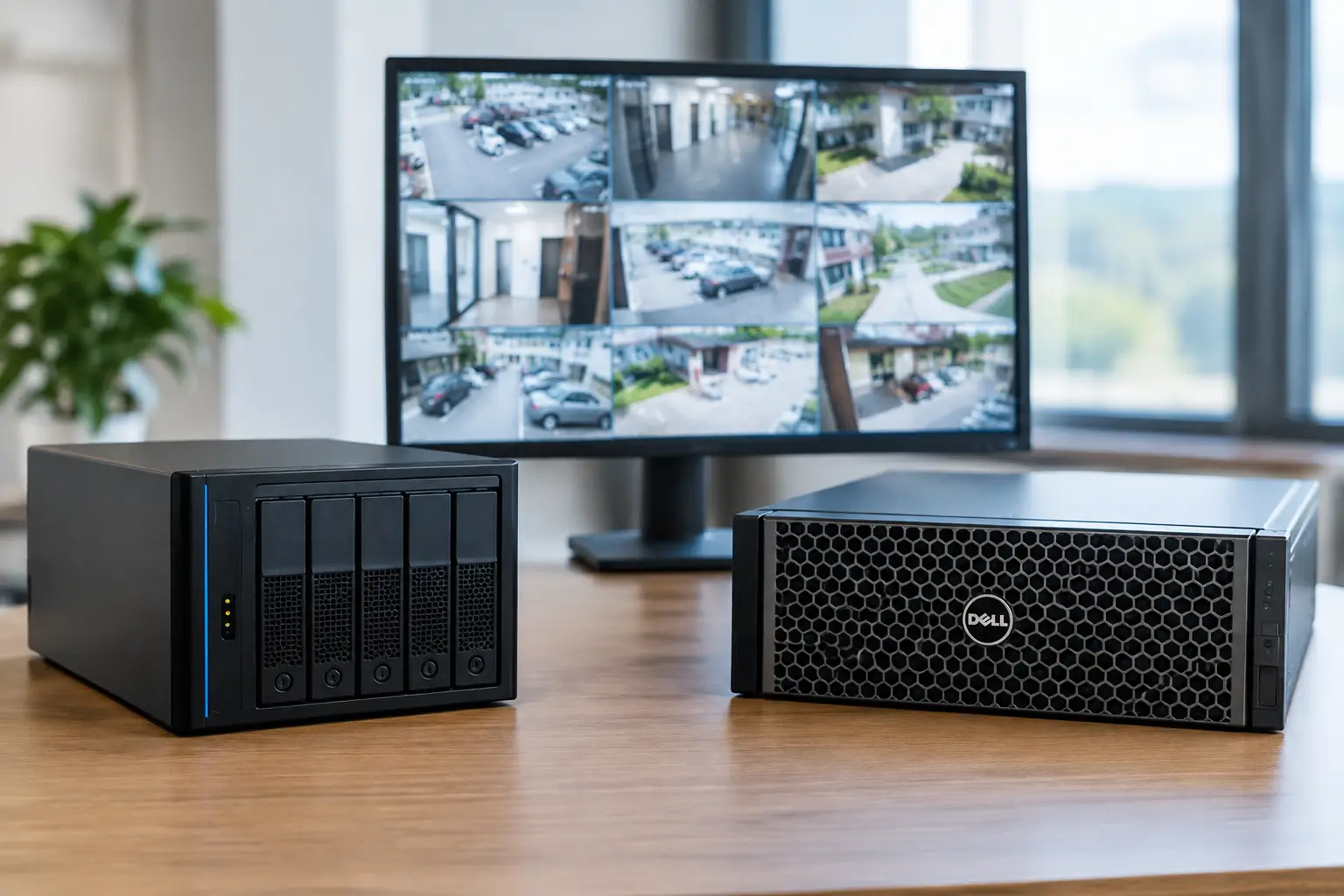
Hub: Surveillance Storage and Video Management Keyword target: Rasilient vs Dell surveillance
A surveillance project can specify excellent cameras and a capable VMS, then fail at the storage layer when recording retention, playback demand, and expansion were treated as secondary decisions. The Rasilient vs Dell surveillance question is therefore not simply about choosing one brand over another. It is about deciding whether the project needs a video-focused storage platform, a configurable server and storage foundation, or a defined combination of both.
For system integrators, consultants, and procurement teams, the correct choice depends on the recording profile, the VMS architecture, the required operational workflow, and who will support the environment after handover. Rasilient and Dell can each fit commercial, government, industrial, and major infrastructure deployments, but they solve different parts of the surveillance infrastructure decision.
Start with the recording workload, not the server count
Video storage is unlike a general office IT workload. Surveillance systems write data continuously, often from many streams at once, while operators may need to search, review, export, or investigate recorded footage at the same time. Retention requirements can also change late in the project when a consultant revises the camera schedule, recording policy, or evidence requirement.
That is why a bill of quantities built around raw capacity alone can create problems. Capacity answers only one question: how much footage can be held. It does not fully answer whether the system can accept continuous recording, support expected playback behavior, recover appropriately after a component issue, or grow without an avoidable redesign.
A useful design review should establish the number of cameras, expected stream settings, recording schedule, retention period, motion or event recording rules, concurrent viewing expectations, VMS requirements, redundancy approach, and anticipated growth. These inputs allow the VMS provider, consultant, integrator, and storage supplier to align on a practical platform rather than relying on an approximate terabyte figure.
Rasilient vs Dell surveillance: the core difference
Rasilient is generally considered where the project calls for surveillance-oriented storage designed around video retention and operational continuity. The appeal is not merely storage capacity. It is the fit between a dedicated video workload and a platform intended to support that workload over an extended recording period.
Dell surveillance infrastructure is commonly evaluated where the client or integrator wants a server and storage environment that can be configured around an established IT standard, VMS deployment model, or broader data center approach. Dell may be particularly relevant when the project team requires defined compute, storage, networking, and support considerations within a familiar enterprise procurement framework.
Neither approach is automatically better. Rasilient may be the more direct path when video storage is the central problem to solve and the project benefits from a purpose-built surveillance storage discussion. Dell may be the stronger fit when surveillance is part of a larger, standardized server and storage architecture with specific compute and infrastructure requirements.
The decision should be based on the required outcome, not a presumption that one platform is always simpler or that a general server platform is always more flexible.
When Rasilient is the stronger fit
Rasilient deserves close consideration when recording retention is extensive, camera counts are substantial, or continuous video capture is the defining workload. It can also be appropriate when the procurement team wants the storage conversation to remain centered on surveillance performance, evidence availability, and operational lifecycle rather than treating video as another generic application.
This approach is valuable for facilities where missed footage can create serious operational, safety, compliance, or investigative exposure. Government sites, transport environments, industrial facilities, critical infrastructure, and large commercial campuses often need clear answers about retention behavior and storage expansion before equipment is released for supply.
Rasilient can also help simplify responsibility boundaries. A project team can assess a storage platform through the lens of the video system it must support, while still validating compatibility with the chosen VMS and the wider network architecture. That does not eliminate the need for careful sizing. It makes correct sizing more central to the product conversation.
The trade-off is that the project must still define the video environment accurately. A specialized storage platform cannot compensate for an incomplete camera schedule, unclear retention mandate, or VMS design that has not been validated. Storage is only as reliable as the assumptions used to size it.
When Dell is the stronger fit
Dell can be the right choice when the surveillance environment needs more than a dedicated recording target. For example, the VMS may require defined server resources, the customer may operate a standardized Dell environment, or the procurement process may require infrastructure that aligns with existing enterprise governance and support practices.
For an integrator, Dell can offer a structured route when compute and storage need to be considered alongside virtualization policy, server roles, rack planning, power planning, and operational support expectations. This can be useful in a central command center, multi-site deployment, or facility where surveillance is managed within a broader technology estate.
The trade-off is that configuration discipline becomes even more important. A server and storage platform must be specified for the real surveillance workload, including continuous write activity and the expected VMS behavior. Treating a surveillance recording system like a lightly used business application can result in a design that looks adequate on paper but performs poorly under real operational conditions.
Dell should therefore be evaluated with the same detailed recording assumptions as Rasilient. Brand familiarity is not a substitute for workload validation.
Compatibility with the VMS must be proven early
Storage selection cannot be separated from the VMS. The VMS determines how video is written, managed, searched, retained, and retrieved. It also shapes the server roles needed for recording, management, client access, analytics, and failover.
For projects using ISS SecurOS or another specified VMS, the integrator should confirm the deployment model before finalizing the storage package. This includes whether recording servers are distributed or centralized, how many cameras are allocated to each server role, how archive storage is addressed, and what recovery process is expected if a recording component becomes unavailable.
Do not assume that a platform suitable for one VMS architecture will be optimally configured for another. Ask for the relevant VMS compatibility guidance, configuration recommendations, and sizing review during the pre-procurement stage. This is especially important for tenders where substitutions, phased expansion, or late camera schedule changes can affect the final storage requirement.
Evaluate the full infrastructure around the storage platform
The best storage decision can still be undermined by weak upstream infrastructure. Cameras, recording servers, storage, and operator workstations all depend on a network that has been planned for video traffic and the required resilience model.
The network design should account for camera connectivity, uplink capacity, segmentation, power requirements at the edge, and the path between cameras, recording services, and archive storage. AETEK supplies PoE switches and network infrastructure for this layer, but it should be specified as part of the overall surveillance architecture rather than as an isolated hardware line item.
Likewise, physical constraints matter. Rack space, power availability, cooling, access for maintenance, and the location of central versus edge equipment may influence whether a centralized Dell-based architecture or a video-focused Rasilient approach is more practical. These are deployment considerations for the project team, not details to defer until equipment reaches site.
Questions to settle before requesting a quotation
A productive quotation request gives the supplier enough information to align the proposed platform with the actual project. At minimum, provide the camera count, camera schedule where available, recording mode, retention requirement, VMS, preferred architecture, site count, expected growth, and any tender-mandated server or storage standards.
It is also helpful to identify whether the project requires central management across locations, whether video must remain available during planned maintenance, and whether the equipment will be procured in phases. These points affect the equipment mix and may determine whether Rasilient, Dell, or a combined architecture is commercially and technically more appropriate.
For Saudi Arabia projects, early clarification is particularly valuable when equipment procurement must align with a fixed construction sequence, consultant approvals, or a formal submittal process. It reduces the risk of selecting a platform that later needs material changes because the recording schedule or retention policy was not finalized.
Choose the platform that protects the project outcome
The right comparison is not “which brand has more storage?” It is “which architecture gives this surveillance system the required retention, operational performance, support path, and expansion option?” Rasilient may lead when video-centric storage is the priority. Dell may lead when the project requires a configurable enterprise infrastructure foundation. In some larger environments, both may have distinct roles.
Seven Sectors Trading Co. can support integrators, consultants, and procurement teams with Rasilient and Dell surveillance storage sourcing for properly defined project requirements. Share the camera count, VMS, retention target, and expected architecture through the Get Quotation form or email info@7sectors.com. A clear workload brief at the start gives the project team a much better chance of finding the footage it needs when it matters.
Ready to discuss your project? Contact Seven Sectors or contact us directly on +966-012 229 3474.