
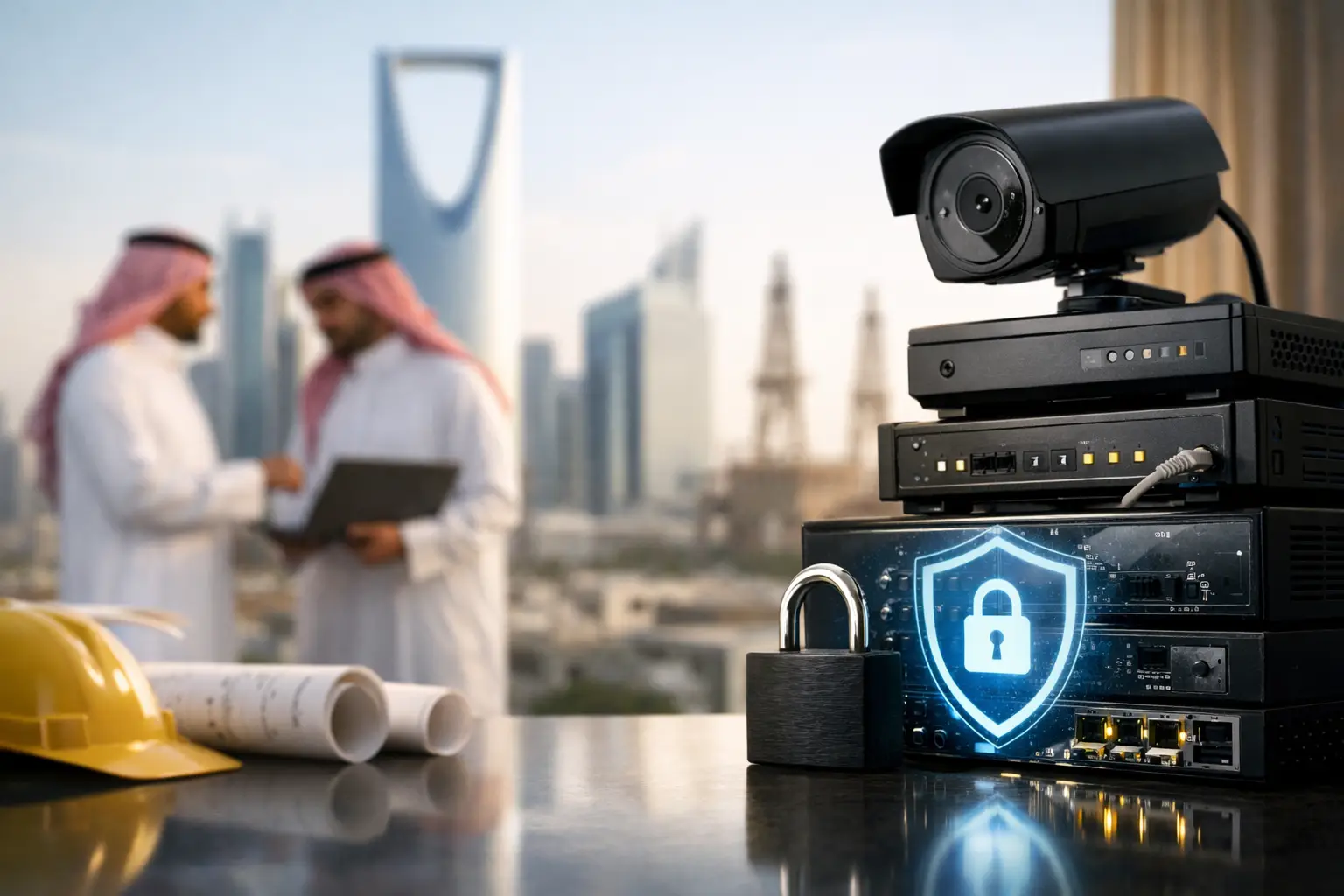
For government facilities, industrial sites, mixed-use developments, and Vision 2030 contractors, a single source security stack Saudi procurement team can rely on is not about buying every device from one manufacturer. It is about controlling compatibility, compliance, documentation, lead times, and technical accountability across the security package. When cameras, network infrastructure, access control, storage, and public address systems are sourced in isolation, the integrator inherits the coordination risk.
A practical stack starts with products that have clear roles. Milesight AI CCTV cameras. AETEKprovides PoE switches, extenders, and industrial network infrastructure. HID supplies access control readers and credentials. ITC covers PA, voice evacuation, conference, and IP audio systems. Rasilient, FIBRENETIX, and Dell provide different routes for surveillance servers, recording, and storage. Vanguard addresses body-worn video and evidence management rather than fixed CCTV.
The value of a coordinated source is not a promise that every project uses every brand. It is the ability to specify the right combination, verify the technical boundaries, and keep the procurement path consistent from a small commercial order to a major tender.
Why a single source security stack matters in Saudi
Saudi projects increasingly combine physical security, network availability, operational communications, and centralized monitoring. A camera package that looks complete on a bill of quantities may still fail at the infrastructure level if PoE power budgets, cable distances, storage throughput, or VMS interoperability were not considered early.
This matters especially in airports, logistics facilities, campuses, government compounds, industrial plants, hospitality developments, and giga-project zones. A 4K camera with AI analytics creates different bandwidth and retention requirements than a conventional 1080p camera. A PTZ positioned at a perimeter or port requires stable power and network connectivity. A voice evacuation system must be selected around zoning, amplifier capacity, speaker circuits, and applicable life-safety requirements, not simply around speaker quantities.
For consultants and procurement teams, the commercial advantage is equally significant. One specialized Saudi partner can coordinate product availability, datasheets, compliance evidence, matching accessories, and pre-sales technical clarification across the stack. Seven Sectors, headquartered in Jeddah and serving projects Kingdom-wide, supports this procurement model as an official AETEK partner and a local source for established international security brands.
Start with Milesight AI CCTV, not generic camera counts
The surveillance layer should begin with the operational question: what must the operator detect, identify, verify, or investigate? Camera quantity alone does not answer it. Milesight AI CCTV cameras allow integrators to match coverage and analytics to the scene rather than applying one camera type across an entire project.
For low-light external areas, Milesight TrueColor AI models and cameras with performance down to 0.002 Lux can support clearer usable video where conventional color imaging becomes limited. For scenes with difficult contrast, 140 dB WDR helps manage entrances, loading bays, glass-fronted lobbies, and vehicle approaches where bright backgrounds can obscure subjects.
Milesight Q Series panoramic cameras are appropriate where a wide scene must be monitored with fewer mounting positions. The range includes 360-degree fisheye and 180-degree dual-sensor options. Milesight PTZ models, with 12X to 23X optical zoom options, serve applications requiring active tracking or long-distance observation. The LPR Pro Bullet Plus Camera should be considered where vehicle identification is a defined requirement, not an assumed capability of every perimeter camera.
Analytics should also be specified with restraint. Milesight AI functions can reduce false alarms by up to 95% in suitable applications, but performance depends on camera angle, illumination, scene behavior, calibration, and the rules configured in the VMS. A project should validate the actual alarm scenario, such as human intrusion after hours or vehicle movement in a restricted lane, before presenting a false-alarm reduction figure as a site outcome.
For government and Vision 2030 procurement, Milesight NDAA-compliant options give consultants a clearer basis for compliance-led selection. The required model, firmware, recorder platform, and project specification should still be checked at submittal stage.
PoE is the layer that decides whether surveillance performs
AETEK is not a camera brand. Its role in the stack is PoE infrastructure, which directly affects camera uptime, transmission distance, enclosure suitability, and maintenance access. This is often the overlooked layer in a surveillance tender.
AETEK H-series outdoor PoE switches provide IP67 protection for exposed environments, including perimeter poles, parking areas, and external compounds. C-series switches fit indoor deployments, while D-series industrial switches are intended for demanding industrial conditions. Ceiling PoE Switches can simplify distributed coverage in ceilings where localized network access reduces long cable runs.
For long-distance camera points, AETEK PoE Extenders support transmission up to 250 meters, subject to the selected design and power requirements. They can reduce the need for intermediate power in suitable layouts, but the integrator must calculate camera consumption, switch power budget, cable quality, ambient conditions, and any heater or IR load. Distance alone is not a design approval.
AETEK products are Taiwan-made and NDAA/TAA-compliant, making them relevant where traceability and origin requirements influence the approved materials list. Selecting the switch at the same time as the camera avoids a common failure: specifying high-demand edge devices onto an undersized PoE network.
Add HID access control around identity and operations
Access control should not be treated as an isolated door hardware package. The correct HID architecture depends on credential policy, tenant needs, visitor workflows, controller integration, and the level of future expansion expected.
HID Signo readers support credential technologies including NFC, Bluetooth, and RFID. This gives project teams a practical route to conventional smart cards, mobile credentials, or a phased transition between both. A corporate office may prioritize mobile access for staff convenience, while a government or industrial facility may require formal card issuance, stronger credential governance, and defined audit procedures.
The procurement decision is not simply reader color or mounting style. It is whether the selected reader and credential ecosystem supports the organization’s required security policy over the project lifecycle. That distinction becomes important when a site expands from a few controlled doors to multiple buildings and operational zones.
Design communications as part of the security response
ITC systems bring the communication layer into the stack. In a security event, video identifies the situation, access control limits movement, and PA or IP audio directs people and staff. These systems should be coordinated rather than purchased as separate packages at the end of a project.
For standard zoned paging, ITC TI-1206S, TI-2406S, TI-3506S, and TI-5006S six-zone amplifiers offer an approach that includes MP3 capability. For larger multi-zone requirements with DSP, the TI-120Z, TI-240Z, TI-350Z, and TI-500Z series may be more appropriate. ITC also provides IP PA through its 77, 67, and 88 series network speakers and intercoms, plus voice evacuation platforms in the 6000, 6100, and 6200 series.
The selection depends on the application. A mosque, airport terminal, stadium, command center, or industrial plant will have very different zoning, intelligibility, paging priority, and evacuation requirements. For meeting environments, ITC TS-0305 and TS-0305A full-digital chairman and delegate units, along with TS-0699 video tracking control, can support integrated conference operations where required.
Recording and storage cannot be an afterthought
The surveillance server layer must be sized for camera count, resolution, frame rate, retention, analytics, redundancy, and the selected VMS. It should not be based on raw terabyte capacity alone. Recording performance is shaped by sustained write workloads, readback during investigations, failover strategy, and the behavior of the VMS database.
ISS SecurOS offers VMS editions ranging from Professional and Premium to Enterprise and MCC. Its platform supports functions including LPR, facial recognition, and behavior analytics, with deployments including Saudi border environments. This makes SecurOS relevant for projects that need a scalable VMS rather than a basic recorder interface.
Rasilient provides VMS-agnostic surveillance servers and forensic storage, including PixelStor, ApplianceStor 1U and 3U NVR platforms, and NFDCloud. Its NFD approach is designed around No Frames Dropped performance, a serious requirement for evidence-led surveillance environments. FIBRENETIX offers enterprise CCTV servers, NVRs, and surveillance storage, while Dell PowerEdge servers, Precision workstations, and PowerVault storage offer another established infrastructure path for VMS deployments.
There is no universal winner between these options. A smaller site may need a focused NVR architecture, while a city-scale or high-retention project may require enterprise storage, redundancy, and a VMS platform capable of managing multiple sites. The right decision comes from workload definition, not brand substitution.
Procurement discipline is the real advantage
A single-source approach works when it preserves technical choice while reducing procurement uncertainty. Require exact part numbers, approved equivalents only where justified, compliance documentation, power and storage calculations, and a clear definition of what belongs to the camera, network, VMS, access, and audio scopes.
For NDAA/TAA-sensitive tenders, compliance must be verified at the product and project level. For operationally critical projects, request clarity on warranty handling, replacement availability, firmware support, and compatibility with the specified platform. These are not administrative details. They determine whether an installed system remains supportable after handover.
The strongest security stack is the one your integration team can defend in a submittal meeting, deliver within the project schedule, and support through the full operating life of the facility. Start with the site risks and operational workflow, then source each layer with the same level of discipline.
A single-source stack also needs the right storage backbone — see our overview of the best surveillance servers for giga-projects.
Ready to discuss your project? Contact Seven Sectors or contact us directly on +966-012 229 3474.