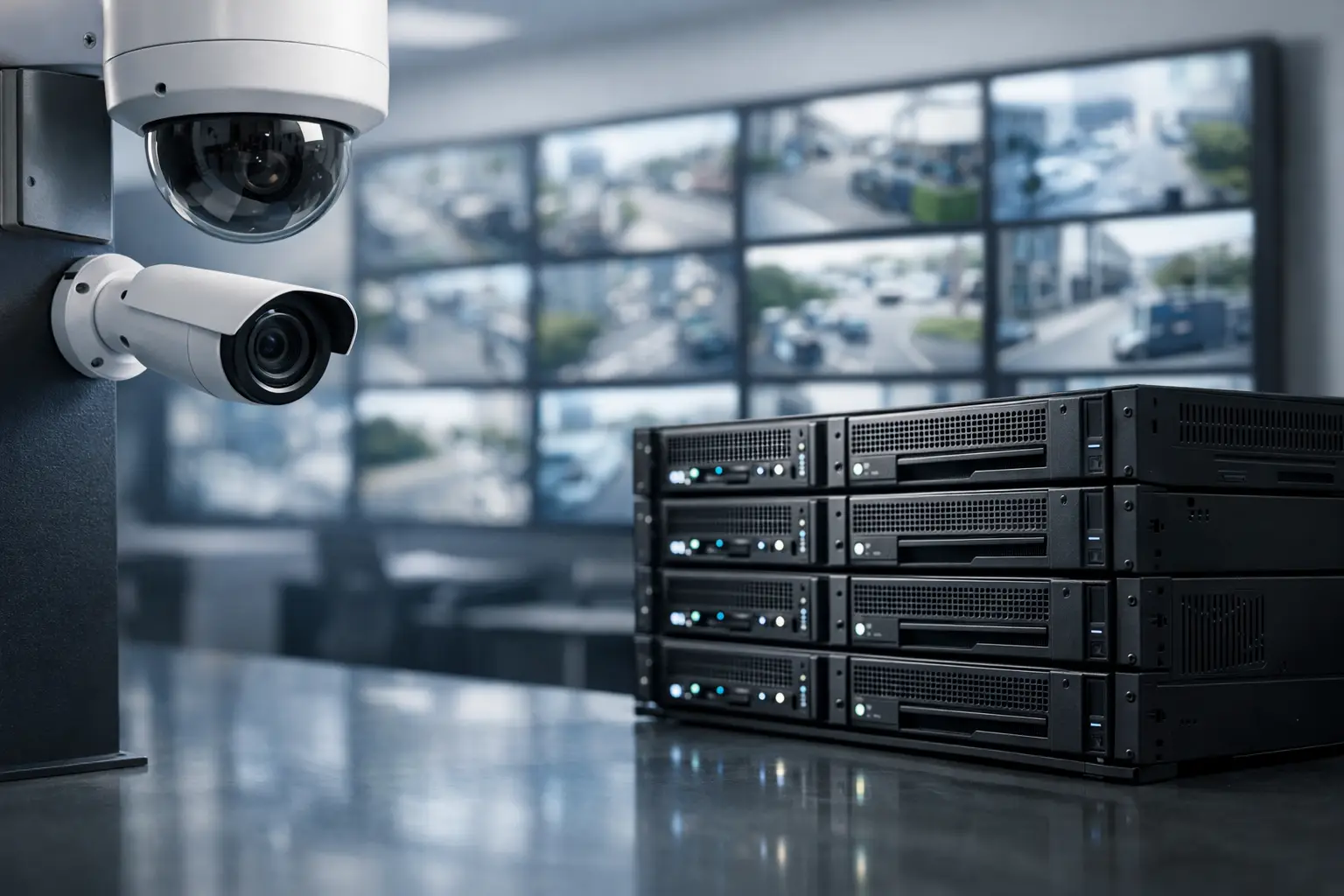
A giga-project can deploy thousands of cameras across perimeter roads, utilities, visitor zones, worker accommodation, ports, public spaces, and critical facilities. In that environment, selecting the best surveillance servers for giga projects requires more than a camera count. The right platform must sustain recording under load and preserve evidence when network conditions vary. It must also integrate with the specified VMS and support a storage strategy that remains practical for years of operation.
For Saudi Vision 2030 contractors, consultants, and government procurement teams, Rasilient surveillance servers and forensic storage provide a strong primary platform for this requirement. Rasilient is built for video-centric workloads rather than general-purpose IT tasks, with solutions used in government, oil and gas, smart city, and large-scale surveillance environments. Seven Sectors is the authorized Saudi partner supporting system integrators with Rasilient, FIBRENETIX, Dell, and the surrounding surveillance infrastructure required for serious projects.
Why Rasilient Fits Giga-Project Surveillance
The server room is often treated as a back-end detail during early CCTV planning. That approach creates risk. A project may specify high-resolution AI cameras, panoramic coverage, long retention periods, and centralized monitoring. Late in the process, teams can discover that the recording platform cannot sustain the combined bandwidth, storage throughput, and failover expectations.
Rasilient addresses this issue with purpose-built surveillance recording and storage platforms. Its No Frames Dropped, or NFD, architecture is central to the value proposition. For a security operation, losing frames during a high-traffic event is not a minor performance issue. It can mean missing vehicle identification, incomplete incident evidence, or unusable footage during an investigation. NFD is designed to prioritize continuous video ingest even as storage capacity and camera volumes increase.
That distinction matters on sites where Milesight AI cameras are generating more than basic motion recordings. A Milesight Pro Series camera, PTZ, Q Series panoramic camera, or LPR Pro Bullet Plus Camera can provide high-value video and analytics. The recording platform must be able to retain that evidence consistently while the VMS manages live viewing, playback, alarms, user permissions, and incident workflows.
Best Surveillance Servers for Giga Projects: Selection Criteria
A server specification should begin with the operational design, not a generic hardware data sheet. The correct Rasilient configuration depends on camera count, resolution, frame rate, codec, retention target, VMS architecture, and recording policy. It also depends on where analytics run: at the camera edge, on the VMS server, or on dedicated compute resources.
Recording throughput matters more than headline capacity
Raw storage capacity can look impressive in a tender response, but capacity alone does not confirm that a platform can record every stream reliably. A server must accept simultaneous camera writes. It must also support VMS queries, playback requests, health monitoring, replication, and occasional high-demand investigation sessions.
For example, a mixed estate of 4K perimeter cameras, 360-degree fisheye cameras, and PTZ cameras needs a different throughput profile than a uniform deployment of fixed 1080p cameras. Variable bitrate recording adds another consideration. Scene activity, weather, vehicle movement, and low-light conditions can all change the real bandwidth requirement.
Rasilient PixelStor is relevant where the project needs scalable forensic storage for high-volume video. ApplianceStor 1U and 3U NVR options can suit different density and rack-space requirements. The appropriate choice should follow a documented camera and retention calculation, with a sensible allowance for expansion rather than an optimistic average bitrate estimate.
Confirm VMS compatibility early
Large projects frequently standardize on a VMS before finalizing the recording architecture. Rasilient is VMS-agnostic and supports environments including ISS SecurOS and Milestone. Consultants and integrators can therefore select storage based on recording performance and lifecycle requirements, without forcing a change in the VMS layer.
ISS SecurOS is particularly relevant for enterprise and command-center applications. Its Professional, Premium, Enterprise, and MCC options support deployments ranging from site-level monitoring to centralized operations with analytics, license plate recognition, facial recognition, and behavioral detection. The storage platform must complement this operating model, especially where multiple sites report to a central control room.
Compatibility, however, is more than confirming that two products connect. The project team should validate supported versions, camera stream settings, failover behavior, and health alarms. Evidence export method and archive retrieval performance also require confirmation. Complete these checks before locking quantities into the final bill of materials.
Retention policy drives architecture
A 30-day retention requirement and a 180-day retention requirement are fundamentally different infrastructure decisions. The same applies when continuous recording combines with event-based recording. Projects requiring higher retention for perimeter cameras, cash-handling areas, access points, and critical infrastructure face even larger storage decisions.
Retention planning should account for usable capacity rather than nominal disk capacity. RAID protection, hot spares, filesystem overhead, expansion reserves, and the required recording performance all affect the final result. Procurement teams should also define whether archived footage will remain on-site, replicate to a secondary location, or extend to a cloud model such as Rasilient NFDCloud.
Cloud storage can be useful for selected evidence, remote resilience, and distributed operations, but it is not automatically the right destination for all continuous video. Assess bandwidth availability, data sovereignty, upload cost, recovery time, and policy requirements carefully. For many high-volume Saudi projects, a tiered approach using local forensic storage with controlled off-site replication is more realistic than moving every camera stream to the cloud.
Building the Supporting Infrastructure
A surveillance server performs only as well as the network delivering video to it. This is where the complete solution stack matters. Milesight AI cameras can reduce unnecessary alarms through intelligent detection, while their TrueColor AI technology, low-light performance down to 0.002 Lux on applicable models, and 140 dB WDR capabilities support demanding scenes. Yet higher-value video also requires disciplined network and storage planning.
AETEK provides the PoE infrastructure that connects and powers cameras in field conditions. Its H-series outdoor PoE switches are IP67-rated for exposed deployments, while C-series indoor and D-series industrial switches address cabinet, building, and industrial requirements. AETEK PoE extenders can support distances up to 250 meters where conventional Ethernet runs are impractical. AETEK is a PoE infrastructure brand, not a camera manufacturer, and its role is to provide dependable power and network connectivity at the edge.
For the server layer, FIBRENETIX enterprise CCTV servers and NVRs provide an additional purpose-built option when the project requirements call for a different platform or form factor. Dell PowerEdge servers, Precision workstations, and PowerVault storage are also suitable building blocks for VMS infrastructure where the design requires a conventional enterprise server and storage architecture. These options are not interchangeable by default. Rasilient is the stronger primary consideration where forensic recording continuity and video-optimized storage matter most. Dell suits compute, management, and broader IT-standardized infrastructure. FIBRENETIX addresses enterprise CCTV server and NVR needs in a defined surveillance design.
Compliance and Procurement Control
Address NDAA and TAA requirements at the specification stage, not after equipment approval. Government and Vision 2030 projects can require verified supply-chain compliance across cameras, networking, servers, software, and accessories. Milesight cameras are NDAA-compliant, and AETEK’s Taiwan-made PoE infrastructure is NDAA/TAA-compliant. For server and storage procurement, the project team should confirm the exact configuration, country-of-origin requirements, firmware policy, and documentation required by the end user.
This is especially relevant when procurement packages are split among CCTV, ICT, access control, and command-center scopes. A server may meet performance expectations but still create approval delays if compliance records, warranty coverage, or compatibility evidence are incomplete. A qualified local partner can help integrators source the specified brands with clearer product traceability and project documentation.
Questions to Resolve Before Ordering
Before selecting a final server quantity, establish the real camera schedule, including planned expansion. Confirm the required resolution, frame rate, codec, recording mode, and retention period for each camera group. Define the VMS version, number of concurrent operators, central monitoring requirement, and any failover or disaster-recovery expectation.
Also clarify whether AI analytics are executed in the Milesight camera, within ISS SecurOS, or through separate analytics compute. Do not add these workloads to a recording server without prior validation. Finally, review rack space, power availability, cooling, UPS autonomy, network uplinks, and the process for replacing failed drives without interrupting evidence retention.
A properly specified surveillance server is an evidence platform, not simply a box of disks. The right decision protects recording continuity today while leaving the project room to grow without a disruptive redesign.
For Rasilient surveillance servers, forensic storage, FIBRENETIX NVRs, Dell VMS infrastructure, and compatible Milesight and AETEK solutions, contact Seven Sectors at info@7sectors.com or submit the website Get Quotation form for pricing and availability. Bring the camera schedule and retention requirement to the first discussion – that is where a dependable server specification starts. For contractors working on the Red Sea Project specifically, see our Red Sea Project security systems partner page.
nnFrequently Asked Questions — Surveillance Servers for Saudi Giga Projects
nnRasilient purpose-built surveillance servers are designed for high-camera-count, high-retention video workloads across government, oil and gas, and smart-city environments — environments that closely match Vision 2030 giga-project requirements. FIBRENETIX enterprise surveillance servers and Dell PowerEdge servers also serve different parts of the recording infrastructure. Seven Sectors supplies all three platforms.
NFD is Rasilient's recording architecture that ensures zero recording gaps under sustained workloads. On a giga project with thousands of cameras, standard server hardware can drop frames during peak load — creating incomplete evidence records. Rasilient NFD platforms maintain continuous recording integrity, which is critical for forensic evidence, audit trails, and incident investigation.
A standard IT server is optimized for general compute or database workloads. Rasilient servers are purpose-built for video-centric tasks: sustained write throughput, high camera stream concurrency, forensic-grade storage redundancy, and VMS-optimized performance. The hardware and operating configuration are designed to sustain surveillance workloads that general-purpose servers underperform under load.
Rasilient servers are VMS-agnostic and validated with ISS SecurOS, Milestone, Genetec, and other major video management platforms. Seven Sectors typically pairs Rasilient with ISS SecurOS for Saudi projects. Contact us if you require validation information for a specific VMS platform on your project.
Storage sizing requires camera count, resolution, frame rate, compression, retention period, and recording mode (continuous or motion-triggered). Seven Sectors performs project-specific storage calculations using the Rasilient or FIBRENETIX platform matched to the VMS specification. Contact us with your camera schedule for a storage architecture recommendation.
Planning security infrastructure for Qiddiya? See our guide to Qiddiya security systems and AV infrastructure for a full breakdown of authorized partner brands suited to Saudi Arabia’s giga-entertainment city.
nnnContractors and consultants working on projects such as Diriyah Gate in Riyadh can find a full overview of our security and AV capabilities on our Diriyah Gate security systems partner page.
nSee the full Surveillance Storage & Servers overview for the complete Rasilient, Dell and Fibrenetix range.
Ready to discuss your project? Contact Seven Sectors or contact us directly on +966-012 229 3474.