
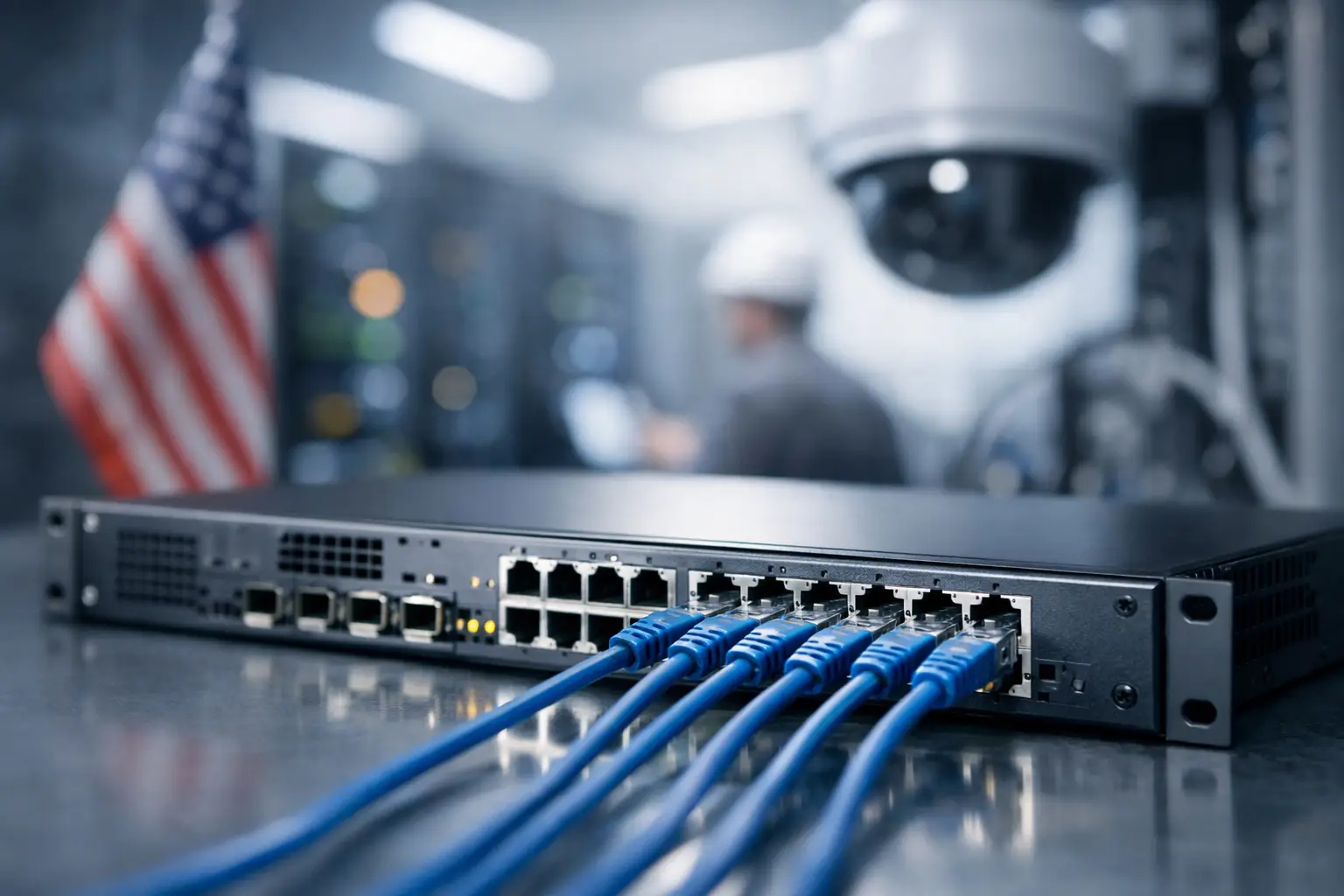
A PoE switch can become a tender compliance issue long before it becomes a network issue. For government facilities, critical infrastructure, and projects carrying U.S.-linked procurement requirements, project teams must specify TAA compliant PoE switches with the same care as cameras, servers, and access-control hardware. A switch that looks suitable on a datasheet may still fail a submittal if the procurement team cannot verify its country of origin, manufacturer documentation, or supplied configuration.
For Saudi system integrators, consultants, and procurement teams, the requirement is increasingly relevant on Vision 2030 developments and security projects where compliant supply chains matter. AETEK PoE infrastructure gives project teams a Taiwan-made option for indoor, industrial, and outdoor network edge deployments, with NDAA/TAA-compliant product selections available through Seven Sectors, the authorized Saudi partner.
TAA Compliance Is a Supply-Chain Requirement
The Trade Agreements Act, or TAA, is commonly referenced in procurement programs that require products to be manufactured or substantially transformed in designated countries. Taiwan is a designated country under the relevant U.S. trade agreements framework. That is why Taiwan-made AETEK equipment can be relevant where project specifications include TAA compliance requirements.
However, “TAA compliant” should never be treated as a generic product label. Compliance depends on the specific model, its declared country of origin, and the documentation available for the shipment. A procurement team should obtain confirmation for the exact PoE switch being quoted, rather than assume that every switch within a manufacturer’s catalog has identical compliance status.
TAA and NDAA are also different requirements. NDAA restrictions address the use of certain covered telecommunications and video-surveillance equipment and services. TAA concerns the product’s eligible country of origin for applicable procurement. Many government and critical-infrastructure specifications ask for both. An AETEK switch selection can support this direction, but the tender requirement should be reviewed line by line before submission.
Why the PoE Switch Matters to the Whole Security System
A PoE switch is not simply a port-count decision. It supplies power, transports video and control traffic, and often sits at the edge of a surveillance or access-control network where cable routes are longest and field conditions are hardest.
A Milesight AI camera with TrueColor performance, a Milesight PTZ, or an HID Signo reader only performs as intended when the network edge provides stable power and the required bandwidth. The switch must handle normal operating load as well as startup demand, infrared activation, heater operation where applicable, and possible future device additions. Underpowered switching can create intermittent camera reboots that technicians find difficult to isolate after commissioning.
For larger surveillance deployments, uplink capacity deserves equal attention. A group of high-resolution cameras can quickly saturate a 1GbE uplink, particularly when several channels send continuous streams to a central VMS and storage environment. The right architecture may require fiber uplinks, managed switching, VLAN segmentation, and capacity planning between the field cabinet, core network, ISS SecurOS environment, and recording platforms from Rasilient, FIBRENETIX, or Dell.
The practical point is simple: compliance gets the product accepted, but engineering suitability keeps the system operating.
Select the AETEK Series Around the Deployment Environment
AETEK offers PoE infrastructure for distinct field conditions. Choosing the series around the environment avoids a common tender mistake: specifying indoor network hardware for locations that need industrial or weatherproof protection.
C-Series for Indoor Network Edges
AETEK C-Series switches suit indoor applications such as commercial buildings, control rooms, office areas, retail facilities, and protected telecom rooms. They are a practical fit where switch placement is controlled and the design needs standard network distribution to cameras, access-control panels, or other PoE devices.
For these installations, the key questions are port count, managed versus unmanaged operation, PoE budget, uplink interface, and rack or wall-mount arrangement. A switch with enough ports but insufficient aggregate power is not an equivalent substitute. Procurement schedules should state both the required number of powered ports and the minimum total PoE power budget.
D-Series for Industrial Locations
Industrial sites need more than a standard indoor switch. Utilities, transport facilities, perimeter installations, warehouses, and oil-and-gas-related environments can involve electrical noise, wider temperature variation, DIN-rail mounting, and cabinet constraints. AETEK D-Series industrial PoE switches serve this class of deployment.
The specification should identify the site conditions instead of merely calling for an “industrial switch.” Ask whether the equipment will sit inside a conditioned cabinet, an outdoor enclosure, or near plant equipment. Confirm the available input power, grounding arrangement, fiber requirements, and whether surge protection is provided at the cabinet and cable-entry level.
H-Series for Exposed Outdoor Deployments
Outdoor surveillance projects often fail at the cabinet boundary. Where a switch must be placed close to cameras on a perimeter, roadway, port, campus, or large construction zone, the AETEK H-Series provides IP67 outdoor PoE switching options.
An IP67 enclosure addresses dust and water ingress, but it does not remove the need for correct mounting, cable-gland selection, grounding, and surge protection. Consultants should also consider service access. A fully sealed outdoor switch is valuable only if technicians can inspect connections and replace components without disrupting adjacent coverage zones.
Power Budget Must Be Calculated, Not Assumed
The IEEE PoE standard shown on a product sheet is only the starting point. The design must calculate the power requested by every endpoint, allow for cable loss, and leave a realistic reserve. This is especially relevant for PTZ cameras, cameras with integrated illumination, and multi-sensor devices.
Start with the manufacturer’s maximum power requirement for each device, not only its typical draw. Then total all connected endpoints and compare the result with the switch’s available PoE budget. Do not confuse a power supply’s rating with the actual PoE budget available to ports. A margin is necessary for startup demand, aging power supplies, ambient temperature effects, and future expansion.
Long cable routes add another complication. Copper Ethernet runs are typically limited to 100 meters, and voltage drop becomes more relevant as distance and load increase. AETEK PoE extenders can extend PoE connectivity up to 250 meters in appropriate designs, reducing the need for a local AC power source near a remote camera. This can be valuable for gates, perimeter zones, parking areas, and large compounds, but the end-to-end power calculation still applies. Engineers must assess extension distance, cable quality, endpoint consumption, and switch output together.
Managed Features Should Match the Security Design
Not every field switch requires advanced management. In a small, isolated group of fixed cameras, a simpler topology may be appropriate. In a multi-building campus, airport, government complex, or command-center project, managed switching can provide meaningful operational control.
VLANs can separate video, access control, management, and business traffic. QoS can help prioritize traffic where network paths are shared. Port monitoring and event logs can shorten troubleshooting when an endpoint drops offline. Fiber uplinks can provide electrical isolation and longer-distance connectivity between field zones and central network rooms.
These features only add value when they are included in the network design and documented for handover. Teams should not specify a managed switch merely because it has more features. They should select it because the project requires segmentation, monitoring, redundancy, or controlled access at the network edge.
Documentation Should Be Part of the Quote Package
For TAA-sensitive projects, project teams should request compliance paperwork at quotation stage, not after the purchase order is issued. This protects the integrator from late substitutions and protects the consultant from approving equipment that cannot be supported with evidence.
A complete review normally includes the exact AETEK model number, country-of-origin confirmation, TAA compliance statement where required, NDAA statement where required, manufacturer datasheet, PoE power budget, enclosure rating for outdoor models, and warranty details. If the tender requires a particular certificate format or project-specific declaration, clarify it before the supplier releases materials.
Part-number discipline matters. A similar switch from the same manufacturer may have a different port configuration, power supply, uplink type, or origin declaration. The approved submittal, quote, purchase order, and delivered carton should all refer to the same model.
A Practical Specification Approach for TAA Compliant PoE Switches
A strong specification describes the job the switch must perform. It should define the required TAA and NDAA status, country-of-origin documentation, environmental class, powered port count, PoE standard and total budget, uplink requirement, managed-network functions, mounting method, and any extension requirement.
This approach gives bidders a clear basis for offering the correct AETEK series instead of treating all PoE switches as interchangeable. It also makes evaluation easier when a project includes indoor areas, outdoor perimeter coverage, industrial facilities, and long-distance camera runs within one package.
For projects in Saudi Arabia, the right supply partner can help keep compliance documentation, product availability, and approved technical selections aligned from the initial bill of quantities through delivery. Seven Sectors supports system integrators, consultants, and procurement teams with AETEK TAA-compliant PoE switch options for government, commercial, and critical-infrastructure requirements.
Specify the evidence as carefully as the hardware. Contact Seven Sectors at info@7sectors.com or submit the website Get Quotation form for pricing, availability, and project-specific AETEK compliance documentation.
Frequently Asked Questions
What does TAA-compliant mean for a PoE switch?
TAA (Trade Agreements Act) compliance means the switch is manufactured or substantially transformed in a country that has a trade agreement with the United States, as defined by U.S. GSA procurement rules. In practice, TAA-compliant switches are manufactured in countries such as Taiwan, not in China, Russia, or other excluded countries. For Saudi government projects with U.S.-linked procurement frameworks or for giga-project developers aligned with international procurement standards, TAA compliance is a submittal requirement for network infrastructure.
Are AETEK PoE switches TAA and NDAA compliant?
Yes. AETEK switches are manufactured in Taiwan and meet both TAA and NDAA Section 889 compliance requirements. This makes AETEK the recommended PoE infrastructure brand for Saudi government facilities, critical infrastructure, and Vision 2030 projects where compliant supply chains are specified. Seven Sectors can provide compliance documentation and letters of conformity on request.
Which AETEK switch series should be specified for an outdoor Saudi government site?
The AETEK H-series outdoor switches (IP67-rated) are the correct choice for perimeter, gate, and field-deployment nodes on Saudi government and infrastructure sites. They provide TAA/NDAA-compliant PoE infrastructure in a weatherproof housing suited to the Saudi climate without requiring a separate outdoor enclosure. The C-series is used for indoor distribution in data rooms and riser closets.
Can TAA-compliant PoE switches support AI cameras with high power draw?
AETEK H-series and C-series switches support PoE+ (802.3at) and PoE++ (802.3bt) depending on the model, providing sufficient power for Milesight AI cameras including PTZ and multi-sensor models. Confirming the per-port and total PoE budget against the camera schedule is essential during design. Seven Sectors can review the camera schedule and recommend the correct AETEK switch model for your project.
Ready to discuss your project? Contact Seven Sectors or contact us directly on +966-012 229 3474.