
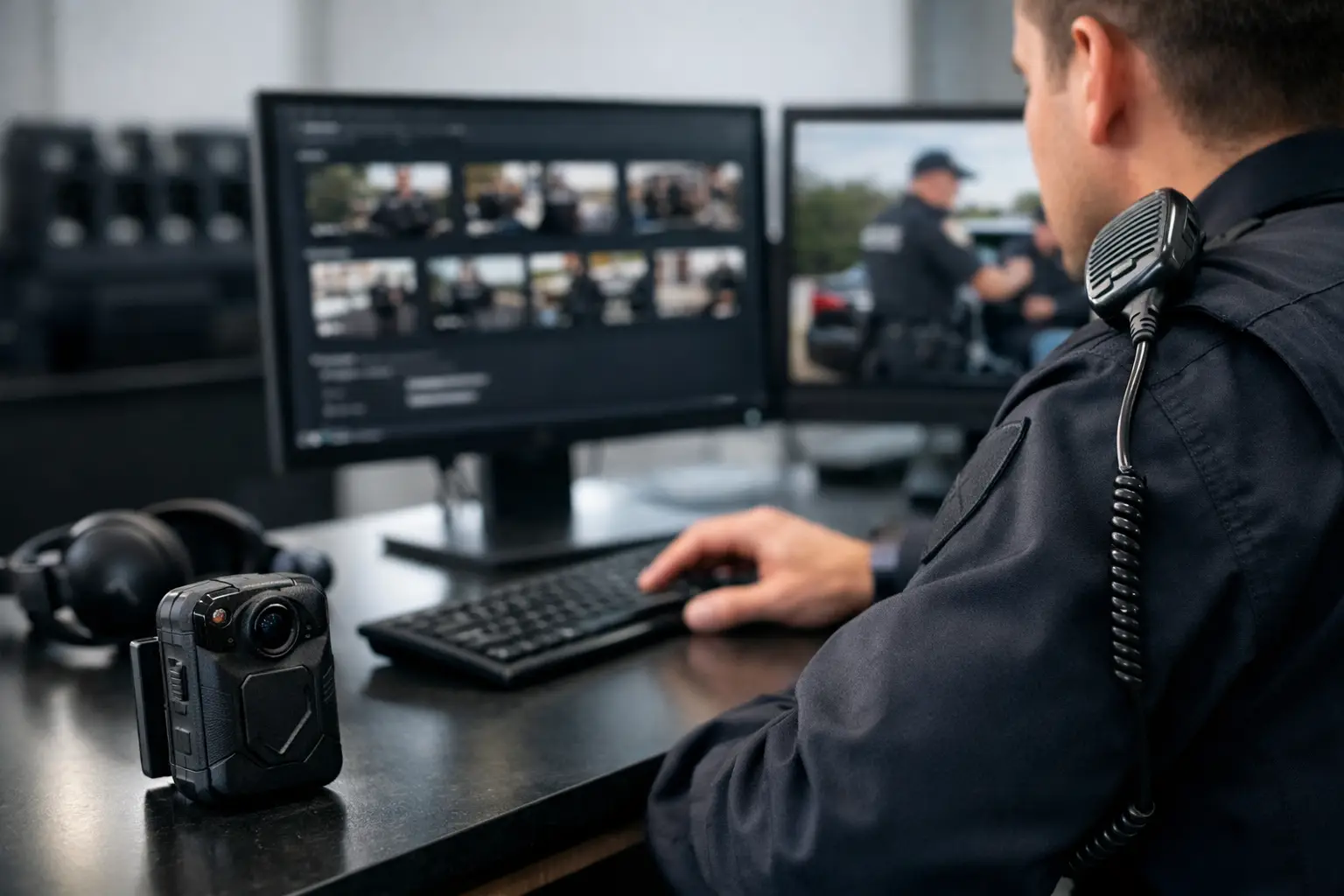
A body-worn camera program becomes difficult to defend the moment footage leaves the device without a controlled process. A digital evidence management system gives security teams, government entities, and industrial operators a structured way to ingest, store, review, share, and retain Vanguard body-worn camera evidence without losing the chain of custody.
For Saudi projects, this is not simply a storage requirement. Procurement teams must consider user accountability, audit records, retention policy, cybersecurity controls, and legal disclosure procedures. The platform must also scale from a limited guard-force deployment to a multi-site operation. The camera captures the event. The evidence management environment determines whether that recording remains usable, verifiable, and accessible when it matters.
Why a Digital Evidence Management System Matters
Body-worn video creates a different evidence workflow from fixed CCTV. A Milesight camera connected to an ISS SecurOS VMS may record continuously or by event to a controlled surveillance environment. A Vanguard BWC-103W, by contrast, is carried by personnel who work across entrances, patrol routes, public-facing checkpoints, loading areas, transport operations, and incident scenes.
That mobility creates operational risk. Shifts may delay footage return, devices may arrive back at irregular times, and supervisors may need to locate a short incident clip among many hours of routine recordings. Without a digital evidence management system, files can end up on local computers, external drives, or informal shared folders. None of these methods provides the control expected for a government facility, critical infrastructure site, or large commercial security operation.
A proper system creates a documented path from capture to review. The system associates evidence with the relevant officer, device, date, time, case number, incident category, and authorized reviewer. The platform should preserve the original file. It records who accessed it, what was exported, and when each action occurred. This auditability is central to evidential integrity.
The Difference Between Video Storage and Evidence Management
Surveillance storage and evidence management solve related but separate problems. Rasilient forensic storage, including NFD architectures designed for no frames dropped recording, supports high-volume CCTV retention where recording continuity is critical. FIBRENETIX enterprise CCTV servers and Dell PowerEdge, Precision, and PowerVault infrastructure also support the compute and storage requirements around VMS environments.
A digital evidence platform is more focused on the evidence lifecycle. It must make it practical to collect footage, classify it, and protect it from unauthorized alteration. It must also apply retention rules and retrieve recordings quickly during an investigation or review. The appropriate design depends on the deployment. A command center may need both: high-capacity infrastructure for fixed surveillance and a dedicated evidence workflow for personnel-worn video.
This distinction is useful during tender specification. Calling for “video storage” alone can leave critical requirements undefined, such as evidence tagging, immutable audit history, role-based user permissions, controlled exports, and case-based access. Consultants should state the workflow they expect, not only the storage capacity they require.
What to Specify for Vanguard Body-Worn Camera Evidence
When evaluating a Vanguard body-worn camera program, start with the operational workflow rather than a feature checklist. Determine who wears the cameras, where they return at the end of shift, who is permitted to review footage, and how incidents are escalated. The answers define the required charging, upload, review, and retention process.
Chain of Custody Must Be Visible
The system should maintain an auditable record from the point evidence is imported. At a minimum, procurement specifications should require logs for upload activity, user access, review, annotation, export, deletion actions, and administrative changes. Supervisors need to know whether a file is original evidence, a reviewed copy, or an export created for a specific authorized purpose.
Chain of custody is not only relevant after a major incident. It protects routine operations as well. A complaint at a visitor screening point, a disagreement during a patrol, or an incident at a logistics gate may require quick review weeks later. Clear audit records reduce uncertainty for the operator, the security provider, and the end customer.
Access Should Follow Job Roles
Not every user needs the same visibility. An officer may require access to assigned recordings, while a shift supervisor requires incident review privileges. Investigators may need case-level access, and system administrators may manage devices and users without needing unrestricted access to sensitive video.
Teams should therefore define role-based access control as a requirement. Teams should also decide whether users need multi-factor authentication and whether external parties can receive controlled exports. They should define how quickly managers can remove access when personnel change roles. These decisions depend on the customer’s security policy, but leaving them until commissioning often creates delays and inconsistent practice.
Retention Needs a Written Policy
Retention is a balancing exercise. Keeping all body-worn video indefinitely increases storage demand, administrative exposure, and the volume of material that must be managed. Retaining footage for too short a period can create problems when a complaint, insurance issue, or investigation appears after the standard deletion window.
A practical policy commonly separates routine footage from tagged incidents. Routine recordings may follow a defined retention schedule. The system preserves footage connected to an investigation, security breach, or formal complaint under a separate hold process. The exact period should be set by the end customer’s legal, operational, and procurement requirements. The evidence system must make that policy enforceable, not dependent on manual reminders.
Search and Classification Affect Response Time
Evidence is only useful if authorized teams can find it. Specify searchable fields that match real operations: officer or device identity, time range, location, incident type, case reference, and assigned tags. If a facility uses multiple guard contractors or operates across Riyadh, Jeddah, Dammam, or remote project sites, consistent naming rules become especially important.
Before deployment, agree on a classification structure. For example, “access dispute,” “perimeter patrol,” “visitor incident,” and “vehicle checkpoint” are more useful than free-text descriptions that vary by user. Good classification reduces the time spent manually reviewing footage and produces more consistent incident records over the life of the program.
Integration Should Be Planned, Not Assumed
A body-worn camera evidence system does not have to replace the customer’s existing security environment. It may operate alongside ISS SecurOS for fixed camera monitoring, HID Signo access control for door events, and network infrastructure supplied through AETEK PoE switches for the wider surveillance estate. AETEK is relevant to fixed-device network design, including IP67 H-series outdoor PoE switches and industrial D-series equipment, but it is not a body-worn camera solution.
The integration question is not whether every system should be connected. It is whether a defined operational benefit justifies the integration. A security control room may benefit from correlating an access event or fixed-camera alarm with a related body-worn video incident. In another deployment, separation may be preferred to limit user access and keep evidence workflows tightly controlled.
For this reason, integrators should verify available interfaces, export formats, user authentication methods, and data ownership requirements during the specification stage. Avoid broad language such as “fully integrated” unless the exact workflow has been validated for the proposed solution.
Compliance and Procurement Considerations in Saudi Arabia
Government, infrastructure, and Vision 2030 projects increasingly require documented product origin, cybersecurity review, and compliance alignment. Teams should address NDAA and TAA compliance early where tender requirements call for them. It is equally important to request product documentation, confirm the supported evidence workflow, and establish which party is responsible for administration after handover.
For a body-worn camera deployment, the procurement package should define device quantities, charging and upload arrangements, and evidence platform licensing or capacity. It should also specify user roles, retention expectations, training responsibilities, and support procedures. These elements are connected. Ordering cameras without sizing the evidence workflow is a common cause of delayed rollout.
Seven Sectors works with system integrators, consultants, and procurement teams that need a dependable local source for Vanguard body-worn camera and evidence management requirements. As an authorized Saudi partner for established security technologies, we help customers source the right components with clear product documentation and project-focused availability.
For pricing, availability, and support in specifying a Vanguard digital evidence management system for your next project, contact Seven Sectors at info@7sectors.com or submit the website’s Get Quotation form. A well-defined evidence workflow gives the camera program a clear purpose long after the recording stops.
Ready to discuss your project? Contact Seven Sectors or contact us directly on +966-012 229 3474.