
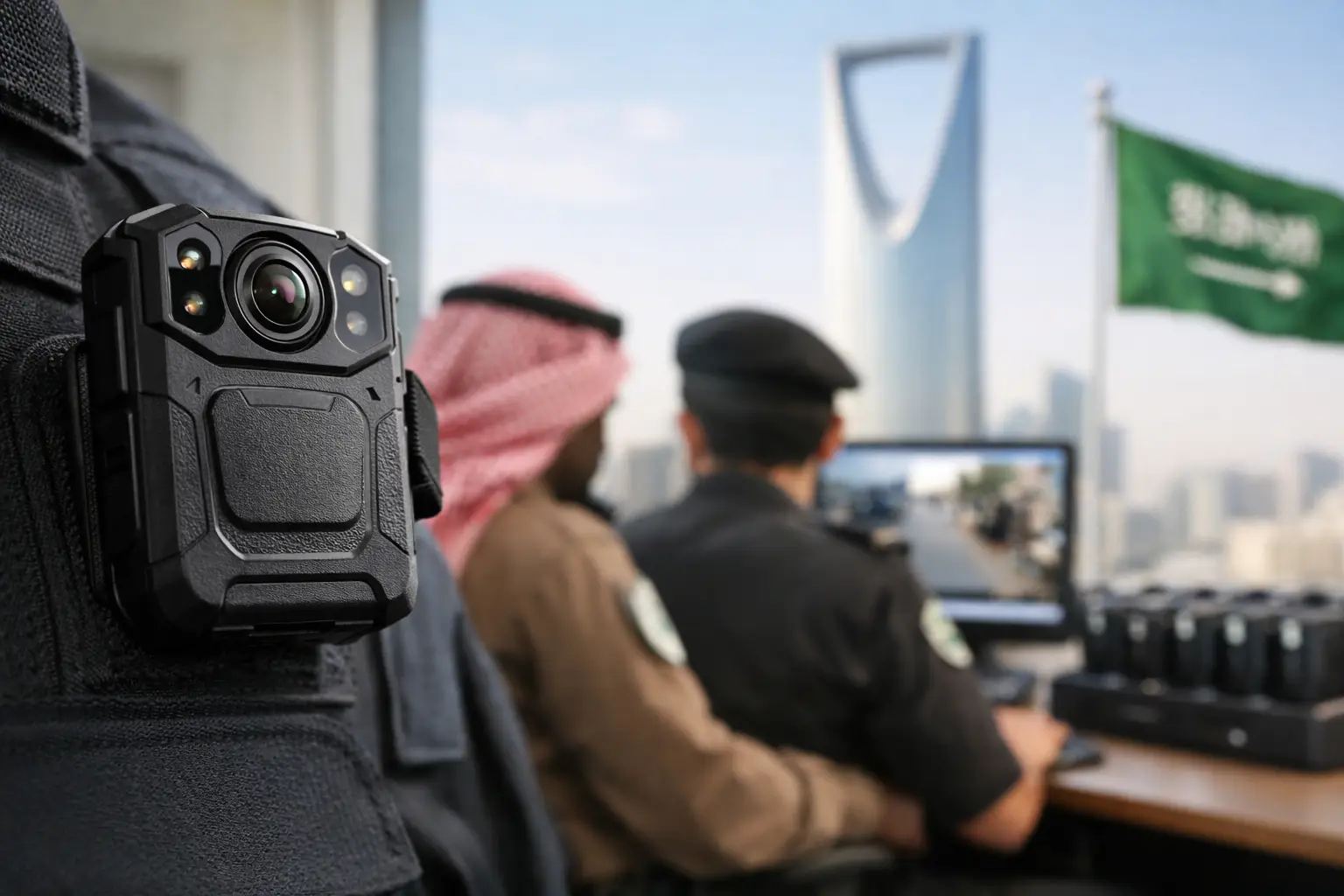
A body-worn camera project can fail long after the camera captures the footage. The critical question is whether an authorized reviewer can locate the original file, confirm who handled it, and produce it without doubt. That test arrives when an incident becomes a complaint, investigation, or legal matter. That is the operational issue behind body camera evidence management requirements in Saudi Arabia.
Saudi government facilities, industrial operators, transport sites, and major project contractors should specify the Vanguard BWC-103W body-worn camera as part of an evidence workflow, not as an isolated wearable device. The camera creates the record in the field. Evidence management determines whether that record remains controlled, searchable, available, and defensible.
The BWC-103W Is Only One Part of the Evidence Chain
The Vanguard BWC-103W suits personnel who need to document frontline interactions and operational events. Typical users include security officers, patrol teams, inspectors, enforcement personnel, site safety teams, and field supervisors. Its value is immediate at the point of capture. A properly managed deployment, however, continues through upload, indexing, review, retention, export, and eventual disposal.
Procurement teams should therefore avoid treating body-worn cameras as a simple quantity-and-accessories purchase. A tender that specifies only camera count, storage capacity, and docking hardware leaves major questions unanswered. Who may view footage? Can an administrator alter retention rules? How does evidence reach an investigator? Does the system retain the original when a user exports a clip? What audit record proves the sequence of activity?
These are evidence-management questions, and they affect the credibility of the whole deployment.
Vanguard BWC-103W Body Camera Evidence Management in Saudi Arabia
Saudi projects commonly involve multiple stakeholders: a security service provider, the facility owner, a consultant, an internal compliance team, and sometimes government investigators. Evidence management must accommodate this reality without allowing broad, uncontrolled access to sensitive recordings.
A sound Vanguard BWC-103W workflow begins with clear assignment. Teams should associate each device with a defined user, shift, department, or operational unit according to the customer’s policy. That association makes later searches meaningful. Searching by a vague incident date is inefficient; searching by officer, device, location, time window, and incident reference is operationally useful.
Once footage enters the evidence environment, role-based access should separate routine users from supervisors, evidence custodians, investigators, and system administrators. Those roles should not automatically have the same rights. A field supervisor may need to review an incident, while an evidence custodian may control export and retention. Keep administrative access limited, documented, and reviewed.
This separation is especially relevant for critical infrastructure, government facilities, airports, logistics hubs, and Vision 2030 project environments. In these settings, recordings may contain personal data, restricted areas, or commercially sensitive operations.
Chain of Custody Must Be Visible, Not Assumed
The strongest evidence process is not one that relies on verbal assurances from staff. It is one that records actions consistently. Each meaningful event should be traceable: capture, upload, viewing, annotation, export, sharing, retention change, and deletion where permitted by policy.
An audit trail gives the customer a practical answer when footage is challenged. It should show which user accessed a record, what action they took, and when it occurred. This does not eliminate the need for disciplined procedures, but it reduces dependence on memory, email chains, and manually maintained spreadsheets.
There is a trade-off. Tight evidence controls can slow urgent review if roles and escalation paths are poorly planned. The answer is not to give every supervisor unrestricted access. Instead, establish incident categories, define emergency access procedures, and identify the individuals who can authorize exceptional release. That approach protects the evidence while keeping operations responsive.
Retention Policy Should Reflect Risk and Contractual Duties
Many teams treat retention as a storage calculation. It is more accurately a policy decision with storage consequences. Routine footage may have a relatively short retention period, However, footage connected to an injury, use-of-force allegation, safety breach, theft, or formal complaint may need a case hold until the matter closes.
The right retention period depends on the organization’s regulatory obligations, client contracts, internal investigation process, and the nature of the site. A construction project, for example, may need procedures that preserve material related to safety incidents and subcontractor disputes. A public-facing facility may prioritize records connected to visitor complaints or security events.
Procurement documents should require the customer’s legal, compliance, and operational stakeholders to approve retention categories before go-live. The system should support practical distinctions between standard footage and protected evidence. Otherwise, teams either retain everything indefinitely, increasing storage exposure and cost, or delete material that deserved preservation.
Build the Operational Workflow Before Ordering at Scale
The most reliable deployments define the daily workflow before anyone issues large quantities of cameras. This includes when staff must record, how they identify a reportable event, and how devices return for upload. It also covers what happens when a device is damaged or unavailable, and who reviews exceptions.
For body-worn video, user adoption matters as much as technical capability. Officers and field teams need clear direction on activation, charging, handover, and incident reporting. Supervisors need to know when to review footage and when to escalate it. Evidence staff need documented procedures for case creation, export approval, and legal holds.
A useful design workshop should address at least four connected areas:
- Device allocation, charging, upload timing, and replacement procedures.
- User roles, authentication, access rights, and audit-review responsibilities.
- Incident classification, case references, annotation standards, and export approval.
- Retention schedules, protected-evidence holds, deletion authority, and storage planning.
These decisions are not paperwork added after procurement. They determine the capacity, administration model, and level of evidence control that the deployment requires.
Integration Should Serve the Investigation Process
Body-worn footage is often one source within a broader incident record. Fixed surveillance video, access-control activity, visitor records, and incident reports may all be relevant. The objective is not to force every technology into one interface. It is to make correlation practical when an event must be investigated.
For example, a Vanguard BWC-103W recording may clarify what occurred at a checkpoint, while HID access control activity confirms the credential event at the same entrance. Milesight AI CCTV can provide the wider scene before and after the encounter. If those systems use synchronized time and a consistent incident reference process, investigators can reconstruct events more quickly and with fewer manual gaps.
This is where consultants should distinguish between integration requirements and integration assumptions. Confirm available interfaces, export formats, identity-management requirements, and time synchronization during technical evaluation. Do not assume that a body camera platform should operate as a fixed-CCTV VMS. Equally, a VMS alone does not replace the evidence controls needed for body-worn video.
Compliance Requires Documentation, Not Labeling
For Saudi public-sector and giga-project procurement, supplier qualification or technical schedules may include NDAA/TAA requirements. Where these requirements apply, procurement teams should request current manufacturer documentation for the specific proposed equipment and software scope. Verify compliance against the tender requirement rather than inferring it from a product category or brand reputation.
The same discipline applies to cybersecurity and data governance. Ask where the platform stores evidence, how it administers accounts, and how it protects credentials. Also ask what logs it provides and how it controls exported material. If the deployment has a defined data-residency, government-security, or customer-security requirement, raise it before finalizing the solution.
Seven Sectors supports Saudi system integrators, consultants, and procurement teams with Vanguard body-worn camera sourcing. It also provides the technical coordination needed to align device quantities with body camera evidence management requirements. The practical advantage is a project conversation focused on the full operational workflow rather than a camera-only bill of materials.
A well-specified Vanguard BWC-103W project gives the customer more than recorded video. It gives authorized teams a disciplined way to preserve facts, respond to incidents, and protect the integrity of every record that may later matter.
The Vanguard BWC-103W is a professional-grade body-worn camera designed for security personnel, law enforcement, and field teams. It combines high-definition video capture with GPS, night vision, and tamper-evident recording to provide irrefutable on-the-ground evidence. Seven Sectors supplies and supports the BWC-103W in Saudi Arabia.
The BWC-103W pairs with a dedicated evidence management platform that automatically uploads footage when the camera is docked, applies chain-of-custody tagging, and restricts access by role. This eliminates manual file handling and ensures footage is preserved in a legally defensible format from the moment of capture.
Yes. The BWC-103W is purpose-built for professional security operations and government field teams. Its rugged design, tamper-evident recording, and secure evidence platform make it suitable for Saudi public safety agencies, private security firms, and giga-project site security.
The Vanguard evidence management platform can share footage for review alongside fixed-camera VMS feeds, giving security managers a unified picture of incidents. Integration depth depends on the VMS and the specific deployment. Contact Seven Sectors for project-specific integration advice.
Seven Sectors is the authorized Vanguard partner in Saudi Arabia. We supply the BWC-103W and the evidence management platform to system integrators, security firms, and government procurement teams. Request a quote or technical consultation through our contact page.
Ready to discuss your project? Contact Seven Sectors or contact us directly on +966-012 229 3474.