
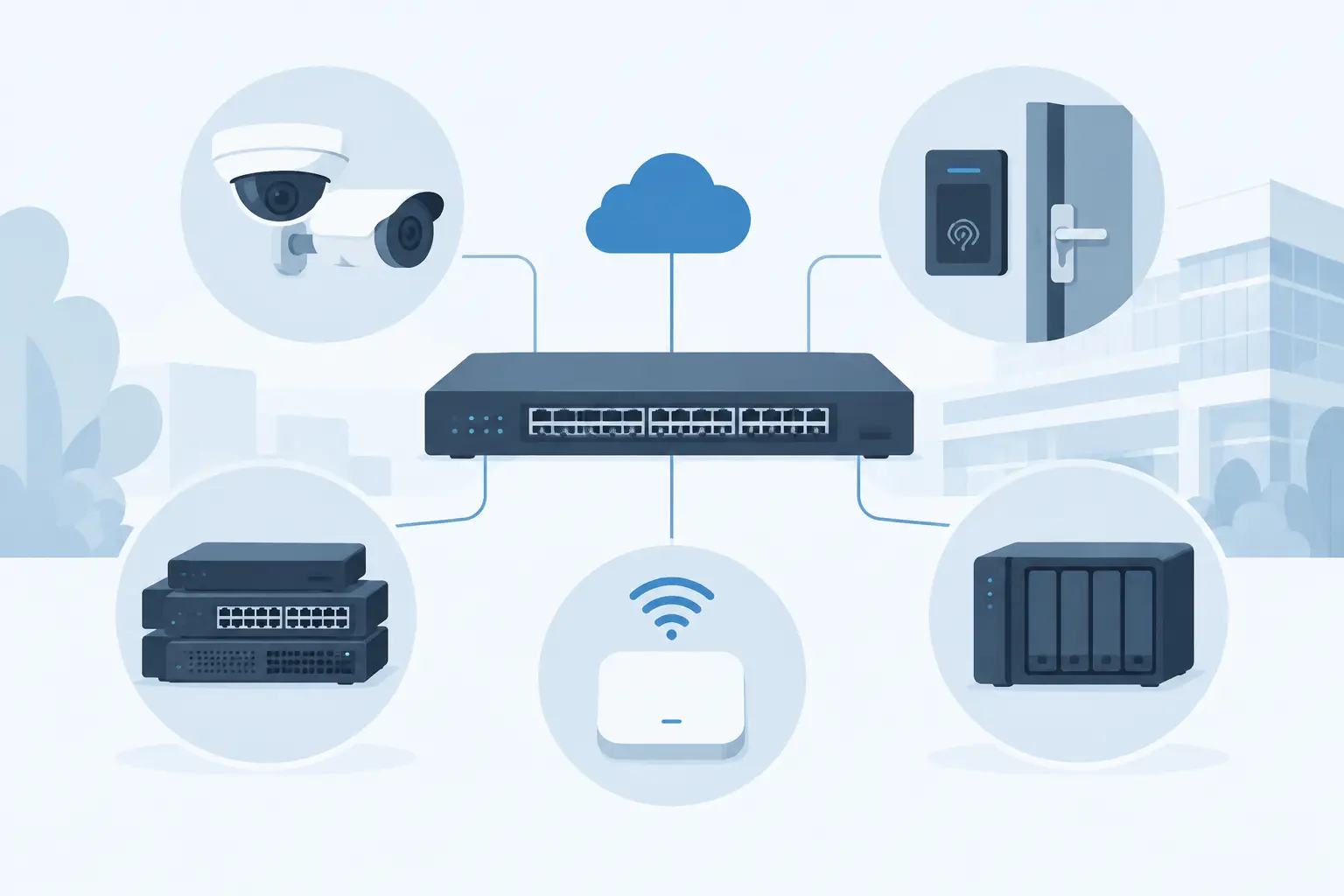
A surveillance network can fail long before a camera, server, or VMS is questioned. The usual cause is an infrastructure decision made too broadly: a switch selected only by port count, a field cabinet treated as an afterthought, or an uplink path left undefined until installation begins. Understanding AETEK network equipment categories helps project teams match the network layer to actual security-system conditions. AETEK supports PoE switching and network infrastructure requirements, while Seven Sectors Trading Co. supplies the range to system integrators, consultants, contractors, and procurement teams across Saudi Arabia.
The right category is not simply the product that appears first on a bill of quantities. It is the equipment type that supports the required endpoints, power distribution, cable routes, environmental conditions, and operational priorities without adding unnecessary complexity to the project.
Start With the Network Role, Not the Device Count
A request for a network switch often arrives with only a camera count and a preferred port quantity. That is rarely enough to specify the correct equipment category. The procurement team needs to know where the switch will sit in the network, which devices it will serve, how those devices receive power, and how the traffic returns to the recording or management environment.
For example, a switch supporting endpoints inside a conditioned security room has different practical requirements from one supporting devices at a gate, perimeter zone, utility area, parking structure, or remote field cabinet. Both may carry surveillance traffic, but their power, enclosure, uplink, and maintenance needs can differ substantially.
A useful starting point is to separate the project network into access, aggregation, and remote-edge functions. This creates a clearer basis for selecting among AETEK network equipment categories and avoids treating every switch as interchangeable.
Managed PoE Switches for Access-Layer Connectivity
Managed PoE switches are generally the core access-layer category for security and low-voltage networks. They connect powered devices to the local network while allowing the system team to control ports, observe status, and organize traffic according to the project design.
This category is appropriate when multiple IP endpoints terminate in a local rack, telecom room, security room, or cabinet. It is commonly considered for surveillance devices, access control panels, intercom endpoints, wireless equipment, and other approved PoE-powered infrastructure. The exact endpoint mix matters because it affects both power planning and traffic behavior.
The key decision is not whether management is desirable in theory. It is whether the project needs operational visibility and control after handover. For most commercial, government, industrial, and critical-infrastructure environments, the answer is yes. A managed switch provides a better basis for structured segmentation, fault tracing, port administration, and future changes than an unmanaged alternative.
However, managed equipment also requires the installation and IT teams to follow the approved network configuration. A capable switch cannot compensate for an unclear VLAN plan, inconsistent addressing, or undocumented uplinks. Consultants should define those responsibilities early, while procurement teams should ensure the supplied category aligns with the approved design intent.
Power Budget Comes Before PoE Port Quantity
PoE ports are only part of the requirement. The switch must also support the anticipated aggregate power demand of all connected devices under normal operation and relevant operating conditions. A schedule that lists many powered endpoints without a power calculation can create avoidable risk, particularly where devices have variable consumption or where future endpoint additions are expected.
Ask for the intended endpoint schedule, the expected load per device, and the project reserve philosophy. This enables the integrator to select a suitable PoE switching category rather than choosing equipment solely because the physical port count appears to fit.
Industrial and Hardened Switching for Field Locations
Remote network points introduce conditions that are not present in a rack room. Heat, dust, vibration, electrical exposure, limited service access, and cabinet constraints can all affect the appropriate equipment selection. Industrial or hardened switching categories are intended for these more demanding deployment environments.
This does not mean every outdoor camera location automatically needs industrial switching. In some designs, a protected field enclosure, a nearby telecom room, or a fiber extension may be the more appropriate answer. The correct choice depends on the cable distance, local power availability, physical protection, and how quickly the location can be accessed for maintenance.
For perimeter surveillance, transport infrastructure, industrial facilities, and distributed sites, the field network should be reviewed as a complete path. The question is not just what switch powers the endpoint. It is also how that switch is powered, how its uplink is protected, what happens during a local fault, and whether the equipment can be maintained without disrupting a wider zone.
AETEK infrastructure categories can support this layered approach when the design calls for network equipment beyond a standard indoor access switch. The final selection should still follow the approved technical submittal and site conditions rather than assumptions based on product appearance.
Fiber and Uplink Infrastructure for Long Network Runs
Copper cabling has practical distance limitations, which makes uplink planning a central decision for larger sites. Where endpoints are distributed across buildings, parking areas, perimeter zones, substations, or remote security posts, fiber connectivity may be necessary to bring traffic back to an aggregation point.
The relevant category may include switches with fiber uplink capability or associated network infrastructure that supports the required architecture. The important procurement detail is compatibility with the consultant’s topology and the selected fiber approach. Procurement should not treat the uplink as a last-minute accessory because it affects the entire communication path between field devices and the central recording environment.
There is also a trade-off between centralizing network ports and distributing them closer to endpoint groups. Centralization can simplify maintenance and reduce the number of field cabinets. Distributed switching can reduce copper run lengths and support remote zones more effectively. Neither approach is automatically better. The decision depends on site geography, containment routes, power availability, resilience requirements, and the approved design.
Surge Protection and Network Resilience at the Edge
Security networks often extend beyond protected building interiors. Outdoor and remote connections may be more exposed to electrical disturbances and transient events. In these locations, network resilience is not only a switch-selection issue. It involves the relationship between power, data cabling, grounding arrangements, enclosures, and protective devices.
AETEK network infrastructure can be considered as part of a broader edge-protection strategy where the project design requires it. The key is coordination. The network equipment, structured cabling, electrical works, and field enclosure provisions must align with the consultant’s drawings and project standards.
Do not add protective hardware as a generic line item without confirming the cable path and equipment interfaces. Poorly coordinated protection can complicate fault finding or leave a critical section of the path unaddressed. For tender work, ask for the relevant network diagrams, cabinet schedules, and interface requirements before finalizing the category and quantity.
How to Build a Clearer AETEK Equipment Schedule
A clean network equipment schedule makes technical review and sourcing more efficient. Rather than listing a generic PoE switch line, define the equipment by its intended role: indoor access switching, managed aggregation, remote-edge switching, fiber-connected field networking, or protective network infrastructure.
For each location, confirm the endpoint count, expected powered load, uplink method, installation environment, cabinet or rack arrangement, and any requirement for network segmentation. This also helps identify where a standard category is sufficient and where a more specialized network solution is justified.
For government and major infrastructure tenders, traceability matters as much as product selection. Procurement teams should maintain the approved make, relevant model references, compliance requirements where specifically required, warranty documentation, and submittal status within the project file. Do not make general compliance claims unless they are confirmed for the exact specified model or series.
Source the Network Layer as Part of the Security Stack
Network infrastructure should be sourced in coordination with the wider security stack, but it should not be treated as an accessory to it. The switching layer affects device availability, troubleshooting, expansion capacity, and the stability of video and access-control communications.
Seven Sectors Trading Co. is an authorized AETEK partner and can support project teams sourcing AETEK PoE switches and related network infrastructure for commercial, government, industrial, and major development requirements in Saudi Arabia. Supply discussions are most productive when the buyer provides the BOQ, network topology, endpoint schedule, and approved technical requirements.
For a quotation or category review against your project documentation, contact info@7sectors.com or submit the Get Quotation form. A well-defined network category at the procurement stage gives the installation team a clearer path and gives the end system fewer avoidable points of failure.
Ready to discuss your project? Contact Seven Sectors or contact us directly on +966-012 229 3474.