
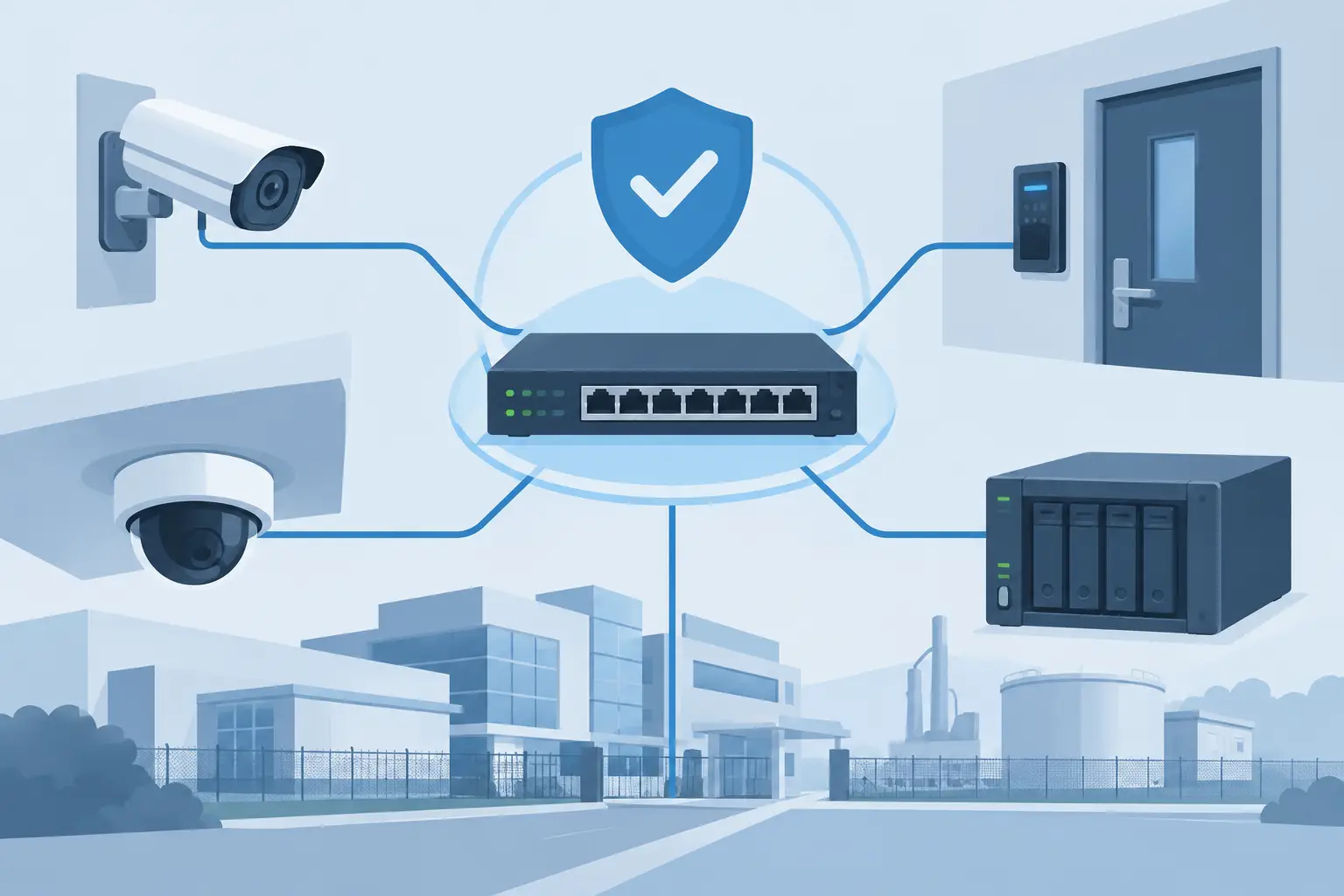
A camera, door controller, or emergency communications endpoint can be fully operational and still fail at the point that matters: its network switch has lost power, its uplink is unavailable, or its PoE budget was consumed without a recovery margin. This PoE network resilience guide is for consultants, integrators, and procurement teams specifying infrastructure where a short interruption creates an operational security gap. AETEK PoE switches and network infrastructure are relevant when the requirement calls for purpose-built power and connectivity across distributed security networks.
Resilience is not achieved by adding redundancy everywhere. It comes from identifying which devices must remain available, what failures are credible at each cabinet or field location, and how quickly the system must recover. The correct architecture for a single commercial building will differ from that of a perimeter, industrial site, transport facility, or government campus.
Start With the Failure That Cannot Be Accepted
The first procurement question is not how many PoE ports are required. It is what happens when one element fails. A switch failure may affect a handful of access points in an office area, or it may remove surveillance, access control, intercom, and perimeter devices from an entire zone. Those are different risks and should not receive the same design treatment.
Define criticality by operational function. Security endpoints at an entrance, a command room, a restricted area, or a remote boundary generally need a higher availability target than devices serving a noncritical internal area. Also separate loss of device power from loss of network communications. A powered camera without an uplink is not useful for live monitoring, while a network connection without PoE will not recover an endpoint that has shut down.
A practical risk review should consider utility power loss, local power supply failure, PoE overload, cable damage, fiber uplink interruption, switch hardware failure, cabinet overheating, and configuration error. It should also define the acceptable outage period for each zone. Procurement teams can then request equipment and quantities that support the required recovery objective instead of purchasing generic network hardware and hoping the topology will compensate.
Build Power Resilience From the PoE Budget Up
PoE resilience starts with a truthful power calculation. Count every endpoint connected to a switch, then use the maximum documented power demand for the specified device mode, not its typical idle draw. Cameras with heaters, illuminators, PTZ functions, or onboard analytics can have changing demand. Access control and communications devices may also create startup peaks that are easy to overlook in a basic port count.
The total endpoint requirement must sit below the available switch PoE budget with a deliberate reserve. That reserve is not wasted capacity. It gives the system room for startup conditions, environmental operation, future devices, and replacement equipment with a different power profile. If a switch is specified at its full PoE capacity on day one, an otherwise minor change order can turn into an outage risk.
The upstream power path needs equal attention. Where continuity is required, the switch power source should be assessed alongside the network topology. This may include a properly selected UPS, a protected electrical feed, and a documented runtime expectation for the actual connected load. A large battery backup does not automatically create resilience if its load calculation is incomplete or if only some cabinets are protected.
For distributed sites, avoid treating every field cabinet as identical. A cabinet supporting a remote gate or perimeter route may need a different power strategy from an internal telecommunications room. The decision depends on the endpoint criticality, distance from the core, local environmental conditions, and the practical ability to reach the location during an incident.
Avoid Single Points of Failure in Power Distribution
One protected supply feeding one switch can be appropriate for a low-consequence area. For critical zones, the specification should identify whether a single switch, single power supply, or single cabinet creates an unacceptable common failure point. Separating high-priority endpoints across more than one switch can reduce the impact of a hardware failure, but it also adds rack space, power demand, and management overhead.
That trade-off matters. Redundancy that cannot be monitored, documented, or maintained may create more operational uncertainty than a simpler architecture. Specify resilience that the operator can support after handover.
Design Uplink Paths for Real Recovery
A resilient PoE edge network needs more than protected power. It needs a viable route back to recording, management, access control, or other required applications. Fiber uplinks are commonly used where distance, electrical isolation, or bandwidth requirements make copper impractical. The key question is whether a single fiber path serves an entire security zone.
Where a path interruption would isolate critical devices, evaluate diverse routing and alternate uplinks. Diverse means more than two links placed in the same tray, conduit, or cabinet. If both routes share the same physical exposure, they can fail together. A second uplink only improves resilience when the path, aggregation point, and failure domain are understood.
Network convergence also deserves attention. Failover is valuable only if it occurs quickly enough for the service being protected and without creating unstable switching behavior. The network team should confirm how the chosen topology responds to a link loss, a switch restart, and restoration of the primary path. This verification is particularly important when surveillance, access control, and operational technology share infrastructure.
Segmentation supports recovery as well as cybersecurity. Separating systems into logical network zones can prevent a fault, broadcast issue, or maintenance activity in one area from affecting unrelated services. The segmentation method should align with the client’s operating model, including who owns switch access, who receives alerts, and who is authorized to make configuration changes.
PoE Network Resilience Guide: Monitor Before Devices Go Offline
A resilience plan that relies on someone noticing a blank screen is not a plan. Switch health, port status, power consumption, uplink condition, temperature alarms where applicable, and event logs should feed into the organization’s monitoring process. The exact platform can vary, but accountability should be clear before procurement is finalized.
Monitoring is most useful when thresholds are meaningful. An alert for every minor event can bury the one alert that signals a cabinet is approaching its PoE limit or an uplink is repeatedly dropping. Establish a baseline after deployment, then review recurring warnings rather than only responding to complete failures.
Documentation is another recovery tool. Each cabinet should have an accurate endpoint schedule, switch identification, uplink destination, power source, port mapping, and escalation contact. When a field issue occurs, technicians should not need to trace live cables or guess which switch supports a critical entrance. For large phased projects, maintain this information through change control so that the record still reflects the installed network months later.
Specify Spares, Support, and Acceptance Testing
The fastest recovery is often replacement, not repair. Critical sites should consider a controlled spare strategy for key switch types, power accessories, and optical components. The appropriate quantity depends on the scale of deployment, equipment standardization, location access, and contractual recovery expectations. Standardizing selected switch families can simplify this approach, provided the port count, uplink, and PoE requirements genuinely match the application.
Acceptance testing should simulate credible failures. Test loss of primary power, loss of an uplink, switch reboot behavior, restoration sequence, and alarm visibility. Confirm that critical endpoints return as expected and that recording or access control services recover without unnoticed gaps. A drawing can show redundancy; only testing demonstrates that it operates as intended.
Seven Sectors Trading Co. supports Saudi project teams with AETEK PoE switches and network infrastructure sourced for security and data deployments. For a quotation aligned with your switch count, power budget, and uplink requirements, contact info@7sectors.com or submit a Get Quotation form.
FAQ
How much PoE reserve should a switch have?
There is no universal percentage. Use the maximum documented endpoint demand, expected startup conditions, planned growth, and the consequence of losing devices. Higher-criticality zones normally justify more reserve than general-purpose areas.
Is dual uplink always necessary?
No. Dual uplinks add value when the service impact of isolation justifies the added cabling, aggregation capacity, configuration, and testing. A secondary link that shares the same physical route may not provide meaningful protection.
Can one resilient switch support all critical endpoints?
It can, but it remains a single hardware failure domain. For high-consequence areas, divide critical endpoints according to operational priority and recovery requirements rather than convenience alone.
The most useful resilience decision is the one that makes a failure understandable and recoverable. Define the failure domain, protect the power path, verify the network route, and make sure the operations team can see trouble before it becomes lost coverage.
Ready to discuss your project? Contact Seven Sectors or contact us directly on +966-012 229 3474.