
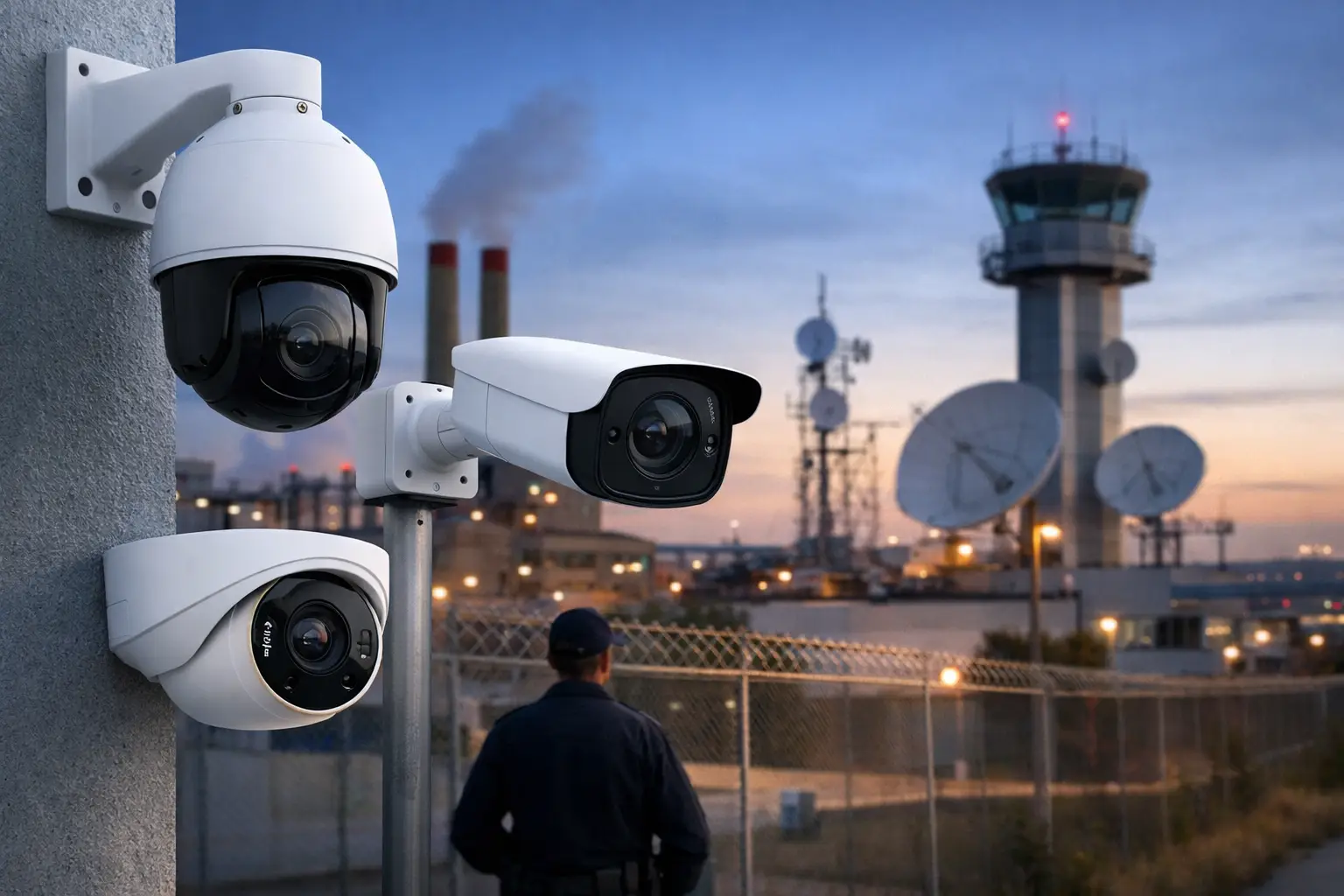
A perimeter incident at 2:00 a.m. is only useful to investigate if the recorded image identifies what happened. Project teams specify Milesight TrueColor AI cameras for this operational gap. They preserve color detail in extremely low light and use AI analytics to separate relevant events from routine movement. For consultants, system integrators, and procurement teams, this can improve evidential video quality and control-room operator workload.
Related: Learn more about our Milesight AI cameras for Saudi Arabia and the full product range we supply.
The value is not simply a brighter image. Consider a camera for a government compound, logistics yard, industrial facility, or giga-project perimeter. It must produce usable footage under difficult lighting and tolerate real site conditions. It must also fit the compliance requirements of the tender. Milesight combines low-light imaging and AI-based event filtering in an NDAA-compliant camera portfolio. The range suits project-led surveillance deployments across Saudi Arabia.
Why Milesight TrueColor AI Cameras Matter at Night
Conventional cameras often shift into monochrome mode when ambient light falls. Infrared illumination can make that footage usable for detection. However, it may not preserve the color of a vehicle, clothing, container, or object. Those details matter when security personnel need to verify an event, investigate an incident, or provide evidence after the fact.
Milesight TrueColor technology aims to maintain color imaging in low-light conditions. Selected models support illumination performance down to 0.002 Lux. As a result, projects can capture more scene detail where external lighting is scarce or excessive supplementary lighting is undesirable. This makes the technology relevant to site boundaries, access roads, loading areas, and parking structures. The same applies to ports and critical infrastructure locations that operate around the clock.
Evaluate low-light performance against the actual scene. A wide open yard, a narrow vehicle lane, and a gatehouse entrance have different lighting, subject distance, and lens requirements. TrueColor performance is strongest when the specification accounts for camera placement, field of view, and available ambient light. Do not treat it as a replacement for sound lighting design.
Wide Dynamic Range for Difficult Entrances
However, night is not the only imaging challenge. For example, entrances, gates, and loading docks frequently combine deep shadow with headlights, floodlights, or direct sun. Milesight cameras with 140 dB WDR help retain information across these high-contrast scenes. For vehicle access points, this can make the difference between seeing a vehicle clearly and recording a bright glare with a dark foreground.
For projects that require identification rather than general observation, the camera choice must match the target task. Resolution alone, however, is not enough. Lens selection, mounting height, angle, shutter configuration, and expected subject speed all play a part. Each one influences whether the camera can capture faces, vehicle characteristics, or license plates effectively.
AI That Reduces Nuisance Alarm Volume
A surveillance system loses operational value when operators receive constant notifications from rain, swaying vegetation, animals, shadows, or moving headlights. Milesight AI analytics aim to identify people and vehicles as relevant targets. This allows teams to focus alerts on events that require a response.
Milesight states that its AI filtering can reduce false alarms by up to 95% in appropriate use cases. However, the result depends on scene configuration and rule calibration. A camera facing a busy public roadway will require a different detection area and schedule from one protecting a fenced utility corridor. Integrators should validate analytic performance during commissioning and tune each scene around the actual security policy.
This is especially useful for distributed sites with limited control-room resources. The system does not have to ask operators to review continuous motion events. Instead, it can prioritize a person entering a restricted area or a vehicle moving through a defined zone. That approach supports faster verification and a more defensible incident process.
Analytics Need Clear Operational Rules
AI does not replace the security plan. Before selecting cameras, stakeholders should define what counts as an event and who receives an alarm. They should also define the verification step and the action that follows. A perimeter intrusion rule, for example, needs clear exclusion zones for adjacent roads and authorized service areas.
This is where consultants and integrators add value. Align analytics with operational reality rather than enabling them as a generic feature. A well-tuned rule can reduce distractions. In contrast, a poorly placed rule can create a new source of alarm fatigue.
Selecting the Right Milesight Form Factor
Milesight offers several camera families because no single form factor suits every surveillance objective. Pro and Mini Series cameras can support standard fixed-camera coverage in commercial and government environments. PTZ models with 12X to 23X optical zoom provide active observation of larger areas. They suit cases where an operator needs to investigate a live event beyond the fixed-camera view.
For broad-area coverage, Milesight Q and Panoramic cameras offer 360-degree fisheye and 180-degree dual-sensor options. These are practical for lobbies, concourses, intersections, open yards, and other locations where a project may otherwise require multiple fixed cameras. The trade-off is that you must assess panoramic coverage for the detail required at the edge of the scene. It is efficient for situational awareness, but it may not replace a dedicated identification camera at a critical point.
Vehicle-sensitive locations may require a more specialized approach. The Milesight LPR Pro Bullet Plus Camera targets license plate recognition applications. In these applications, you must position and configure the camera for lane geometry, vehicle speed, lighting, and plate visibility. Do not specify it as a general-purpose bullet camera when reliable plate capture is the primary requirement.
Projects can also consider the Milesight 5G Series where wired connectivity is impractical. The same applies where temporary and remote deployments require an alternative backhaul strategy. Confirm network availability, carrier coverage, bandwidth cost, cybersecurity policy, and power arrangements early. Wireless transport can solve a site constraint. However, it does not match the operational profile of a fixed fiber or Ethernet connection.
Infrastructure and Compliance Are Part of the Camera Decision
Camera performance depends on the network and recording platform behind it. For outdoor and industrial camera locations, AETEK H-series outdoor PoE switches provide IP67-rated PoE infrastructure. AETEK D-series products, by contrast, address more demanding industrial environments. AETEK is a PoE infrastructure manufacturer, not a camera brand. Its role is to deliver power and network connectivity to Milesight cameras across challenging cable routes and field enclosures.
Where cable distance exceeds standard Ethernet limitations, AETEK PoE Extenders can support runs up to 250 meters. This depends on power budget and topology requirements. This can be useful for gates, perimeter poles, and remote structures where adding a local power source is costly or difficult. The final design should verify camera wattage, switch capacity, surge protection, environmental ratings, and the number of connected devices.
For recording and management, Milesight cameras can form part of a broader VMS and storage architecture. ISS SecurOS can provide video management, enterprise monitoring, and analytics integration for larger environments. In addition, Rasilient, FIBRENETIX, and Dell platforms address different surveillance server and storage requirements. The correct combination depends on retention periods, camera count, resolution, bitrate, redundancy requirements, and the customer’s preferred VMS environment.
NDAA compliance is a material procurement consideration for Saudi government, critical infrastructure, and Vision 2030-related projects. Milesight’s NDAA-compliant camera portfolio helps procurement teams address this requirement. However, tender documents may also specify wider conditions. These can relate to country of origin, cybersecurity, approved manufacturers, server hardware, and network equipment. Confirm compliance at the model and project-document level, rather than assuming it from a brand name alone.
Where TrueColor AI Delivers the Best Return
The strongest use case is a site where low-light evidence and alarm accuracy directly affect security operations. For example, industrial yards and logistics facilities benefit from color video around vehicle routes and loading zones. Similarly, government facilities need more reliable event verification around secure boundaries and visitor approaches. Transport infrastructure, hospitality developments, and large mixed-use projects can use targeted AI alerts to manage high volumes of activity. That way, they avoid treating every movement as an incident.
For giga-project contractors in NEOM, the Red Sea Project, Qiddiya, KAEC, and other major developments, timing matters. Tie camera selection to phased construction, temporary access patterns, and the transition to permanent operations. A camera package may need to support a construction perimeter today and a finished asset tomorrow. That does not always mean the same model belongs in both stages. It does mean the surveillance strategy should account for how the site will change.
Seven Sectors is an authorized Saudi partner for Milesight solutions. We support system integrators, consultants, and procurement teams with product availability and project-focused sourcing. The objective is straightforward. Specify cameras that deliver usable images, relevant alerts, and compliance confidence without adding unnecessary complexity to the project.
Do you need pricing, availability, or support selecting Milesight TrueColor AI cameras for your next Saudi project? Contact Seven Sectors at info@7sectors.com or submit the website Get Quotation form.
Ready to discuss your project? Contact Seven Sectors or contact us directly on +966-012 229 3474.