
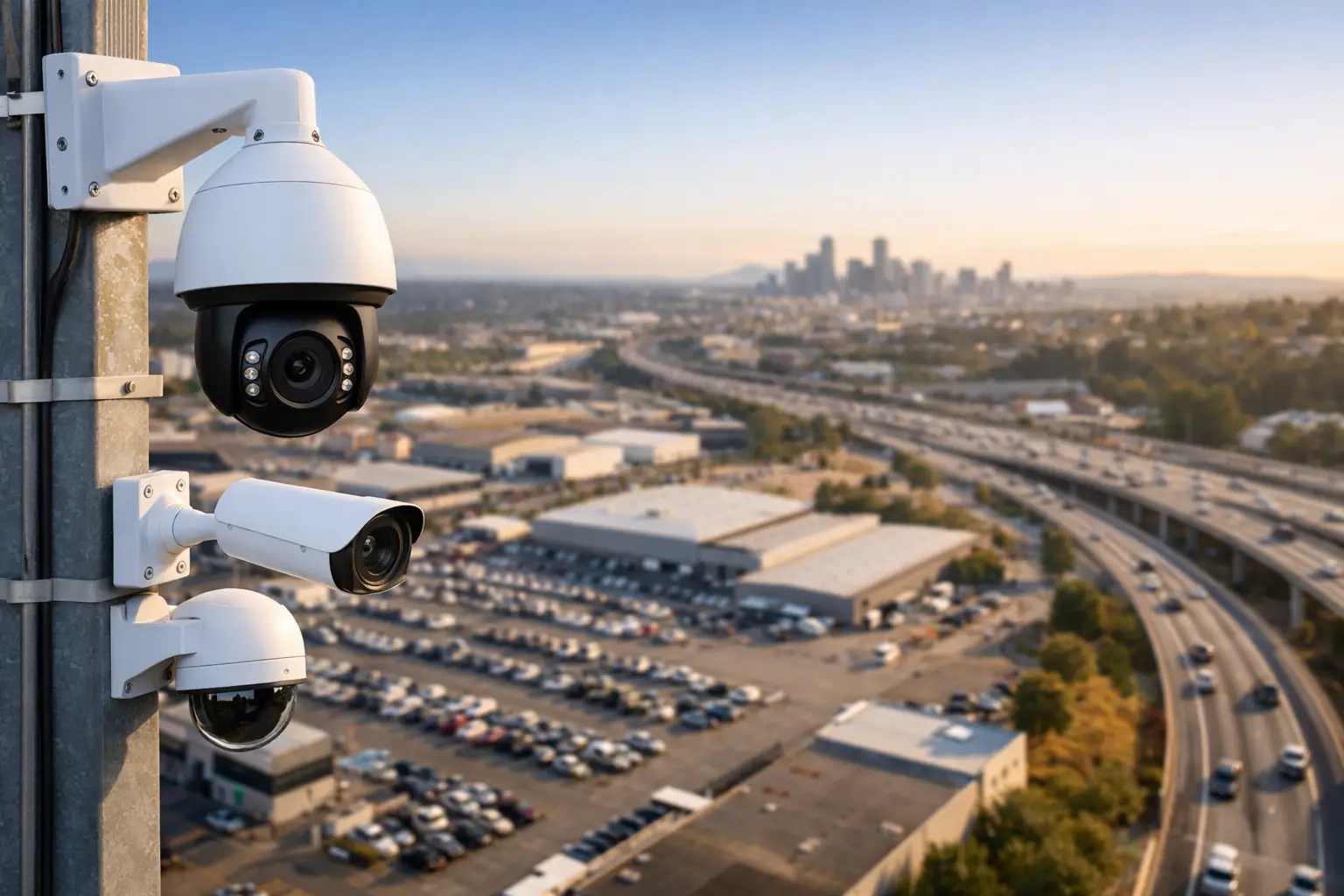
A security control room should not need four fixed cameras to understand one open area. In airport approaches, logistics yards, building lobbies, public concourses, and perimeter intersections, the Milesight Q-Series addresses this issue with panoramic coverage options that reduce camera count while preserving meaningful scene awareness. For consultants and integrators, the value is not simply a wider image. It is the ability to specify coverage based on operational risk, mounting geometry, evidence requirements, and network capacity.
Milesight is an NDAA-compliant AI CCTV brand suited to commercial, government, industrial, and Vision 2030 project requirements. The Q-Series should be evaluated as a panoramic camera option within a wider Milesight architecture, rather than treated as a replacement for every fixed bullet, turret, or PTZ camera on a site.
Where Milesight Q-Series Cameras Fit Best
Panoramic surveillance is most effective where activity is distributed across a broad, defined space and operators need immediate context. A 360-degree fisheye camera can suit a central ceiling position in a lobby, reception hall, elevator waiting area, or covered retail concourse. A 180-degree dual-sensor panoramic approach is often more appropriate on a building facade, along a gate lane, across a loading bay, or overlooking an open car park edge.
The key question is not whether a panoramic camera sees more of the scene. It is whether the scene contains targets that must be recognized, identified, or followed at distance. Wide-angle coverage gives excellent situational awareness, but pixel density decreases as the protected area becomes larger. A camera covering a broad vehicle yard from one high mounting point may reveal movement across the site, yet it may not provide the facial or vehicle detail required at every boundary point.
For this reason, a Q-Series camera often performs best as the overview layer. It can work alongside Milesight Pro Series cameras for dedicated entry and exit views, Milesight PTZ cameras for active verification and tracking, and the Milesight LPR Pro Bullet Plus Camera where plate capture is a formal requirement. This layered approach prevents a common tender mistake: specifying one panoramic view for a task that requires multiple evidence-grade views.
Selecting a Milesight Q-Series Coverage Geometry
The correct panoramic geometry depends on the mounting surface and the direction of risk. Ceiling-mounted 360-degree coverage is practical when there is a central location with a clear view around it. It is a natural fit for interior public areas, warehouse cross-aisles, and circular traffic zones. However, ceiling height, lighting fixtures, hanging signage, and HVAC elements can create blind spots that should be checked before a camera location is finalized.
A 180-degree dual-sensor configuration is generally better where all relevant activity occurs in front of the camera. Examples include a warehouse apron, a mosque entrance plaza, a school frontage, a service corridor, or a two-lane vehicle approach. Compared with a fisheye image, a panoramic dual-sensor view may provide a more familiar horizontal perspective for live operators and recorded-video review.
Mounting height is central to performance. A low mounting height can expose the camera to tampering and limit its field of view. Excessive height can make people and vehicles too small for the required evidentiary task. The specification should identify the furthest point at which the project needs detection, observation, recognition, or identification. Those requirements should then be checked against the selected camera’s field of view, resolution, and final mounting position.
A panoramic device should not be selected solely because it reduces the bill of materials. Fewer camera bodies can reduce cable runs, switch ports, mounting points, and maintenance locations. But savings disappear if the selected coverage leaves blind areas or produces recordings that cannot support an incident investigation. The best design is the one that assigns the Q-Series to open-area awareness and assigns narrow-field cameras to critical detail.
Fisheye Views Need a VMS Plan
A fisheye camera captures a circular scene that may need dewarping for practical viewing. Procurement teams should confirm how the selected VMS will display live and recorded panoramic streams, including split views and dewarped views where required. This matters particularly in multi-site command centers, where operators need consistent camera handling and fast incident review.
ISS SecurOS is one example of a VMS environment that can be considered when projects require enterprise video operations, analytics, and centralized monitoring. The final compatibility assessment should cover camera integration, stream settings, user permissions, retention policy, and the exact operator views required by the end user. The camera is only one part of the operational result.
AI Analytics Must Match the Scene
Milesight AI camera technologies are intended to focus attention on relevant people and vehicles rather than every movement in the image. This is valuable in busy Saudi project environments where shadows, lighting changes, weather, vegetation, and normal site activity can overwhelm operators with nuisance events. Milesight cites up to a 95% false alarm reduction for its AI analytics in applicable use cases, but actual results depend on camera placement, scene configuration, and rule design.
With panoramic coverage, analytics configuration requires additional care. A single broad view can include public walkways, roads, access lanes, landscaping, and restricted zones. If all activity is treated as an alarm, the control room will receive unnecessary notifications. Instead, define event rules around operational boundaries: an after-hours entrance route, a sterile loading zone, a fence approach, or a restricted equipment area.
It also matters whether the camera is expected to monitor people, vehicles, or both. A vehicle rule positioned too close to a public road may generate constant activity. A people rule aimed across a distant open yard may not meet the target-size requirement. The integrator should validate rules using representative activity before final acceptance, including daytime, nighttime, and high-traffic conditions.
Milesight TrueColor AI performance and low-light capabilities can be relevant where wide areas transition from daylight to artificial illumination. Milesight cameras offer specifications such as 0.002 lux sensitivity and up to 140 dB WDR across applicable models, but procurement documents should always state the required performance by exact model rather than applying a family-level specification to every camera. Lighting design remains essential. A camera cannot compensate for poorly placed floodlights, direct glare, or unlit identification points.
Network and Recording Considerations
A panoramic camera may reduce physical camera quantity, but it can still require thoughtful bandwidth and storage planning. Resolution, frame rate, compression settings, scene complexity, motion activity, and retention period all affect the final recording load. A busy transport entrance and a quiet internal lobby will not produce the same storage demand, even when using the same camera model.
For Power over Ethernet design, the camera’s final power requirement, cable distance, environmental enclosure needs, and available uplink capacity must be checked. AETEK PoE switches are relevant here as network infrastructure, not as CCTV cameras. For outdoor or exposed field locations, AETEK H-series IP67 PoE infrastructure can support an appropriate hardened network approach. Indoor C-series switches and industrial D-series options should be selected according to the actual cabinet, environment, and power design.
Where long copper runs are unavoidable, PoE extenders can support distances up to 250 meters in suitable designs. That does not remove the need for proper voltage, bandwidth, surge protection, and thermal planning. For high-value deployments, the network schedule should identify camera ports, PoE budget, backbone uplinks, recording paths, and spare capacity from the beginning.
Storage selection should also follow the project’s retention and evidentiary requirements. Rasilient surveillance servers and forensic storage are appropriate considerations for larger environments where recording integrity and VMS interoperability are priorities. For projects built around Dell PowerEdge servers and PowerVault storage, the final infrastructure should be sized around the chosen VMS and actual camera workload. Neither approach should be treated as a generic server purchase.
Procurement Checks for Saudi Projects
Government teams and giga-project contractors need more than a camera data sheet. They need traceable supply, verified compliance documentation, availability aligned with project schedules, and product selection that fits the tender specification. NDAA compliance is frequently relevant to government, critical infrastructure, and Vision 2030 procurement. Where TAA compliance is also required, it should be confirmed against the exact product and project requirement before submission.
A practical submittal review for Milesight Q-Series cameras should verify the selected panoramic format, mounting arrangement, scene objectives, VMS integration, AI rules, power method, storage impact, and compliance documentation. It should also identify companion cameras where detailed identification, PTZ response, or license plate recognition is required. This produces a more defensible CCTV schedule than a camera-count comparison alone.
Seven Sectors is the authorized Saudi partner for Milesight solutions, supporting system integrators, consultants, and procurement teams with project-focused sourcing across the Kingdom. For Milesight Q-Series pricing, availability, and model guidance for your project, contact Seven Sectors at info@7sectors.com or submit the website Get Quotation form.
Ready to discuss your project? Contact Seven Sectors or contact us directly on +966-012 229 3474.