
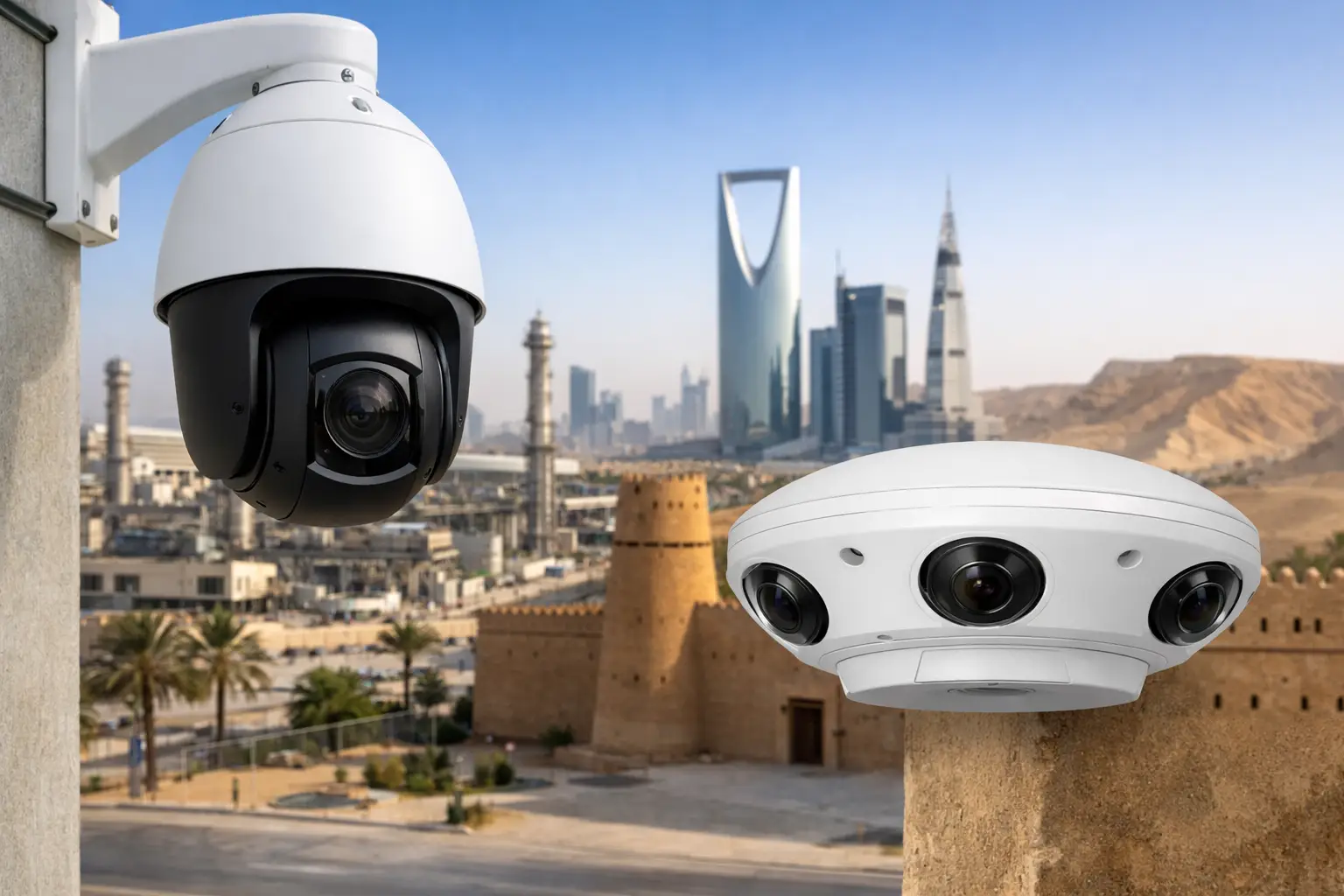
A camera overlooking a logistics yard, airport perimeter, or government entrance has to answer two different operational questions: what is happening across the whole scene, and who or what requires closer investigation? The Milesight PTZ vs panoramic decision is therefore not a simple choice between two camera types. It determines how operators monitor activity, how incident evidence is retained, how the network is sized, and where fixed-camera coverage is still required.
For Saudi commercial, infrastructure, and public-sector projects, the right answer is often a mixed Milesight camera layout. Panoramic cameras establish persistent scene awareness. Milesight PTZ cameras provide live detail at distance. Procurement teams and system integrators should specify each device around its operational role rather than expecting either format to solve every surveillance requirement.
Milesight PTZ vs panoramic: the operational difference
A Milesight panoramic camera is fixed in position and captures a wide field continuously. In the Milesight Q Series, this may mean a 360-degree fisheye view or a 180-degree dual-sensor panoramic view. The camera does not need to move to preserve the wider scene, which makes it effective wherever operators need uninterrupted visibility of movement, direction, and crowd flow.
A Milesight PTZ camera physically pans, tilts, and zooms. The PTZ Series includes 12X to 23X optical zoom options, allowing an operator or an event rule to inspect a vehicle, person, gate, or perimeter point in more useful detail than a wide overview camera can normally provide. It is designed for active observation, target verification, and incident response across larger areas.
The key trade-off is simple. When a PTZ follows one target, it is no longer watching the rest of its patrol area. A panoramic camera retains its entire scene but will not provide the same long-range identification detail as a correctly positioned optical-zoom PTZ. This distinction matters in control-room environments where an operator may be responsible for many cameras at once.
When a Milesight panoramic camera is the stronger choice
Panoramic coverage is particularly effective when the security objective is to understand the whole scene without blind intervals. A 360-degree fisheye can reduce the number of cameras required at a lobby intersection, indoor concourse, retail warehouse aisle crossing, parking circulation point, or public waiting area. A 180-degree dual-sensor panoramic camera is often better suited to broad facades, loading bays, fence lines, and roadway approaches where coverage is needed in one direction.
For consultants, the value is not merely a wider image. A fixed panoramic camera creates a continuous record of activity across its defined area. If an incident is reported after the fact, the investigator can review the full scene rather than relying on where a PTZ happened to be pointed at that moment. This is useful for premises where multiple events can occur simultaneously, including municipal facilities, transport environments, major entrances, and warehouse dispatch zones.
Milesight panoramic models also support the wider AI CCTV proposition of the brand. TrueColor AI capability, low-light performance down to 0.002 Lux on relevant Milesight models, and 140 dB WDR help address scenes with difficult illumination, such as a bright entrance beyond a shaded lobby or vehicle activity under floodlighting. However, image conditions must still be evaluated at the actual mounting height and direction. A panoramic view of a very large outdoor yard may show activity well, yet remain unsuitable for evidential facial or plate detail at the far edge.
Panoramic cameras also introduce planning considerations that should not be ignored. Fisheye streams can require dewarping at the VMS, client workstation, or camera side, depending on the selected configuration. A 360-degree scene can create a higher pixel-management and storage burden than a conventional narrow-view camera. Integrators should account for recording resolution, frame rate, retention policy, and operator workstation performance before assuming that fewer camera housings automatically mean lower system cost.
Where Milesight PTZ cameras earn their place
Milesight PTZ cameras are most valuable where distance changes the surveillance problem. A security operator monitoring a port approach, a large parking area, an industrial boundary, or a campus roadway may need to inspect an alarm location hundreds of meters from the nearest control point. Optical zoom allows that operator to assess the event without waiting for a patrol team to reach the area.
This makes PTZ cameras a strong choice for active security posts, perimeter corridors, critical gates, large plazas, and compound roads. The camera can run preset tours during normal conditions, then move to a preset or manually track an event when an alarm is received. A PTZ is also valuable as a verification layer above fixed cameras: the fixed cameras provide continuous detection coverage, while the PTZ supplies close-up situational assessment.
That last point is central to a sound specification. A PTZ should rarely be the only camera protecting a critical area. If the camera is viewing a distant gate, a separate incident at another section of the perimeter may be missed. Fixed Milesight panoramic or conventional AI cameras should maintain baseline coverage, especially around access points, fence approaches, and areas with simultaneous activity.
PTZ deployment also requires closer attention to mounting and infrastructure. Height, vibration, wind exposure, cable routing, and the intended zoom distance affect the result. An optical zoom rating alone does not guarantee identification performance. The consultant must define the target size, required level of detail, lighting conditions, and maximum observation distance. A PTZ placed too far from the operational target can still produce a weak investigative image.
Network and power design should follow the camera role
Camera selection affects the PoE and network design from the beginning. A Milesight PTZ may have a different power requirement from a fixed panoramic model, particularly where environmental features and active camera functions are involved. The selected model’s datasheet should determine the PoE budget, not a generic assumption based on the number of ports.
For outdoor camera networks, AETEK H-Series IP67 PoE switches provide an appropriate infrastructure option where protected field switching is required. AETEK is a Taiwan-made PoE infrastructure brand, not a camera brand, and its outdoor switches, industrial D-Series options, indoor C-Series, and PoE extenders can help integrators build the physical network around Milesight camera locations. Where cable routes exceed standard Ethernet distance, AETEK PoE extenders can support runs up to 250 meters under the applicable design conditions.
Bandwidth planning is equally important. A panoramic camera can generate high-resolution wide-scene video, while a PTZ may use higher bit rates when operators zoom into detailed, moving targets. Recording all streams at maximum settings is not always the correct answer. Define the required recording quality, analytics events, live-view requirements, and retention period for each scene. For larger projects, storage performance must be validated so that recorded video remains available without dropped frames during peak activity.
Selecting by scene, not by product preference
A practical specification begins with the operational question each camera must answer. If the requirement is, “What happened anywhere in this lobby or loading area?” a Milesight panoramic camera is likely the first option to assess. If the requirement is, “Can the control room inspect that vehicle at the far gate now?” a Milesight PTZ is the stronger fit.
For a perimeter, combine continuous fixed coverage with PTZ verification points. For a large building entrance, use panoramic coverage for queue movement and approach paths, then add a PTZ only when long-range investigation or active response is genuinely required. For parking and logistics areas, a 180-degree panoramic view can document circulation while PTZ cameras cover strategic inspection points. If license plate capture is the primary requirement, use a dedicated Milesight LPR Pro Bullet Plus Camera at the controlled lane rather than asking a general-purpose PTZ or panoramic camera to perform a specialized LPR role.
Government and Vision 2030 project teams should also document compliance requirements early. Milesight cameras are NDAA-compliant, and AETEK PoE infrastructure is NDAA/TAA-compliant. Where a tender calls for specific NDAA or TAA documentation, confirm the exact product and project requirement before approval. Compliance is part of a credible bill of materials, not a last-minute substitution issue.
Seven Sectors supports Saudi system integrators, consultants, and procurement teams as an authorized Saudi partner for Milesight and complementary security infrastructure. For pricing, availability, and help matching Milesight PTZ and panoramic cameras to your project scope, contact Seven Sectors at info@7sectors.com or submit the website Get Quotation form. A camera schedule built around real operator decisions will deliver better coverage than one built around camera counts alone.
Ready to discuss your project? Contact Seven Sectors or contact us directly on +966-012 229 3474.