
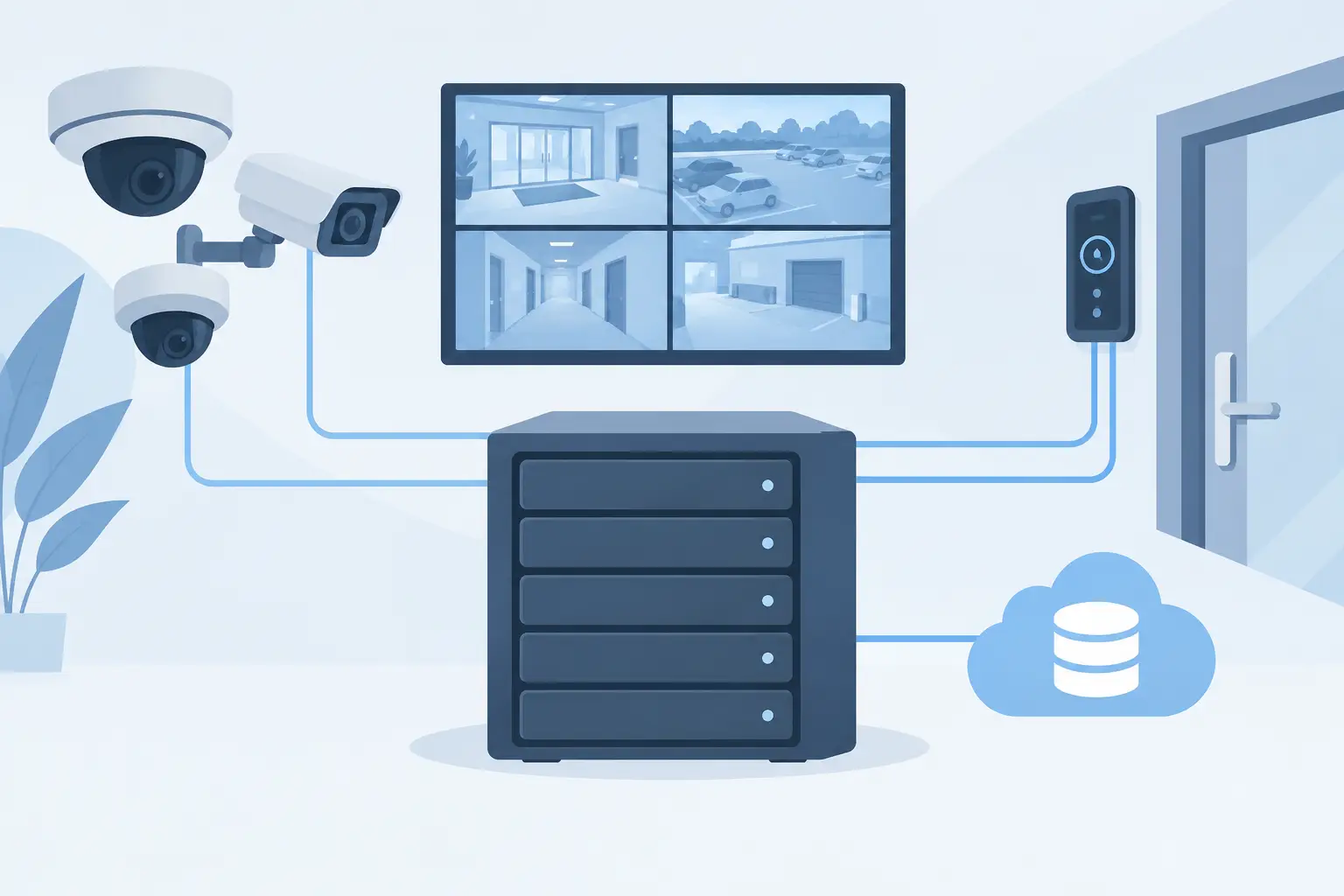
Surveillance storage is often treated as the final line item in a CCTV bill of materials. That approach creates avoidable risk. If recorded video cannot be retained for the required period, recovered after a disk event, or retrieved quickly during an investigation, camera coverage alone does not meet the operational need. This Rasilient storage guide helps project teams assess the storage decision before procurement, with Rasilient positioned as a specialist option for surveillance recording environments.
For system integrators, consultants, MEP contractors, and government procurement teams, the correct storage platform depends on more than total camera count. Recording behavior, retention policy, VMS architecture, resolution choices, expected incident retrieval, and expansion plans all affect the design basis. Seven Sectors Trading Co. supplies Rasilient surveillance storage solutions to support these project requirements across Saudi Arabia.
Start with the recording requirement, not raw capacity
A storage requirement should begin with what the system must record and prove, not with a target number of terabytes. Procurement teams should establish whether cameras record continuously, on motion, by analytics event, or through a combination of policies. Continuous recording creates a predictable workload, while event-led recording can reduce stored footage but may make capacity forecasting more dependent on site activity and VMS rules.
Retention is the next decision. Different areas within one facility may require different retention periods. Perimeter cameras, access points, loading areas, critical plant rooms, public spaces, and incident-sensitive zones may not all carry the same operational or contractual obligation. A single retention assumption across every camera can either oversize the system or leave critical footage exposed to early overwrite.
The recording profile also matters. Camera resolution, frame rate, codec selection, scene activity, and image quality settings influence the daily data volume. These inputs must come from the approved camera and VMS design rather than broad estimates made during early budgeting. Where the design remains incomplete, teams should document assumptions clearly and allow room for validation before placing a final storage order.
Rasilient storage guide: assess workload and protection together
A surveillance storage platform is not simply a collection of disks. It must manage sustained video writes, support retrieval when operators need evidence, and continue protecting recorded material when component issues occur. That is why total usable capacity alone is not an adequate comparison point.
The first workload question is write performance. Surveillance systems can produce a constant stream of simultaneous recordings, often across many cameras and VMS recording services. Storage must support that recording pattern without creating gaps, delayed writes, or unpredictable system behavior. The second question is read performance. Investigations may require several users to review live and archived footage while recording continues. A design that only considers ingest can create an operational bottleneck when footage is most needed.
Protection is equally central. Disk failures are a normal infrastructure consideration, not an exceptional event that can be ignored in a tender response. The procurement requirement should define how recorded data is protected, what happens during a component failure, and how the platform returns to a protected state. These decisions involve trade-offs: stronger protection can reduce usable capacity, while a capacity-first design may place more pressure on operational recovery procedures.
Rasilient storage is relevant where surveillance teams need a purpose-built approach to video retention and system availability. The final configuration should still be matched to the approved VMS, recording architecture, and site operating requirements. Product selection should follow the project design, not replace it.
Confirm the VMS and network architecture
Storage cannot be selected in isolation from the video management system. Some VMS environments use centralized recording servers, while others distribute recording across multiple servers or site locations. The storage architecture must align with where recording services run, how video is written, and how operators access archived footage.
Ask whether the project requires direct-attached storage, shared storage, or an architecture that supports separate recording and management functions. The right answer depends on the VMS platform, the number of recording servers, the resilience expectations, and whether the system will expand in phases. A centralized approach may simplify management in some deployments, while distributed recording can better suit multi-building facilities or geographically separated sites.
Network planning also needs attention. Video traffic, storage traffic, client viewing, and management traffic can compete for the same infrastructure if the design does not separate or prioritize them appropriately. This is particularly relevant when a project is expanding an existing security network rather than deploying a new environment. The storage supplier should receive the relevant VMS and network information early enough to identify compatibility questions before equipment is specified.
Build expansion into the procurement decision
Many surveillance systems grow after handover. Additional cameras may be added because of operational changes, perimeter extensions, tenant requirements, or updated risk assessments. A storage platform selected only for the initial camera schedule can force a premature replacement or create an inconsistent mix of storage methods later.
Expansion should be discussed in practical terms. Will the project add cameras in one major phase or in smaller packages? Is more retention likely to be requested after operation begins? Could higher-resolution cameras be introduced in priority areas? Will new sites need to be brought into the same VMS environment? These questions affect not only capacity but also the preferred path for adding storage and recording resources.
There is a balance to maintain. Buying too far ahead can tie up project budget in unused capacity. Buying with no expansion path can create higher cost and disruption later. For most commercial, industrial, government, and infrastructure projects, the sensible approach is to specify for the approved scope while confirming a clear, compatible growth route.
Write storage requirements that can be evaluated fairly
Tender documents often state a storage duration but leave the technical basis unclear. That makes it difficult for procurement teams to compare proposals on equal terms. A stronger requirement describes the recording assumptions behind the retention target and requests confirmation of usable capacity, protection method, compatibility, and expansion approach.
The specification should also identify the VMS platform, anticipated recording behavior, number of cameras by recording profile, retention requirements by area where applicable, and whether operational access to archived footage is expected during peak recording periods. If the project has a resilience requirement, define the outcome expected from the system rather than relying on vague wording such as “high availability.”
For government and major infrastructure procurement, documentation quality matters. Require suppliers to identify assumptions, exclusions, and dependencies. This reduces the risk of a proposal appearing compliant on capacity while omitting the architecture, licenses, server resources, or connectivity needed for a functioning recording environment.
Questions to resolve before requesting a quotation
Before requesting a Rasilient storage quotation, provide the approved camera schedule, VMS details, recording policy, retention requirement, and expected future expansion. If available, include the server architecture, storage connectivity preference, and any project requirements for redundancy or operational continuity.
It is also useful to confirm who owns the final design decision. Seven Sectors supplies established international technology through authorized partnerships, while the system integrator, consultant, or appointed design authority should validate the complete system architecture. Clear responsibility avoids a common problem: storage being purchased correctly against incomplete or changing recording assumptions.
FAQ
Is retention duration enough to size surveillance storage?
No. Retention duration must be considered with camera settings, recording mode, video activity, VMS behavior, protection requirements, and future growth. Two systems with the same camera count and retention period can require materially different storage resources.
Should storage be specified before the VMS is confirmed?
A preliminary budget can be prepared, but final selection should follow VMS confirmation. Recording architecture and compatibility requirements directly affect the appropriate storage approach.
Can one storage design serve every site type?
Not always. A single-building commercial system, a distributed industrial facility, and a multi-site government environment may have different recording, access, resilience, and expansion requirements. The project context should drive the configuration.
A well-specified storage platform gives the security team confidence that recorded video remains available when a routine review becomes an urgent investigation. For assistance sourcing Rasilient storage for an approved surveillance design, contact Seven Sectors Trading Co. at info@7sectors.com or submit a Get Quotation form with the project recording requirements.
Ready to discuss your project? Contact Seven Sectors or contact us directly on +966-012 229 3474.