
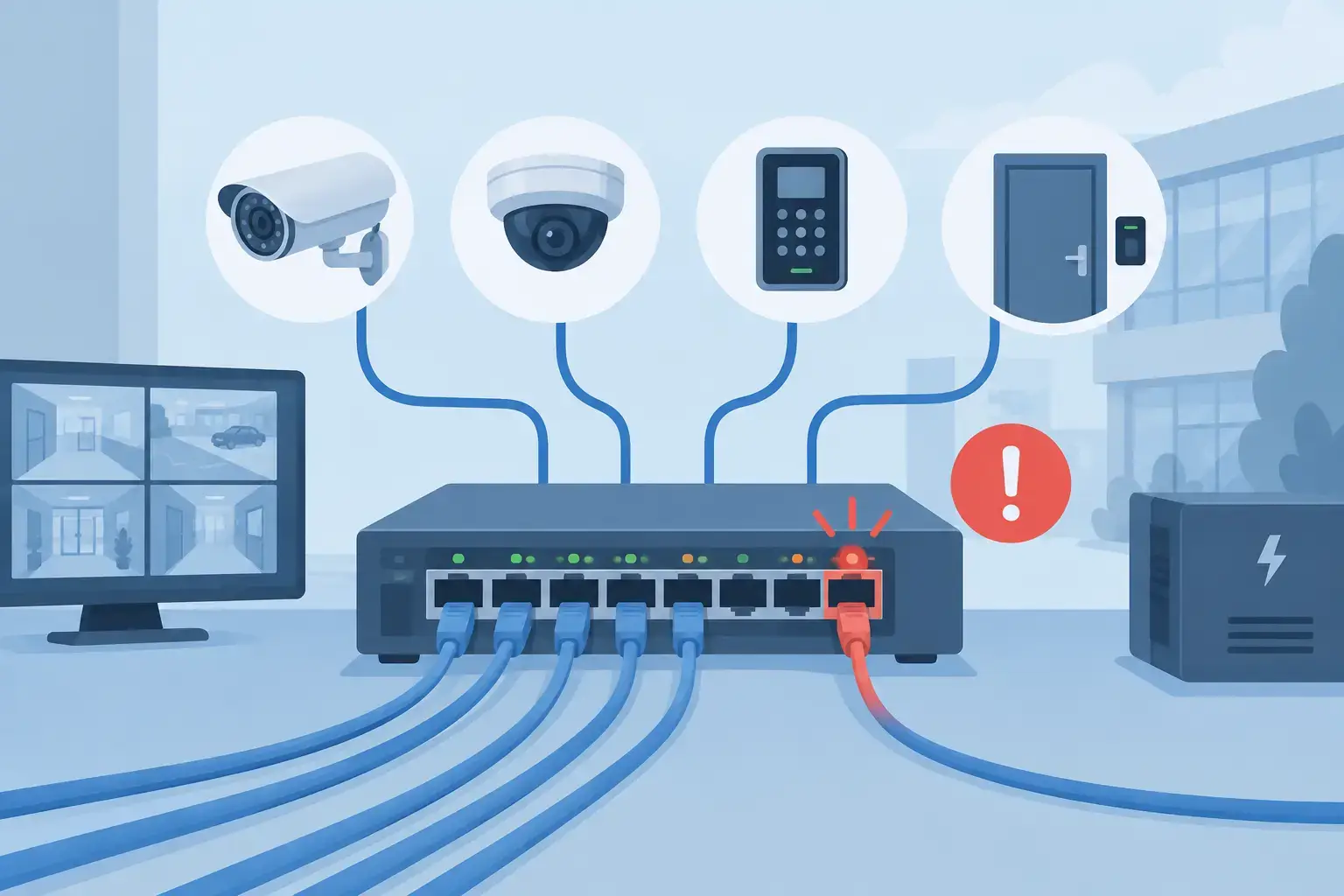
A camera drops offline during a perimeter incident, or an access-control door controller restarts without warning. The first question is often: why do PoE switches fail when they are expected to carry both network traffic and device power? In commercial security environments, the answer is rarely a single defective switch. It is usually a mismatch between power demand, field conditions, cabling quality, protection strategy, and operational monitoring. Seven Sectors Trading Co. supplies AETEK PoE network infrastructure for integrators and procurement teams that need to control these risks before equipment reaches site.
A PoE switch is not simply a network connection point. It is a power system at the edge of the security network. When it is underspecified, poorly protected, or installed in an unsuitable enclosure, the resulting fault can affect cameras, wireless links, intercoms, access-control devices, and other powered endpoints at the same time.
Why Do PoE Switches Fail Under Real Project Loads?
The most common failure is not necessarily hardware failure. It is power budget exhaustion.
Every PoE switch has a total power budget shared across its powered ports. A project may appear compliant on paper because each endpoint can be powered by the selected PoE standard. The issue appears when the combined load rises. Cameras can draw more power when infrared illumination activates, heaters engage, a PTZ moves, or environmental conditions change. If the connected load exceeds the switch budget, ports may cycle, devices may operate intermittently, or lower-priority endpoints may lose power.
This is why port count alone is not a valid basis for selection. A 24-port switch does not automatically support 24 devices at their maximum possible demand. The power calculation needs to account for the normal operating load, peak demand, headroom for startup behavior, and future expansion. For tendered projects, that calculation should be documented against the actual device schedule rather than estimated by device quantity.
Power supply degradation can create a similar symptom. Internal power components are exposed to heat and electrical stress over time. A switch that initially supports the installed load may become unstable later if its power supply is repeatedly operated near capacity. Designing with practical reserve capacity reduces that risk and makes maintenance planning more predictable.
Heat Is a Reliability Issue, Not Just an Enclosure Detail
PoE operation produces more heat than data-only switching because the unit is delivering energy as well as forwarding traffic. High port utilization, elevated ambient temperatures, poor ventilation, and crowded cabinets compound the thermal load.
In security cabinets, the switch may share space with recorders, fiber equipment, power supplies, UPS units, and patch panels. A cabinet can be acceptable during handover and become problematic once all equipment is active. Heat buildup may cause ports to shut down, power delivery to become unstable, or the switch to reduce performance before a complete outage occurs.
Outdoor and industrial deployments create a different challenge. Equipment installed in field cabinets, gatehouses, parking areas, utility zones, or exposed infrastructure locations can face dust, humidity, solar heat, and wide temperature changes. The switch and enclosure must be considered together. A suitable industrial-rated switch cannot compensate for an enclosure with inadequate heat management or water ingress protection.
For critical security coverage, the design decision is not simply managed versus unmanaged. It is whether the selected hardware and enclosure arrangement are appropriate for the actual environment, loading profile, and maintenance access available on site.
Cabling Faults Can Look Like Switch Failures
When a powered endpoint goes offline, the switch is often blamed first. However, damaged or marginal cable runs are among the most frequent causes of intermittent PoE issues.
Poor terminations, crushed cable, moisture intrusion, excessive run length, incorrect conductor quality, and inconsistent patching can all increase resistance or disrupt data pairs. A camera may remain connected in low-load conditions but restart at night when its power requirement rises. This creates a confusing fault pattern: the network device appears healthy during testing, then fails during actual operation.
Copper cabling should be verified as part of the fault investigation, not treated as an assumed constant. Testing should check continuity, pair integrity, cable length, and PoE delivery behavior under load. Replacing a switch without checking the field cable may only move the problem temporarily.
There is also a project-control issue. Security, ICT, electrical, and civil work packages often converge at field cabinets. Cable routes may be changed late, terminations may be reworked, and equipment may be energized before all protective measures are complete. Clear labeling and as-built documentation help the maintenance team isolate whether a problem belongs to the endpoint, cable path, power source, or switch port.
Surges and Grounding Damage PoE Equipment Quietly
Electrical surges are a major cause of premature switch failure, particularly where network links extend to outdoor devices or between separate buildings. Lightning activity, utility disturbances, inductive loads, and grounding differences can introduce transient voltages through power feeds or copper network cabling.
The visible result may be a fully failed switch. More often, the damage is partial: a single port stops supplying power, an uplink becomes unstable, or the device operates until a high-load event exposes the weakened component.
Protection must be planned across the full path. This includes appropriate electrical protection at the cabinet supply, correctly selected Ethernet surge protection where required, effective grounding and bonding practices, and sensible use of fiber links between buildings or high-risk zones. A surge protector is not a substitute for a complete grounding strategy, and grounding alone does not eliminate the need to assess cable exposure.
Consultants and integrators should also identify whether outdoor endpoints are fed from the same electrical reference as the switch. Ground potential differences can cause recurring faults that are difficult to diagnose from network logs alone.
Configuration and Network Design Still Matter
A PoE switch can have adequate power and healthy hardware yet still appear to fail because of network configuration issues. VLAN errors, loop conditions, broadcast storms, uplink congestion, port security settings, and incorrect device discovery parameters can make endpoints unreachable even when PoE delivery is normal.
Managed PoE switches provide more visibility in these situations. Port-level power status, current draw, link events, error counters, and remote reboot capability can reduce troubleshooting time. That visibility is particularly useful where switches support distributed cameras across large facilities, campuses, transport zones, or industrial perimeters.
But management features add a responsibility: configuration must be controlled. Default credentials, undocumented VLAN assignments, and unrecorded port changes create support problems later. The best operational outcome comes from aligning the switch configuration with the network architecture, documenting it at handover, and setting a clear process for changes after occupancy.
A Practical Fault-Isolation Sequence
When an endpoint loses connection, start by identifying whether the issue is power, data, or both. Check the switch port status and PoE indicators, then compare the endpoint behavior on a known-good port. Review the total PoE load across the switch before assuming a port has failed.
Next, inspect and test the cable path, including patch leads, surge protection devices, intermediate junctions, and field terminations. If several ports show instability, investigate cabinet temperature, input power quality, grounding, and upstream network behavior. If one port is affected repeatedly, test the endpoint and cable before replacing the switch.
This structured approach prevents unnecessary replacement of healthy infrastructure and produces better evidence for warranty or procurement decisions. It also helps determine whether the corrective action is a higher power budget, better cabinet ventilation, revised protection, cable remediation, or network reconfiguration.
Procurement Questions That Prevent Repeat Failures
Before sourcing PoE switches for a security package, confirm the total device load and the peak power scenario, not only the endpoint count. Review the installation environment, including cabinet conditions, outdoor exposure, and available electrical protection. Confirm the required uplink architecture and whether management features are needed for remote fault diagnosis.
It is also worth standardizing on an infrastructure range that can be supported consistently across project phases. AETEK PoE switches and network infrastructure are relevant where integrators need application-focused options for security network deployments, but final selection should always follow the power schedule, topology, environmental conditions, and consultant requirements.
Frequently Asked Questions
Can a PoE switch fail because too many devices are connected?
Yes. The issue is usually the total power drawn by connected devices, not the physical number of connected ports. A switch can run out of PoE budget even when every port is technically compatible with the endpoint.
Why does a PoE camera work in daytime but fail at night?
Night operation can increase camera power demand when infrared illumination or other functions activate. Marginal cabling, insufficient power budget, or a weakened power supply may only show symptoms during that higher-load period.
Should a failed PoE switch always be replaced?
Not immediately. Check the input power, cabinet temperature, PoE load, cable condition, surge protection, and endpoint behavior first. These checks can identify the actual cause and prevent the replacement unit from suffering the same fault.
For security networks supporting critical operations, PoE reliability should be treated as a design and procurement discipline rather than a replacement exercise. If you need support sourcing suitable AETEK PoE infrastructure for a specified project, contact Seven Sectors Trading Co. at info@7sectors.com or submit a Get Quotation request with the device schedule and site conditions.
Ready to discuss your project? Contact Seven Sectors or contact us directly on +966-012 229 3474.