
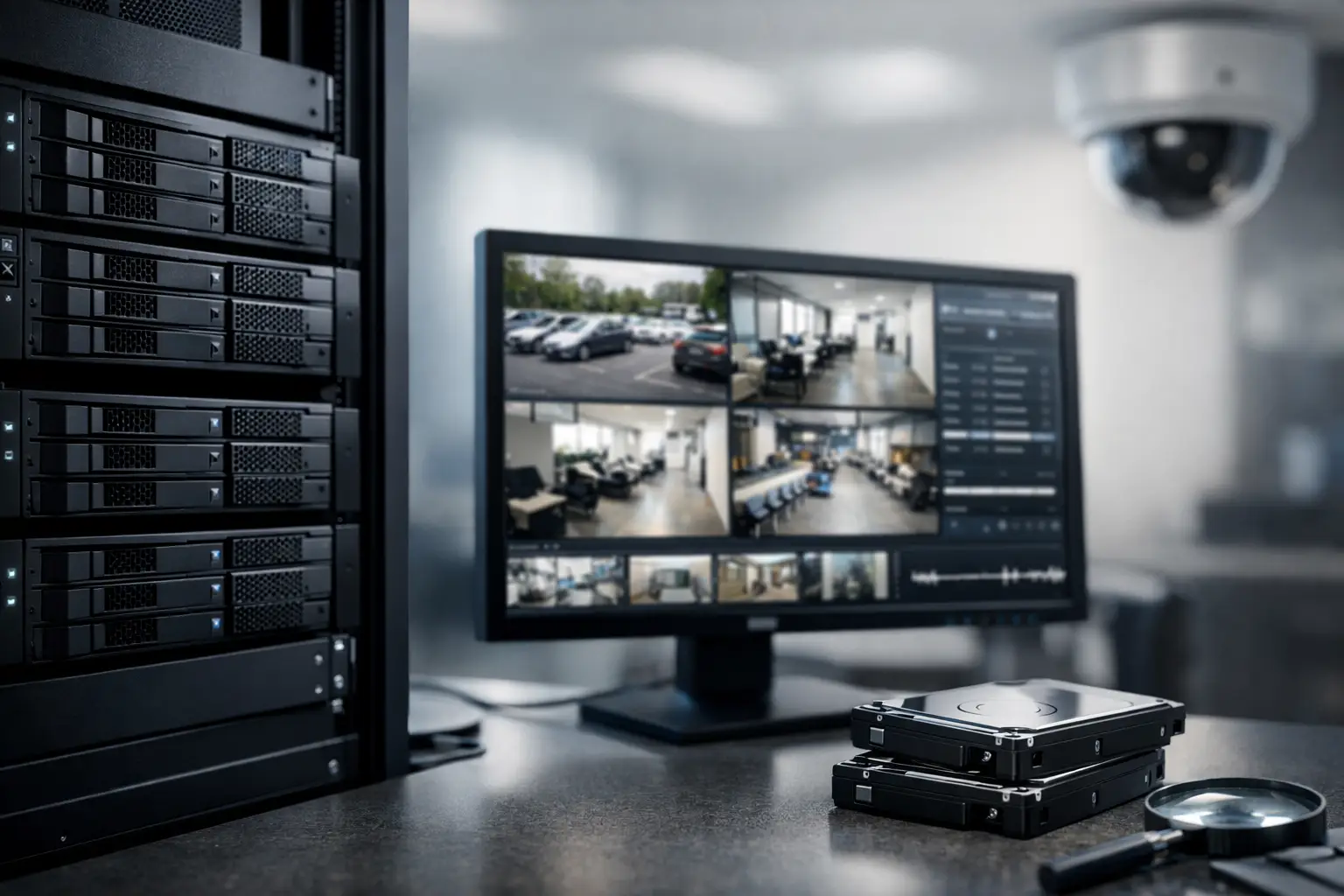
A surveillance project can have high-resolution cameras, capable analytics, and a well-specified VMS, yet still fail when recorded evidence is incomplete. Rasilient PixelStor addresses that risk at the storage layer, where sustained recording performance, retention requirements, and rapid forensic retrieval must work together. For government facilities, oil and gas sites, transport environments, and smart city projects, video storage is not a back-end commodity. It is part of the evidence chain.
Why Rasilient PixelStor Matters in Enterprise CCTV
Modern surveillance systems generate a difficult mix of workloads. Cameras write video continuously, operators replay incidents, investigators export clips, and analytics platforms may request footage at the same time. A storage platform designed only around capacity can struggle when these activities overlap. The result may be delayed playback, inconsistent recording performance, or gaps that only become visible after an incident.
Rasilient PixelStor is built as forensic surveillance storage rather than general-purpose IT storage. Its purpose is to support the recording and retrieval behavior of enterprise video systems, including high-camera-count environments where write performance must remain consistent over long retention periods. This makes it relevant where evidence integrity, operator response, and auditability carry real operational and contractual consequences.
Rasilient’s NFD architecture, meaning No Frames Dropped, is central to this positioning. The practical objective is straightforward: preserve recorded video under demanding workloads rather than allowing storage contention to compromise the evidence record. Actual results still depend on correct system sizing, camera bit rates, retention policy, VMS configuration, network design, and the concurrency expected during investigations. NFD should therefore be treated as an architectural advantage that must be matched to a properly engineered bill of materials, not as a substitute for capacity planning.
Storage Is a Recording Decision, Not Just a Retention Calculation
A common tender approach starts with camera count, resolution, days of retention, and a total number of terabytes. That calculation is necessary, but it is incomplete. Two projects with the same raw capacity requirement can place very different demands on storage.
A perimeter deployment with continuous Milesight cameras may generate steady write traffic across many streams. A control room, meanwhile, may create intense read activity when operators review alarms, export footage, or examine an incident from multiple angles. A city surveillance project can add distributed recording patterns, long retention requirements, and concurrent access from several authorized users. The storage design must account for these behaviors, not only for the final capacity number.
PixelStor is intended for these surveillance-specific conditions. It allows system integrators and consultants to specify a dedicated forensic storage tier alongside the VMS rather than treating video archives as an afterthought. This is especially relevant in projects where footage must remain usable weeks or months after capture, not simply appear as recorded in a dashboard.
Questions to Resolve Before Specifying PixelStor
The best storage specification starts with evidence requirements. Consultants and integrators should establish the recording mode for each camera group, expected bit rate, codec, frame rate, retention period, and the number of users likely to retrieve video concurrently. They should also define whether the site requires continuous recording, event recording, or a mixed policy.
The VMS matters equally. Rasilient PixelStor is VMS-agnostic and can support platforms such as ISS SecurOS and Milestone, giving project teams flexibility where a customer has standardized on a particular video management environment. Compatibility does not eliminate the need for validation. The proposed VMS version, camera count, recording policy, client workload, and storage configuration should be checked as one system before procurement.
Network behavior should be reviewed at the same stage. Camera traffic, recording servers, client workstations, and archive storage all depend on stable network paths. AETEK PoE infrastructure can supply the network edge for camera deployments, including outdoor and industrial conditions where appropriate, while PixelStor provides the specialized storage layer behind the VMS. These are different roles, and separating them clearly helps avoid a design that over-specifies one layer while under-specifying another.
Where PixelStor Fits Best
Rasilient PixelStor is particularly relevant for projects where video is expected to become evidence, not merely situational awareness. Government compounds, critical infrastructure, oil and gas facilities, airports, logistics operations, and major urban developments often require longer retention, controlled access, and dependable retrieval under pressure.
For Vision 2030-related developments, project teams may be asked to support phased expansion, multiple security subsystems, and formal compliance requirements. Storage selection should be considered early because it affects server design, rack space, power, cooling, network throughput, licensing assumptions, and future capacity planning. Late changes to the archive layer can create avoidable redesign work once camera quantities and retention periods increase.
Procurement teams should also distinguish between compliance requirements and performance requirements. NDAA or TAA requirements, where mandated by the project or end user, must be confirmed against the specific product configuration and current manufacturer documentation. At the same time, the project still needs storage engineered for continuous surveillance recording. Compliance alone does not prove that a platform can sustain the workload of a large CCTV archive.
PixelStor, ApplianceStor, and NFDCloud
Rasilient offers more than one route to surveillance recording and storage. PixelStor is suited to dedicated forensic storage deployments where scale, retention, and concurrent access require purpose-built architecture. It is often a strong fit when the project already has recording servers or a VMS environment that needs an independent storage foundation.
Rasilient ApplianceStor 1U and 3U NVR platforms provide a more appliance-oriented option for projects that require integrated network video recording hardware. The choice between an appliance and separate storage infrastructure depends on the camera count, site architecture, expansion model, operational support requirements, and whether the customer wants a tightly packaged NVR approach or a more modular VMS and storage design.
NFDCloud introduces another consideration for organizations evaluating cloud-connected video retention and evidence access. It should not be assumed that cloud is automatically the correct answer for every Saudi deployment. Bandwidth availability, data residency policies, operational procedures, internet resilience, and the cost of long-term retention must all be assessed. In many critical sites, local forensic storage remains the primary requirement, with cloud capabilities considered according to the customer’s governance model.
Avoiding Common Storage Specification Errors
The most expensive video storage problems usually begin with assumptions. One is sizing every camera at a default bit rate without considering scene complexity, low-light behavior, motion, compression settings, or analytics. Another is calculating retention against average bandwidth while ignoring busy periods and simultaneous playback. A third is overlooking how rapidly a system will grow after additional entrances, perimeter zones, or buildings are added.
There is also a tendency to treat an NVR, a general server, and forensic storage as interchangeable. They are not. Dell PowerEdge servers and PowerVault storage, FIBRENETIX surveillance platforms, and Rasilient products can each have a place in a surveillance architecture, but they should be selected for their stated roles and validated against the VMS workload. PixelStor is the specialist option when the storage layer itself is a key part of the evidence-performance requirement.
For system integrators, a defensible proposal documents the assumptions behind capacity and performance. It identifies camera profiles, retention targets, expected client access, expansion allowance, and the VMS integration approach. That documentation protects both the contractor and end user when requirements change during project delivery.
A Local Supply Partner for Rasilient Projects
Seven Sectors supports Saudi system integrators, security consultants, and procurement teams sourcing Rasilient forensic storage for enterprise surveillance projects. Based in Jeddah and serving projects across the Kingdom, we help align the required Rasilient platform with the VMS, camera estate, retention target, and tender documentation – without treating storage as an isolated line item.
The right archive platform gives operators a better chance of finding the video that matters when it matters. For Rasilient PixelStor pricing, availability, and project-specific supply support, contact Seven Sectors at info@7sectors.com or submit the website Get Quotation form.
Frequently Asked Questions
What is Rasilient PixelStor and how does it differ from standard NAS or NVR storage?
Rasilient PixelStor is a purpose-built surveillance storage platform designed specifically for the mixed read-write workloads of professional CCTV systems. Unlike general-purpose NAS devices, PixelStor is optimized for simultaneous video write streams, concurrent operator playback, and investigator export — without one workload degrading another. It also incorporates Rasilient’s NFD (No Frames Dropped) technology, which prevents the recording gaps that standard storage can produce under load.
What is NFD (No Frames Dropped) technology and why does it matter for CCTV evidence?
NFD is Rasilient’s proprietary storage management technology that maintains continuous video recording even when the system is under heavy playback, export, or analysis load. Standard NVR storage platforms can drop frames when the drive I/O is saturated. NFD architecture prevents this, ensuring that recorded footage has no gaps — which is critical when video is used as legal evidence in Saudi government, oil and gas, or transport security contexts.
Is Rasilient PixelStor compatible with ISS SecurOS, Milestone, and other VMS platforms?
Yes. Rasilient PixelStor is VMS-agnostic and integrates with all major platforms including ISS SecurOS, Milestone XProtect, Genetec, Avigilon, and others via standard protocols and driver support. Seven Sectors, as the authorized partner for both Rasilient and ISS SecurOS in Saudi Arabia, can advise on the validated integration configuration for your chosen VMS and camera mix.
What storage capacities does Rasilient PixelStor support?
Rasilient PixelStor is available in 1U and 3U appliance form factors (ApplianceStor) and in the larger PixelStor chassis configurations. Capacities scale from project-level NVR deployments to enterprise installations storing petabytes of video. The correct sizing depends on camera count, resolution, frame rate, retention period, and compression format. Seven Sectors provides storage sizing calculations as part of the project specification service.
Which Saudi sectors commonly specify Rasilient PixelStor for video retention?
The primary sectors are government and public safety (where video evidence chains must be complete and defensible), oil and gas facilities (which require long retention periods and high reliability), transport and logistics hubs, smart city command centers, and giga-project security operations. Rasilient’s references include Transguard Group and the British School of Kuwait — organizations with rigorous continuity requirements.
See the full Surveillance Storage & Servers overview for the complete Rasilient, Dell and Fibrenetix range.
Ready to discuss your project? Contact Seven Sectors or contact us directly on +966-012 229 3474.