
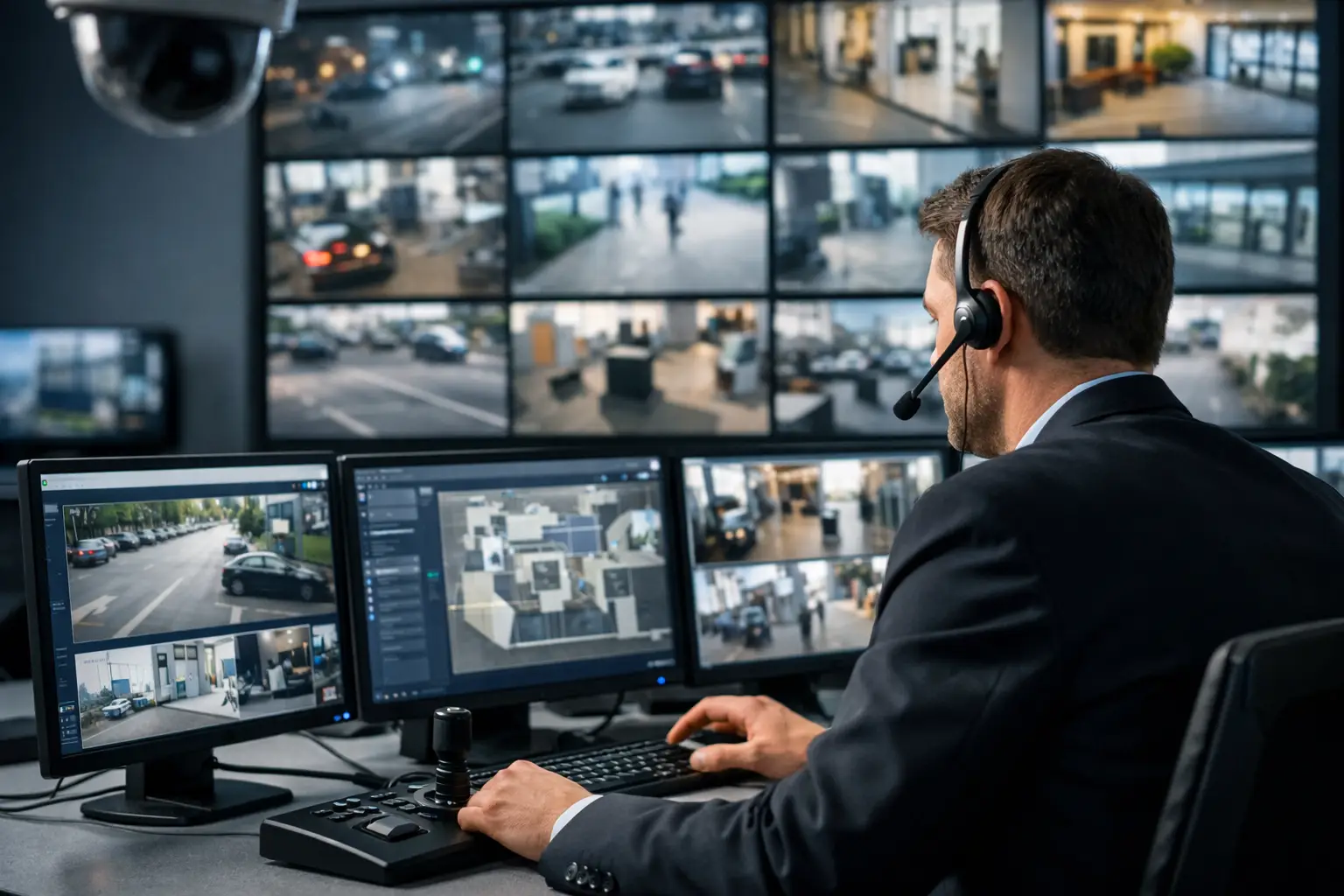
A camera project becomes difficult to manage long before the camera count reaches the hundreds. Operators need live views, incident playback, user permissions, camera health status, and usable evidence – often across multiple buildings or remote sites. That is where the question, what is VMS software, becomes a procurement and operational issue rather than a simple IT definition.
For enterprise surveillance projects, a video management system, or VMS, is the software layer that connects IP cameras, recording servers, operators, and analytics into one controlled environment. ISS SecurOS is the primary VMS focus here. It is an enterprise platform used in large-scale security environments. Deployments span more than 50 countries with support for over 7 million cameras globally.
What Is VMS Software in an Enterprise Security Project?
VMS software receives video streams from network cameras and records them to storage. It presents live and recorded video to authorized users and helps teams find relevant footage quickly. It is not a camera, a PoE switch, or a storage server. Instead, it is the control layer that makes those components work as a coordinated security system.
A small site may use an NVR with a local monitor and basic search tools. That can be adequate for a limited number of cameras and a single security desk. A government complex or transport facility has different requirements from a smart-city zone or Vision 2030 project. It may need distributed recording, role-based access, and multiple operator workstations. Alarm handling, maps, audit trails, analytics, and centralized oversight from a command center may also apply.
ISS SecurOS is designed for this higher level of operational control. Its editions – Professional, Premium, Enterprise, and MCC – allow consultants and integrators to align the software scope with the project’s camera volume, analytics requirements, site topology, and command-center model.
ISS SecurOS: More Than Live Video
A VMS should not be specified only by the number of supported cameras. Camera capacity matters, but the practical question is how operators will use the system during an incident.
SecurOS provides a unified interface for live monitoring, playback, export, alarm response, and investigation workflows. Instead of moving between individual camera web pages or disconnected recorders, authorized personnel work from a common software environment. This is particularly valuable when a facility has cameras across perimeter fencing, vehicle gates, public areas, loading zones, control rooms, and critical infrastructure.
For Saudi government and enterprise tenders, the VMS can also become the point where operational accountability is enforced. User roles can define who is permitted to view, search, export, configure, or administer video. Audit records help security management understand who accessed footage and when. These controls matter when video is treated as evidence, not merely as a monitoring feed.
Video Recording and Playback
Recording only helps if operators can retrieve footage without delay. SecurOS organizes video for playback and investigation while supporting enterprise recording architectures. The exact design depends on retention periods, camera resolution, frame rates, recording mode, network conditions, and the number of concurrent users.
For example, a high-resolution Milesight AI camera may produce valuable evidentiary detail at a gate or perimeter, but it also affects storage capacity and network bandwidth. A system integrator should calculate those requirements based on real scene conditions rather than apply a generic days-of-retention figure across every camera.
The VMS does not replace storage engineering. It works with it. Rasilient surveillance servers and forensic storage are relevant where no-frames-dropped recording performance is a project requirement. Rasilient is VMS-agnostic and supports platforms including ISS. FIBRENETIX enterprise CCTV servers and storage, as well as Dell PowerEdge servers and PowerVault storage, can also be evaluated according to the approved architecture, retention target, and tender specification.
Analytics That Support Investigations
Modern VMS software becomes more valuable when it can turn video into searchable operational data. ISS SecurOS supports applications such as license plate recognition, facial recognition, and behavior analytics. These capabilities can reduce the time required to investigate a known event, locate a vehicle, or review an exception.
Specify analytics carefully. License plate recognition performance depends on camera angle, illumination, vehicle speed, lane coverage, and local plate requirements. Facial recognition has legal, privacy, data-governance, and policy considerations that the end user must address. Behavior analytics requires scene-specific testing to ensure alarms are meaningful for the environment.
The goal is not to generate more alerts. It is to send operators fewer, higher-value alerts with sufficient video context to make a decision. Milesight AI cameras can contribute event data at the edge, while SecurOS provides the platform where operators can monitor, investigate, and manage security events at scale.
The VMS Is Part of a Complete Architecture
A VMS project succeeds or fails at the integration points between cameras, switching, servers, storage, and operator workstations. Software cannot compensate for underpowered recording hardware, unreliable PoE delivery, congested uplinks, or poorly selected cameras.
At the field layer, Milesight AI CCTV cameras provide the video and analytics inputs. Models such as the TrueColor AI range can be relevant for low-light scenes, while Milesight PTZ, panoramic, and LPR camera ranges address specific coverage requirements. Camera selection must follow the use case: a perimeter, entrance lane, lobby, parking area, or industrial yard does not require the same lens, low-light performance, or analytics configuration.
At the network layer, AETEK supplies PoE infrastructure, not cameras. AETEK H-series IP67 outdoor switches, C-series indoor switches, D-series industrial switches, ceiling PoE switches, and PoE extenders designed for distances up to 250 meters can help address field connectivity requirements. The correct switch selection depends on available power budget, operating environment, port count, fiber uplink requirements, and the criticality of the connected devices.
At the core, size recording servers and storage for continuous ingest and playback demand. One common mistake is sizing only for camera recording and overlooking simultaneous client playback, analytics processing, failover requirements, and evidence export. A production environment serving a command center needs headroom, monitoring, and a defined response plan for server or storage faults.
Centralized Management for Multi-Site Operations
For a single building, local video management may be enough. For a university, municipality, logistics network, airport-related facility, industrial group, or geographically distributed government operation, centralized management is often the stronger model.
SecurOS MCC is intended for multi-site command-and-control environments. It allows authorized teams to oversee distributed systems from a central location while maintaining the practical boundaries between sites. This can be important for organizations that need a central security operations center but do not want every site to lose its local operational capability.
Centralization comes with trade-offs. Wide-area network bandwidth, latency, local retention, cybersecurity, operator permissions, and resilience all need consideration. A central command center should not mean that every stream is permanently pulled across a WAN at maximum bitrate. System architects may use local recording with centrally available video on demand, event-driven video, or lower-bandwidth monitoring streams depending on the operational need.
What Procurement Teams Should Ask Before Specifying a VMS
The best VMS specification starts with operational scenarios, not a list of brand names or an arbitrary camera total. Procurement teams and consultants should define the incidents operators must handle, the evidence retention policy, the number of concurrent workstations, and the sites that require central visibility.
They should also verify compatibility with the selected cameras and infrastructure, server and storage sizing methodology, licensing structure, cybersecurity controls, integration requirements, and support responsibilities. For regulated projects, NDAA and TAA compliance requires review across the supplied solution where the tender or end-user policy demands it. ISS is a proven enterprise VMS option for projects that require advanced capabilities, while compliance must always be confirmed against the exact project scope and approved bill of materials.
A VMS is also a long-term operational commitment. Cameras may come in phases, new facilities may join the network, and analytics requirements may shift after handover. Choosing an expandable platform is usually more valuable than purchasing a system that only meets the day-one camera count.
When ISS SecurOS Is the Right Fit
ISS SecurOS is especially relevant where video is part of an integrated, high-accountability security operation. It is suited to enterprise and government environments that need centralized oversight, distributed architecture, serious investigation tools, and analytics that can be used in real workflows. ISS has a Middle East presence and experience in demanding regional deployments, including Saudi border applications.
That does not mean every project needs an enterprise VMS. A modest, single-site installation with limited retention and one local operator may be better served by a simpler architecture. The correct choice depends on risk, scale, required integrations, and the customer’s ability to operate the platform effectively after project completion.
For system integrators, consultants, and procurement teams, the practical value of VMS software is control: control of video, evidence, users, alarms, and expansion. Seven Sectors can support sourcing discussions for ISS SecurOS, Milesight AI cameras, AETEK PoE infrastructure, and suitable server and storage options for Saudi projects. Contact Seven Sectors at info@7sectors.com or use the website’s Get Quotation form to discuss pricing and availability.
For the hardware side of a VMS deployment, see our video surveillance system design guide for AI CCTV and how AI video analytics support large-scale project security.
nnFrequently Asked Questions — VMS Software and ISS SecurOS
nnVideo management system (VMS) software connects IP cameras, recording servers, and operators into one controlled environment. It handles live viewing, recorded footage search, user permissions, alarm management, and analytics integration. For projects with more than a small number of cameras or multiple sites, a VMS provides the operational control that a standalone NVR cannot.
An NVR records video from network cameras and typically provides basic playback. A VMS is a software platform that manages cameras, storage servers, analytics, user roles, maps, and alarm workflows across a larger, more complex system. ISS SecurOS can manage millions of cameras across distributed sites — a scale that no NVR architecture supports.
Yes. ISS SecurOS supports a wide range of IP cameras, including Milesight. The platform integrates via ONVIF and manufacturer-specific drivers, allowing mixed-camera deployments. Seven Sectors supplies both ISS SecurOS and Milesight as part of integrated project packages for Saudi system integrators and consultants.
ISS SecurOS Professional suits mid-size deployments. Premium and Enterprise editions add advanced analytics, distributed architecture, and larger camera capacity for government or critical infrastructure projects. MCC (Mission Critical Center) is the command and control edition for large-scale operations centers. Seven Sectors can advise on the correct edition based on camera count, site count, and analytics requirements.
ISS SecurOS licensing is structured around camera count and edition. Seven Sectors supplies ISS SecurOS to system integrators and project teams across Saudi Arabia. Contact us with your camera count, site topology, and analytics requirements for a project quotation. We do not publish per-camera list prices.
Ready to discuss your project? Contact Seven Sectors or contact us directly on +966-012 229 3474.